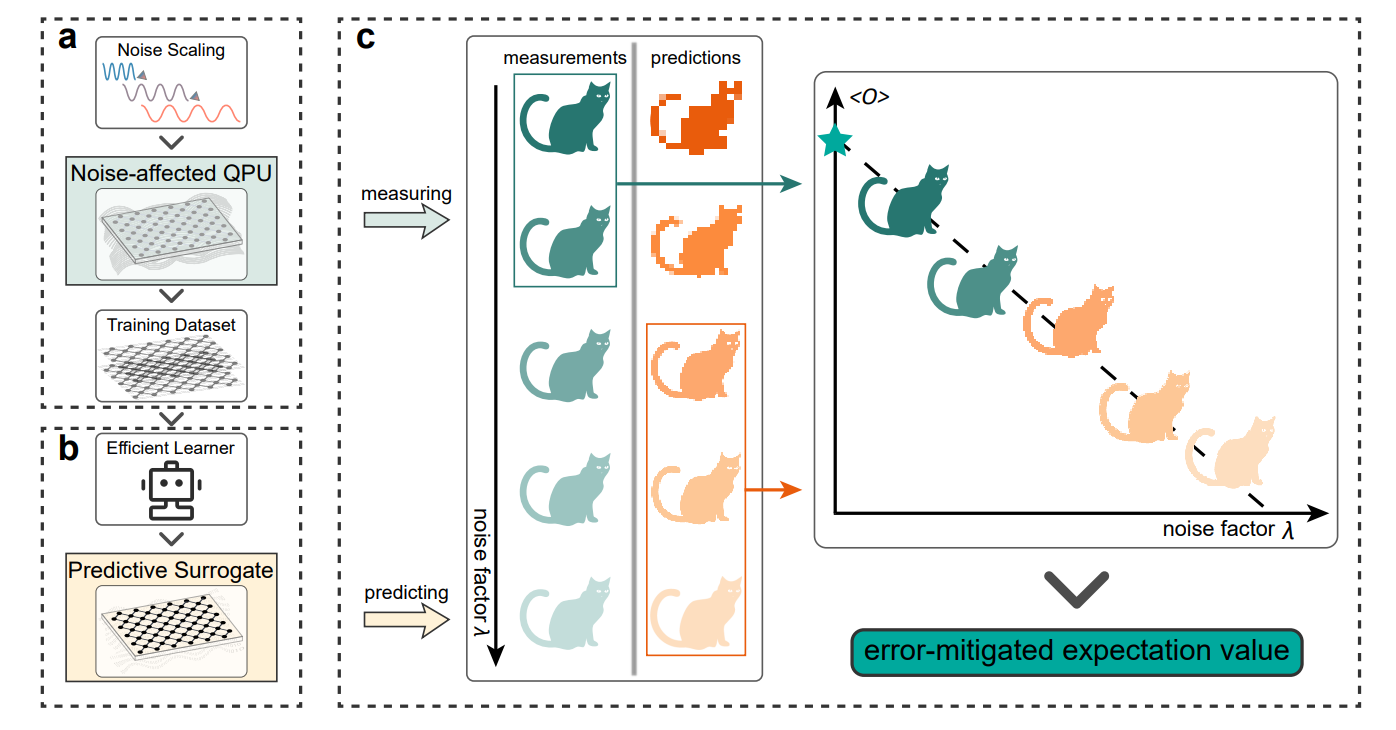
Quantum computers promise revolutionary computational power, but their susceptibility to noise currently limits their practical application. Researchers Wei-You Liao, Ge Yan, and Yujin Song, alongside colleagues, address this challenge with a new approach to quantum error mitigation, a technique designed to improve the reliability of calculations without requiring a massive increase in the number of qubits. Their work focuses on zero-noise extrapolation, a common error mitigation method, and introduces a significant improvement called surrogate-enabled ZNE. This innovative technique uses classical machine learning to perform the necessary calculations on conventional computers, dramatically reducing the measurement overhead typically associated with error mitigation and offering a pathway to scalable quantum computation for complex problems, as demonstrated through simulations on systems with up to 100 qubits.
ZNE, a powerful technique for improving the accuracy of quantum computations, demands numerous measurements, limiting its scalability for complex problems. This research introduces classical machine learning surrogates to predict the outcomes of quantum circuits, thereby reducing the need for repeated quantum executions and enabling more efficient error mitigation. The core idea involves training these classical surrogates to model the behavior of quantum circuits, allowing for accurate extrapolation without requiring extensive quantum measurements.
This hybrid approach combines direct quantum measurements at lower noise levels, where the surrogate is less reliable, with surrogate predictions at higher noise levels, where measurements are expensive. The surrogate models utilize a frequency truncation threshold to control complexity and are trained offline, amortizing the training cost across multiple evaluations. Extensive numerical simulations, conducted on both the 1D Transverse-Field Ising Model and the 1D Heisenberg Model, demonstrate the effectiveness of hybrid S-ZNE. The team simulated various noise models, including local depolarizing noise, thermal relaxation, and coherent over-rotation, and evaluated performance using metrics such as mean squared error, mitigation residual, and quantum resource cost. Results confirm that hybrid S-ZNE achieves comparable error mitigation accuracy to conventional ZNE while significantly reducing the number of quantum measurements required, potentially by around 60% per instance. This trade-off between offline training and per-instance measurement costs makes hybrid S-ZNE particularly advantageous for applications involving repeated evaluations.
Surrogate Models Reduce Quantum Measurement Overhead
Researchers have developed surrogate-enabled zero-noise extrapolation (S-ZNE), a novel error mitigation technique that dramatically reduces the measurement overhead associated with conventional zero-noise extrapolation (ZNE). Conventional ZNE requires a number of quantum measurements that scales linearly with the complexity of the quantum circuit, limiting its scalability. S-ZNE overcomes this limitation by leveraging classical learning surrogates to perform extrapolation entirely on the classical side, achieving a constant measurement overhead for an entire family of circuits. The team trained classical surrogates to model the behavior of quantum circuits, allowing for accurate extrapolation without repeated quantum measurements.
Experiments, employing both ground-state energy estimation and quantum metrology tasks, validated the effectiveness of S-ZNE. The trained surrogates closely followed the ideal curve when evaluated on a discretized range of input values, demonstrating accurate prediction capabilities. Quantitative analysis revealed that both conventional ZNE and S-ZNE achieved a low mean squared error, significantly lower than the unmitigated error. Crucially, S-ZNE required significantly fewer measurement shots than conventional ZNE, resulting in an 80% reduction in quantum measurement cost. This efficiency gap is expected to widen as the number of input points increases, highlighting the potential of S-ZNE for scaling quantum computations. The study establishes S-ZNE as a practical tool for enhancing quantum error mitigation capabilities on near-term quantum processors, offering a promising path toward scalable quantum computation.
Surrogate Models Reduce Quantum Measurement Overhead
Researchers have developed surrogate-enabled zero-noise extrapolation (S-ZNE), a new technique to significantly reduce the measurement overhead associated with error mitigation on near-term quantum processors. These processors are inherently noisy, and error mitigation techniques are crucial for obtaining meaningful results. Traditional zero-noise extrapolation (ZNE) amplifies noise levels to extrapolate back to a noiseless result, but this requires a substantial number of measurements that scale linearly with the complexity of the quantum circuit and the number of input parameters. The team’s breakthrough lies in leveraging classical machine learning surrogates to predict the outcomes of quantum circuits, effectively moving the computational burden from the quantum hardware to classical computers.
By training these surrogates on a limited dataset of quantum measurements, S-ZNE can accurately predict expectation values for new inputs without requiring additional quantum executions. This decoupling of noise extrapolation from repeated quantum sampling delivers a constant measurement overhead, regardless of the number of input parameters, representing a fundamental scaling advantage over conventional ZNE. Experiments conducted on quantum circuits with up to 100 qubits, simulating both ground state energy estimation and quantum metrology tasks, demonstrate that S-ZNE achieves performance comparable to conventional ZNE while drastically reducing the required sampling effort. Specifically, the results confirm that S-ZNE maintains accuracy levels equivalent to traditional ZNE, but with a significantly lower computational cost. Theoretical analysis further validates the approach, proving that S-ZNE achieves comparable error scaling in many practical scenarios. This advancement positions S-ZNE as a powerful and practical tool for enhancing the capabilities of near-term quantum computing and paving the way for more complex and reliable quantum algorithms.
Surrogate Models Reduce Quantum Noise Overhead
Researchers have developed surrogate-enabled zero-noise extrapolation (S-ZNE), a new technique to improve the reliability of calculations performed on near-term quantum processors. These processors are inherently noisy, and error mitigation techniques are crucial for obtaining meaningful results. S-ZNE addresses a key limitation of existing zero-noise extrapolation methods, which require a substantial number of measurements as the complexity of the quantum calculation increases. The team’s approach leverages classical machine learning to predict the results of quantum circuits, effectively moving much of the computational burden from the quantum processor to a classical computer.
This innovation allows S-ZNE to achieve a constant measurement overhead, regardless of the size of the quantum calculation, offering a significant advantage in scalability compared to conventional methods. Numerical experiments, including calculations on systems with up to 100 qubits, demonstrate that S-ZNE maintains accuracy comparable to traditional zero-noise extrapolation while dramatically reducing the required computational resources. The authors acknowledge that the performance of S-ZNE, like other error mitigation techniques, is dependent on the specific noise characteristics of the quantum processor. They also suggest that the method could be further extended to hybrid quantum-classical algorithms. Future research will focus on exploring the full potential of this approach and adapting it to a wider range of quantum computing applications, potentially paving the way for more complex and reliable quantum calculations.
🗞 Sample-efficient quantum error mitigation via classical learning surrogates
🧠 ArXiv: https://arxiv.org/abs/2511.07092