

Researchers from Hanyang University have successfully implemented a syndrome extraction circuit with flag qubits on IBM quantum computers, demonstrating that quantum error correction can be achieved even when data and syndrome qubits are not adjacent. The IBM machine’s unique heavy-hexagon structure requires flag qubits for quantum error-correcting codes. The team used the repetition code as a test code, showing that logical error rates decrease exponentially as the distance of the repetition code increases. This development could lead to more reliable and efficient quantum computations on IBM devices, potentially advancing quantum technologies and applications.
What is the Significance of Quantum Error-Correction Codes in Quantum Computers?
Quantum computers, currently based on noisy intermediate-scale quantum (NISQ) hardware, are prone to errors during computations. To mitigate this, quantum error correction codes have been introduced. These codes are crucial in constructing a fault-tolerant quantum computer that can deliver reliable results from arbitrary quantum circuits. The success of quantum error correction codes has been reported in Google and neutral atom quantum computers. However, no reports on IBM quantum computers show error suppression due to its unique heavy-hexagon structure. This structure restricts connectivity, and quantum error-correction codes on IBM quantum computers require flag qubits.
The IBM quantum machine, which has the largest number of qubits, has a heavy-hexagon structure rather than a lattice one. This is because the focus is on enhancing the performance of physical qubit gates in real quantum hardware, even if it means sacrificing hardware connectivity. Hence, implementing the quantum error correcting code in an IBM quantum machine may require flag qubits owing to its heavy-hexagon structure.
Previous studies have focused on evaluating the quantum error-correcting code that does not have flag qubits in real devices, such as the Sycamore device from Google, where physical qubits can have more connectivity than the heavy-hexagon structure. In the case where flag qubits exist, quantum error correction in the current IBM machine has not been explored in terms of increasing the size of the structure.
How Effective is the Syndrome Extraction Circuit with Flag Qubits?
In this study, the researchers from the Department of Applied Physics at Hanyang University, Republic of Korea, report successfully implementing a syndrome extraction circuit with flag qubits on IBM quantum computers. They demonstrate its effectiveness by considering the repetition code as a test code among the quantum error-correcting codes. Even though the data qubit is not adjacent to the syndrome qubit, logical error rates diminish exponentially as the distance of the repetition code increases from three to nine. Even when two flag qubits exist between the data and syndrome qubits, the logical error rates decrease as the distance increases similarly. This confirms the successful implementation of the syndrome extraction circuit with flag qubits on the IBM quantum computer.
The IBM machine uses a heavy hexagon structure and may require flag qubits to implement quantum error-correcting codes. Therefore, the effectiveness of the syndrome extraction circuit with flag qubits should be verified to determine whether the structure maintains error suppression. To verify the effectiveness of the syndrome extraction circuit with flag qubits, the researchers select the repetition code, which is the simplest of surface code families. They test the performance of the syndrome extraction circuit with or without flag qubits on ibm-kyoto, an IBM quantum machine, by evaluating the machine’s efficiency in correcting errors.
What is the Role of Flag Qubits in Error Correction?
When there is a flag qubit in the syndrome extraction circuit, the data and syndrome qubits cannot be adjacent and interact directly. Therefore, the researchers use the added flag qubits to connect the data qubits indirectly with the syndrome qubits. They illustrate how they detect errors during the syndrome extraction circuits with initially selected physical qubits in the hardware. The error types considered are either bit-flips or phase-flips. When they verify the performance of the code on ibm-kyoto, the logical error rate of the repetition code containing the flag qubits decreases exponentially as the number of data qubits increases. This implies that the error correction can be performed using the syndrome extraction circuit with flag qubits in the repetition code on ibm-kyoto.
How Does the Repetition Code with Flag Qubits Work?
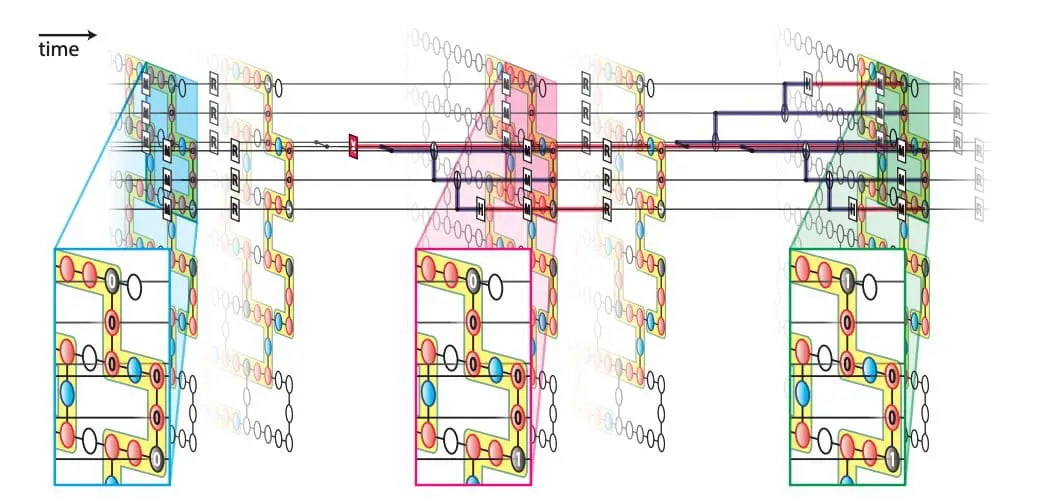
A repetition code of distance d consists of a one-dimensional array of data qubits of n_data = d and syndrome qubits of n_synd = d-1. The researchers use initially selected physical qubits from a heavy-hexagon structure to consider a syndrome extraction circuit with flag qubits. The code progresses with time represented on the horizontal axis from left to right. The blue, black, and red dots correspond to data, syndrome, and flag qubits. The code undergoes multiple rounds of a syndrome extraction circuit, which involves reset and measurement gates on each syndrome and flag qubit. When the code uses the Z syndrome extraction circuit, it shows the detection of an X error on a data qubit. The error is an example of an ST error. This error disseminates Z or X errors to nearby flag and syndrome qubits, indicated by the blue and red lines from the data qubit. Over time, outcomes of three syndrome qubits, those closest to the data qubit, are recorded.
What are the Implications of this Study?
This study demonstrates that quantum error correction for bit-flips or phase-flips can be achieved on IBM devices even when the data and syndrome qubits are not close. This is a significant step forward in quantum computing, particularly for IBM quantum computers. The successful implementation of the syndrome extraction circuit with flag qubits on the IBM quantum computer could pave the way for more reliable and efficient quantum computations. This could potentially lead to developing more advanced quantum technologies and applications. However, further research and testing are needed to fully understand and optimize the use of flag qubits in quantum error correction.
Publication details: “Effectiveness of the syndrome extraction circuit with flag qubits on IBM
quantum hardware”
Publication Date: 2024-03-15
Authors: Younghun Kim, Hansol Kim, J. S. Kang, Wonjae Choi, et al.
Source: arXiv (Cornell University)
DOI: https://doi.org/10.48550/arxiv.2403.10217


