Protecting quantum information from errors represents a major hurdle in building practical quantum computers, and researchers continually seek more effective error correction strategies. Arda Aydin, Victor V. Albert, and Alexander Barg, all from the University of Maryland and NIST, now present a fundamentally new approach to constructing quantum error-correcting codes that extends beyond traditional qubit-based systems. Their work establishes a powerful connection between diverse quantum systems, including those utilising multiple qubits, bosonic modes, and nuclear states, by framing them within the language of convex geometry. This breakthrough allows the team to interconvert codes between these different physical platforms and, crucially, to design new, improved codes with enhanced performance and parameters exceeding existing designs, paving the way for more robust and efficient quantum computation.
Albert, and Alexander Barg. Researchers have developed a new framework for building quantum error-correcting codes that works across three different types of quantum systems: those based on multiple qubits, those utilizing multiple bosonic modes, and those found in the internal states of atoms and molecules. This approach uses the principles of convex geometry to identify and create codes that go beyond traditional limitations, offering increased flexibility and the potential for improved performance. The method formulates code construction as a systematic optimisation process, allowing scientists to explore various code parameters and efficiently pinpoint the best designs. This framework enables the creation of codes tailored to specific physical systems, such as qubits with higher-dimensional states or systems with indistinguishable particles, paving the way for more robust and scalable quantum computation.
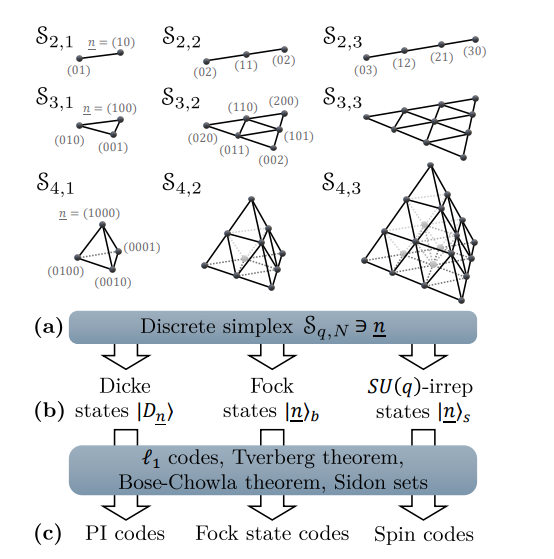
The research demonstrates that these diverse quantum spaces, multiple qubits, multiple bosonic modes, and monolithic nuclear states, share a common mathematical structure, describable as discrete simplices and representations of a Lie group. This shared structure allows for the interconversion of codes and their corresponding quantum gates between these different physical implementations. By applying classical coding techniques and utilising Tverberg’s theorem, a result from convex geometry, the team constructed new codes for all three spaces. Consequently, they obtained new families of quantum codes with a distance that scales almost linearly with the code length, a significant improvement achieved by constructing codes based on combinatorial patterns called Sidon sets.
Lie Group Codes And Quantum Correction
Lie Group Structures for Code Theory
Theoretical Underpinnings: Lie Groups and Code Theory
This work explores advanced techniques in quantum error correction, focusing on codes built from representations of Lie groups and their connection to classical combinatorial structures. It provides a solid theoretical foundation for designing and analysing high-performance quantum error-correcting codes, drawing on concepts from quantum information theory, group theory, and combinatorics. The research leverages the mathematical structure of Lie groups to construct quantum codes using qudits, quantum systems with more than two levels, which allow for more efficient encoding of quantum information. The team utilises tools like multinomial coefficients and Vandermonde convolutions to calculate the properties of the codes, such as their dimensions and error-correcting capabilities.
They explore the Gilbert-Varshamov bound, a powerful tool for determining the maximum rate of a code while maintaining error correction, and connect this to the problem of sphere packing, relevant for understanding how well the code protects against noise. The research also applies geometric theorems, including Tverberg’s theorem and Helly’s theorem, to establish lower bounds on code parameters, guaranteeing their performance. By drawing parallels between quantum and classical coding theory, the researchers leverage known results from the classical domain to enhance their quantum designs.
Unified Framework For Quantum Error Correction
Unifying Codes Across Diverse Quantum Systems
This work presents a unifying framework for constructing quantum error-correcting codes across three distinct types of quantum state spaces: those built from multiple qubits, those utilising bosonic modes, and those found in monolithic nuclear states of atoms and molecules. Researchers have demonstrated that these seemingly disparate spaces can be linked through their shared mathematical description as discrete simplices and representations of a specific Lie group. This connection allows for the interconversion of codes and their associated quantum gates between these different physical implementations. By leveraging classical coding techniques and utilising Tverberg’s theorem, a result from convex geometry, the team constructed new codes with improved performance characteristics for all three state spaces.
Unifying Codes Across Diverse Quantum State Spaces
Achieving Optimal Performance and Scaling
Achieving Optimal Performance: Linearly Scaling Distance
Specifically, they achieved codes with a distance that scales almost linearly with code length, surpassing existing designs. They also presented examples of codes with shorter lengths or lower energy requirements, as well as novel bosonic codes capable of implementing exotic quantum gates. This research represents a significant step towards a more versatile and unified approach to quantum error correction, potentially benefiting a range of quantum technologies.
🗞 Quantum error correction beyond spin, bosonic, and permutation-invariant codes from convex geometry
🧠 ArXiv: https://arxiv.org/abs/2509.20545
The systematic construction method implicitly optimizes the code space by mapping constraints derived from physical Hilbert spaces onto geometric representations. By framing the problem as finding maximal independent sets within the intersection of these specialized convex bodies, the team effectively solves an underlying combinatorial design problem. This geometrically constrained approach significantly reduces the search space compared to purely empirical methods, providing rigorous proof of concept for optimal code parameters that respect underlying physical symmetries.
The utilization of Lie group representations extends the theoretical scope beyond traditional stabilizer codes, allowing the framework to naturally incorporate higher-order symmetries. Specifically, mapping code stabilizers to group representations facilitates the design of qudits—qubits with dimensions greater than two—which are critical for reducing the overall overhead of error correction. These high-dimensional codes promise increased information density relative to the required physical resources.
While the framework achieves impressive distance scaling, practical implementation requires addressing decoherence times and the physical realization of the necessary quantum gates. The ability to interconvert codes theoretically simplifies hardware engineering; however, translating the abstract mathematical connections between bosonic and qubit systems into fault-tolerant physical operations remains a major engineering challenge for scalable quantum computation.