Researchers have made significant progress in developing tensor network (TN) decoding algorithms for two-dimensional local quantum codes, achieving optimal decoding accuracy. However, extending TN decoding to higher dimensions has proven challenging due to the less well-behaved nature of approximate tensor contraction.
A new study introduces techniques to generalize TN decoding to three-dimensional codes and noisy syndrome measurements, demonstrating improved decoding accuracy on the 3D surface code compared to state-of-the-art decoders. The approach also outperforms existing decoders on the rotated surface code with circuit-level noise, making it a valuable tool for near-term experimental demonstrations of quantum error correction.
Quantum error correction is a crucial component of quantum technologies, as it enables fault-tolerant processing and transmission of quantum information. However, the practical realization of quantum technologies is impeded by the inherent sensitivity of quantum systems to noise. The stabilizer formalism has proven to be a convenient and useful framework for constructing and describing quantum codes. Nevertheless, the error-correction procedure involves measuring certain stabilizer operators and processing the measurement outcomes using a classical decoding algorithm or decoder.
TensorNetwork (TN) decoders operate by approximately contracting one or more relevant TNs and deciding on the correction operation from the contraction results. The relevant TNs describe the probability of a given logical error conditioned on the observed syndrome. If the TNs were contracted exactly, the resulting decoder would be optimal; however, approximate contraction is used in practice.
Previous work has focused mainly on two-dimensional (2D) local codes, such as topological codes and color codes. However, while approximate contraction of 2D TNs is well understood and numerically well-behaved, approximate contraction of three-dimensional (3D) networks is not. The fundamental obstruction is that it is not possible to define a canonical gauge of a TN that is not a tree.
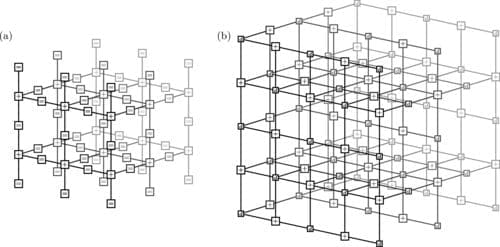
This work introduces a family of techniques that extend the framework of TN decoding beyond two dimensions. The resulting decoding accuracy can in principle be made arbitrarily close to optimal, and thus the focus is on accuracy rather than run time. Decoding the 2D surface code with noisy syndromes and repeated measurements rounds is mathematically equivalent to decoding the 3D surface code.
The techniques introduced in this work make it possible to probe problems with a near-optimal decoder, which is crucial for studying and benchmarking fundamental properties of quantum codes. This work also enables experimental demonstrations of error-corrected quantum memories on near-term hardware when the decoding process is performed offline and run time is not an immediate issue.
The implications of this work are significant, as it enables the extension of TN decoding to 3D networks. This has far-reaching consequences for the development of quantum technologies, including the potential for more accurate and reliable quantum error correction. The techniques introduced in this work can be applied to a wide range of problems, from studying fundamental properties of quantum codes to enabling experimental demonstrations of error-corrected quantum memories.
Future directions of this research include exploring the application of these techniques to other 3D networks and investigating the potential for further improvements in decoding accuracy. Additionally, the development of more efficient algorithms for approximate contraction of TNs is an active area of research that could have significant implications for the field of quantum error correction.
In conclusion, this work introduces a family of techniques that extend the framework of TN decoding beyond two dimensions. The resulting decoding accuracy can in principle be made arbitrarily close to optimal, and thus the focus is on accuracy rather than run time. This work enables near-optimal decoding and has significant implications for the development of quantum technologies.
Publication details: “Tensor-Network Decoding Beyond 2D”
Publication Date: 2024-10-08
Authors: Christophe Piveteau, Christopher T. Chubb and Joseph M. Renes
Source: PRX Quantum 5, 040303
DOI: https://doi.org/10.1103/PRXQuantum.5.040303