
Researchers led by Peter Zoller at the University of Innsbruck and the Institute of Quantum Optics and Quantum Information (IQOQI) have developed a new approach to study and understand entanglement in quantum materials. The team, including Christian Kokail and Rick van Bijnen, used an ion trap quantum simulator with 51 particles to recreate a real material and study it in a controlled environment. The scientists witnessed effects in the experiment that had previously only been described theoretically. The research, funded by the Austrian Science Fund FWF, the Austrian Research Promotion Agency FFG, the European Union, and others, was published in Nature.
Understanding Quantum Entanglement
Quantum entanglement is a phenomenon where the properties of two or more particles become interconnected in such a way that one cannot assign a definite state to each individual particle anymore. Instead, all particles that share a certain state have to be considered at once. The entanglement of the particles ultimately determines the properties of a material. This feature of many particles being entangled is what makes the difference in quantum physics. However, it is very difficult to determine.
Researchers at the University of Innsbruck and the Institute of Quantum Optics and Quantum Information (IQOQI) of the Austrian Academy of Sciences (ÖAW) have developed a new approach to improve the study and understanding of entanglement in quantum materials. To describe large quantum systems and extract information from them about the existing entanglement, one would need to perform an impossibly large number of measurements. The researchers have developed a more efficient description, that allows them to extract entanglement information from the system with drastically fewer measurements.
Quantum Simulation and the Study of Entanglement
In a laboratory setting, the scientists have recreated a real material particle by particle using an ion trap quantum simulator with 51 particles. This allows them to study the material in a controlled environment. The main technical challenge faced by the researchers is how to maintain low error rates while controlling 51 ions trapped in the trap and ensuring the feasibility of individual qubit control and readout.
During the process, the scientists witnessed for the first time effects in the experiment that had previously only been described theoretically. This combination of knowledge and methods has been worked out over the past years and is now being put into practice.
Temperature Profiles and Quantum Entanglement
In a quantum material, particles can be more or less strongly entangled. Measurements on a strongly entangled particle yield only random results. If the results of the measurements fluctuate very much – i.e., if they are purely random – then scientists refer to this as “hot”. If the probability of a certain result increases, it is a “cold” quantum object. Only the measurement of all entangled objects reveals the exact state. In systems consisting of very many particles, the effort for the measurement increases enormously.
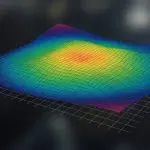
Quantum field theory has predicted that subregions of a system of many entangled particles can be assigned a temperature profile. These profiles can be used to derive the degree of entanglement of the particles. In the Innsbruck quantum simulator, these temperature profiles are determined via a feedback loop between a computer and the quantum system, with the computer constantly generating new profiles and comparing them with the actual measurements in the experiment.
New Areas of Physics and Quantum Simulators
The methods developed by the researchers provide a powerful tool for studying large-scale entanglement in correlated quantum matter. This opens the door to the study of a new class of physical phenomena with quantum simulators that already are available today. With classical computers, such simulations can no longer be computed with reasonable effort. The methods developed in Innsbruck will also be used to test new theory on such platforms.
The results of this research have been published in the scientific journal Nature. Financial support for the research was provided by the Austrian Science Fund FWF, the Austrian Research Promotion Agency FFG, the European Union, the Federation of Austrian Industries Tyrol and others.
The Future of Quantum Entanglement Research
The research into quantum entanglement is a fundamental challenge in quantum information science. The findings and methods developed in this research have wide-ranging applicability to revealing and understanding entanglement in many-body problems with local interactions including higher spatial dimensions. As we venture towards achieving quantum advantage, the understanding and manipulation of quantum entanglement will play a crucial role.
Quick Summary
Scientists have developed a new approach to study and understand entanglement in quantum materials, a phenomenon where the properties of particles become interconnected. Using a quantum simulator, they have been able to recreate and study materials in a controlled environment, providing a powerful tool for studying large-scale entanglement and opening the door to the study of new physical phenomena.
- Quantum entanglement is a phenomenon where the properties of multiple particles become interconnected, influencing the properties of a material.
- Researchers led by Peter Zoller at the University of Innsbruck and the Institute of Quantum Optics and Quantum Information (IQOQI) of the Austrian Academy of Sciences (ÖAW) have developed a new approach to study and understand entanglement in quantum materials.
- The team, including Christian Kokail and Rick van Bijnen, have developed a more efficient method to extract entanglement information from large quantum systems with fewer measurements.
- Using an ion trap quantum simulator with 51 particles, the scientists recreated a real material particle by particle in a controlled laboratory environment. This work was led by Christian Roos and Rainer Blatt.
- The team observed effects in the experiment that had previously only been described theoretically.
- In a quantum material, particles can be more or less strongly entangled. Measurements on a strongly entangled particle yield only random results. Scientists refer to this as “hot”. If the probability of a certain result increases, it is a “cold” quantum object.
- The methods developed by the team provide a powerful tool for studying large-scale entanglement in correlated quantum matter. This opens the door to the study of a new class of physical phenomena with quantum simulators.
- The results have been published in Nature. Financial support for the research was provided by the Austrian Science Fund FWF, the Austrian Research Promotion Agency FFG, the European Union, the Federation of Austrian Industries Tyrol and others.