Quantum devices now model complex physical phenomena. Uddhav Sen and colleagues at Coventry University, in a collaboration between Coventry University and Dipartimento di Fisica, Sapienza Universit`a di Roma, show how quantum cellular automata, enabled by mid-circuit measurement and reset capabilities, can simulate both closed and synthetic open dynamics. Their work focuses on a discrete-time totally asymmetric simple exclusion process, revealing the emergence of quantum effects and correlations within transport models. The findings highlight the possibility of implementing these models on quantum hardware and provide insights into characterising collective quantum correlations in systems undergoing strong driving forces.
Quantum correlations persist in transport models despite minimal entanglement
Detecting quantum correlations in transport models previously demanded strong entanglement, typically assessed through measures like concurrence or entanglement entropy. These traditional methods often struggle when the entanglement between subsystems falls below a certain threshold, hindering the observation of subtle quantum effects. Stationary states of a quantum cellular automaton implementing a totally asymmetric simple exclusion process can retain quantum correlations even with minimal entanglement. Quantum correlations persist in transport models despite minimal entanglement. This represents a major shift, as prior methods failed when bipartite entanglement fell below a threshold necessary for detection. The totally asymmetric simple exclusion process (TASEP) is a fundamental model in statistical physics, describing the dynamics of particles moving along a line with a constraint that only one particle can occupy a given site at any time. Implementing this model on a quantum platform allows for the investigation of quantum phenomena not accessible in its classical counterpart.
This novel approach reveals that quantum behaviour can emerge in simple, dissipative transport models. It challenges assumptions about the origins of quantum features, which are often linked to high degrees of entanglement, and opens new avenues for characterising collective quantum correlations in strongly driven systems. The system was constructed, evolving in discrete time steps with local updates, using mid-circuit measurement and reset to model the particle transport process. Mid-circuit measurement allows for the extraction of information about the system’s state during the computation, while reset operations ensure the system remains in a well-defined initial state for subsequent time steps. Simulations utilising it revealed that bipartite entanglement initially dominates the system’s evolution, but diminishes over time, suggesting that other forms of quantum correlation may be responsible for the observed behaviour. The initial dominance of bipartite entanglement is expected, as the system begins in a relatively ordered state, but its subsequent decay necessitates the exploration of alternative correlation measures.
Stationary states, representing the long-term behaviour of the system, demonstrably retained quantum correlations even when entanglement was minimal, indicating a more subtle form of quantum behaviour is at play. These correlations are not necessarily captured by standard entanglement measures, suggesting the presence of quantum coherence or other non-classical correlations. The team observed these correlations across large-scale simulations, suggesting the potential for characterising collective quantum effects in complex systems. The size of the simulated system, and the duration of the simulations, are crucial parameters in establishing the robustness of these findings. Current results focus on idealised conditions and do not yet demonstrate the feasibility of building practical quantum transport devices. Real-world implementations will inevitably face challenges related to decoherence, control errors, and scalability.
Validating transient quantum advantage in simplified particle transport models
Increasingly, researchers are focused on using quantum systems to model complex physical processes, particularly those involving particle transport, with applications ranging from biological systems to materials science. A key challenge remains in definitively proving these correlations are genuinely quantum and not merely classical in origin, even though quantum correlations can persist even without strong entanglement. Distinguishing between classical and quantum correlations requires careful analysis and the use of appropriate theoretical tools, such as negativity or the violation of Bell inequalities. The scientists acknowledge their current approach relies on an idealised model, and establishing strong durability against the inevitable imperfections of real quantum hardware is vital. Quantum decoherence, arising from interactions with the environment, is a major obstacle to maintaining quantum correlations and achieving sustained quantum advantage.
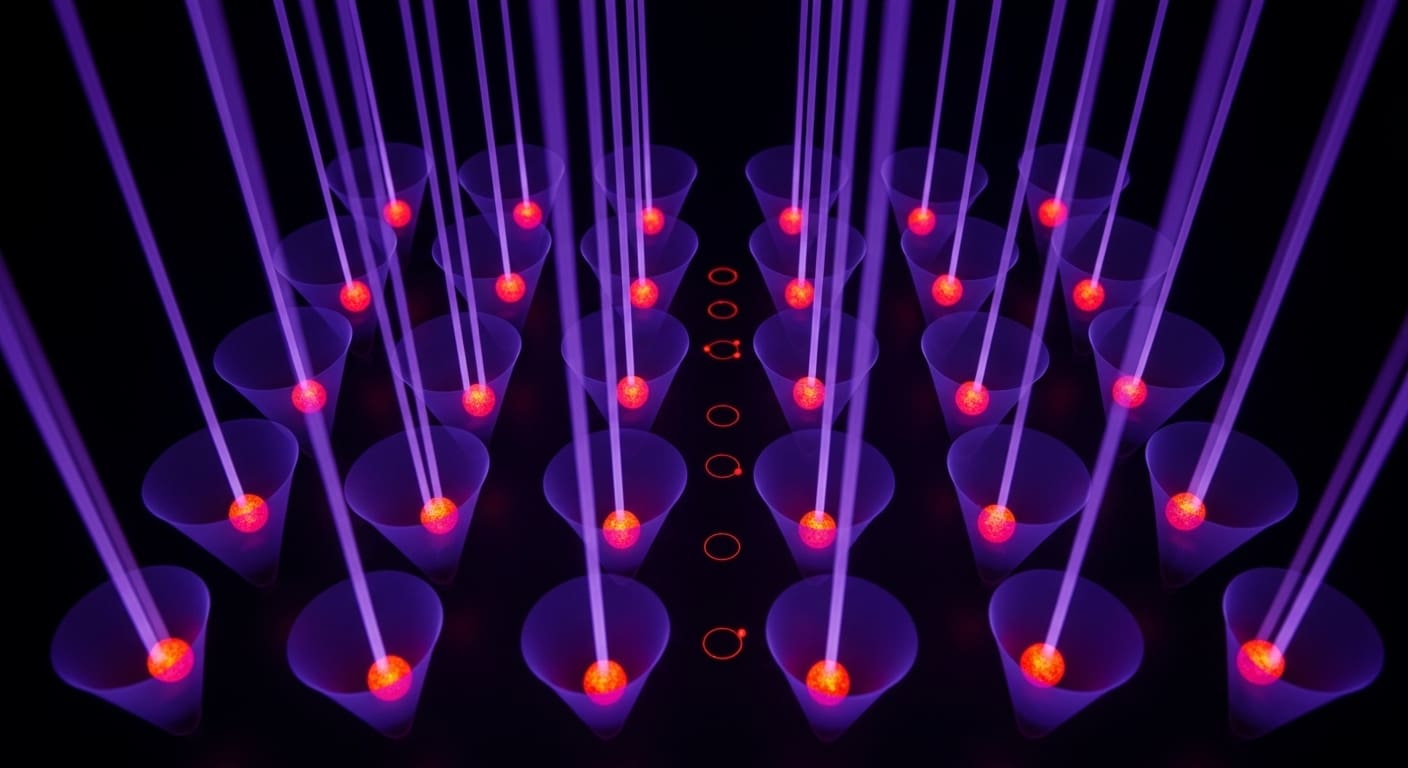
However, doubts remain about whether these quantum correlations truly outperform classical simulations given the simplified models used, providing a valuable blueprint for building and testing quantum devices capable of simulating particle transport. The computational cost of simulating quantum systems classically scales exponentially with the number of qubits, while quantum computers offer the potential for polynomial speedups in certain cases. Demonstrating even transient quantum behaviour in these systems is a significant step, validating the potential of quantum cellular automata for modelling complex physical phenomena. A quantum cellular automaton capable of modelling particle transport was successfully demonstrated, revealing subtle quantum correlations beyond simple entanglement. Mid-circuit measurement and reset were employed by scientists to simulate a one-way flow of particles, and initial stages of this simulation showed entanglement as the dominant quantum feature. The choice of a one-way flow, or TASEP, simplifies the analysis and allows for a clearer understanding of the underlying quantum dynamics. The enduring presence of quantum links in the system’s long-term, stable state is the key finding, highlighting the potential for exploring quantum phenomena in systems where entanglement is weak or absent. This suggests that quantum correlations can be sustained by mechanisms beyond entanglement, potentially involving coherence or other forms of non-classical correlations. Further research is needed to fully characterise these correlations and their role in enhancing the performance of quantum transport models. The 1D nature of the system and the use of 30 qubits were key parameters in the simulation.
The research successfully demonstrated a quantum cellular automaton simulating particle transport using ten qubits. This is important because it reveals that quantum correlations, beyond simple entanglement, can persist in systems modelling particle flow, potentially offering advantages over classical simulations. The study employed mid-circuit measurement and reset to observe these subtle quantum links in a one-dimensional system. Future work will focus on fully characterising these non-entanglement correlations and exploring how they might improve the efficiency of quantum transport models.
👉 More information
🗞 Nonequilibrium phases and quantum correlations in synthetic transport models
🧠 ArXiv: https://arxiv.org/abs/2603.24478