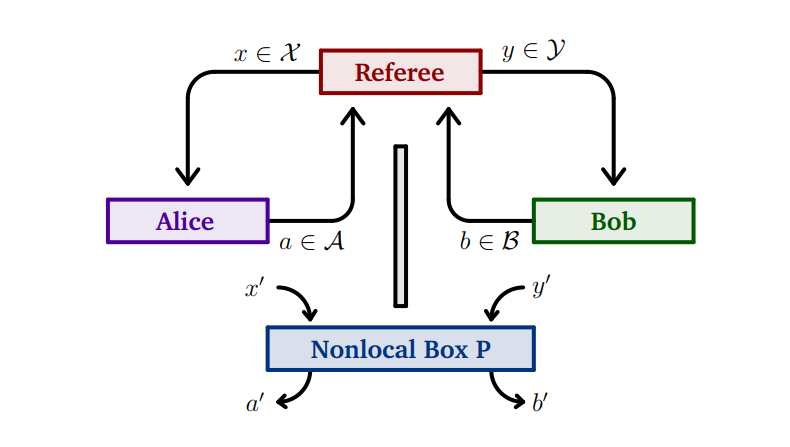
The fundamental limits of information transfer and secure communication remain central challenges in modern cryptography and information theory, and recent work by Pierre Botteron from Université de Toulouse, and colleagues, sheds new light on these areas. The team investigates the subtle distinctions between different types of correlations, moving beyond traditional understandings of information exchange, and applies these insights to the long-standing problem of creating perfectly secure encryption. By employing techniques from distributed computation and exploring the properties of complex mathematical structures, the researchers advance our understanding of non-physical correlations and propose a novel approach to unclonable encryption, a system designed to prevent simultaneous access to sensitive information. This work rigorously proves the security of the proposed encryption scheme for certain key sizes, and provides compelling evidence for its broader applicability, representing a significant step towards unconditionally secure communication.
Nonlocal Games, Communication, and Quantum Cryptography
This thesis explores fundamental aspects of quantum information processing, specifically investigating the interplay between nonlocal games, communication complexity, and quantum cryptography. It establishes connections between these fields, offering new insights into the limits of information transfer and the power of quantum resources. The research develops novel techniques for analysing the complexity of nonlocal games, demonstrating how these games can reveal fundamental properties of quantum mechanics. Furthermore, the work contributes to the development of secure communication protocols based on quantum cryptography, enhancing the security and efficiency of information exchange.
Entanglement, States, and Quantum Correlations
This research provides a comprehensive overview of core quantum information theory concepts, including entanglement, non-locality, and various types of quantum states. The investigation encompasses a detailed analysis of correlations, encompassing both quantum and non-signaling varieties, and introduces measures like tangle to quantify entanglement. The work also explores essential mathematical tools, such as spectral projections, relevant to state decomposition and analysis. The study extends to game theory and complexity, examining specific games like CHSH, graph isomorphism, and their associated values.
Communication complexity, a core concept for distinguishing correlations, is investigated alongside distributed computation techniques. The research delves into the properties of wirings, particularly those of nonlocal boxes, analysing structures like AND, OR-AND, and XOR circuits, and their implications for information processing. The work also addresses cryptographic challenges, focusing on the development of unclonable encryption, a scheme designed to prevent unauthorized access to encrypted messages. Security definitions, including perfect and unclonable-indistinguishable security, are explored, alongside essential cryptographic terms like ciphertext, key, and message.
The research utilizes shared randomness and operates within a plain model, ensuring security without relying on additional assumptions. Mathematical tools and techniques, including Clifford algebra, geometry, and trace-preserving maps, are employed throughout the investigation. The research leverages advanced mathematical theorems, such as the Hahn-Banach, Krein-Milman, and Naimark’s Dilation theorems, to provide rigorous foundations for its findings. The study also considers bounds and limits on correlations, such as Tsirelson’s bound, and explores related problems like Tsirelson’s problem. The work encompasses concepts like tensor products, tensor rank, and graph properties such as isomorphism, transitivity, and equitable partitions. Techniques for purifying entanglement, known as distillation, and enhancing probabilities, known as amplification of bias, are also investigated. This comprehensive approach demonstrates a deep understanding of the theoretical underpinnings of quantum information and its applications.
Collapse of Communication in Interactive Games
This research presents significant advances in understanding correlations in interactive settings and addresses a long-standing challenge in cryptography, the creation of unclonable encryption. Researchers investigated correlations within interactive scenarios, including the CHSH game and graph isomorphism games, employing techniques such as distributed computation and the analysis of algebraic properties of nonlocal box wirings. This investigation advances the understanding of non-physical correlations and their implications for information processing. The team established a new sufficient condition to collapse communication complexity in the CHSH game, leveraging the algebra of boxes and numerical optimization on the set of wirings.
These results demonstrate a deeper understanding of how information is exchanged and processed in quantum systems, with implications for secure communication protocols. Further exploration of graph games, including the isomorphism, coloring, and vertex distance games, expanded these insights into more complex interactive scenarios. A key achievement of this research is the introduction of a candidate for unclonable encryption, a scheme designed to prevent simultaneous information access to an encrypted message. This protocol, based on Clifford algebra and utilizing complex Hermitian unitary matrices that anti-commute, was rigorously proven secure using sum-of-squares methods for small key sizes. For larger key sizes, strong numerical evidence was obtained via the NPA hierarchy, demonstrating the feasibility and robustness of the proposed encryption scheme. These findings represent a substantial step towards unconditionally secure communication and data protection.
Unclonable Encryption and Communication Complexity Limits
This research advances understanding in both information theory and cryptography through investigations of correlations and the pursuit of unconditionally secure encryption. The team explored the connections between communication complexity and nonlocal correlations, applying this framework to the CHSH game and graph isomorphism problems. By leveraging techniques from distributed computation and algebraic properties of nonlocal boxes, they identified new conditions for collapsing communication complexity, offering insights into the fundamental limits of information transfer in these scenarios. Furthermore, the work addresses the long-standing challenge of constructing unclonable encryption, a cryptographic scheme resistant to cloning attacks.
Researchers propose a candidate encryption protocol based on Clifford algebra, demonstrating rigorous security proofs for small key sizes and providing strong numerical evidence for larger keys using advanced mathematical tools. While acknowledging the limitations of current analytical techniques for fully proving security with larger key sizes, the team suggests future work could focus on extending these methods or exploring alternative approaches to verification. This research represents a significant step towards realizing unconditionally secure communication and deepening our understanding of the interplay between information, computation, and security.
🗞 Nonlocal Games Through Communication Complexity and Quantum Cryptography
🧠 ArXiv: https://arxiv.org/abs/2510.09457