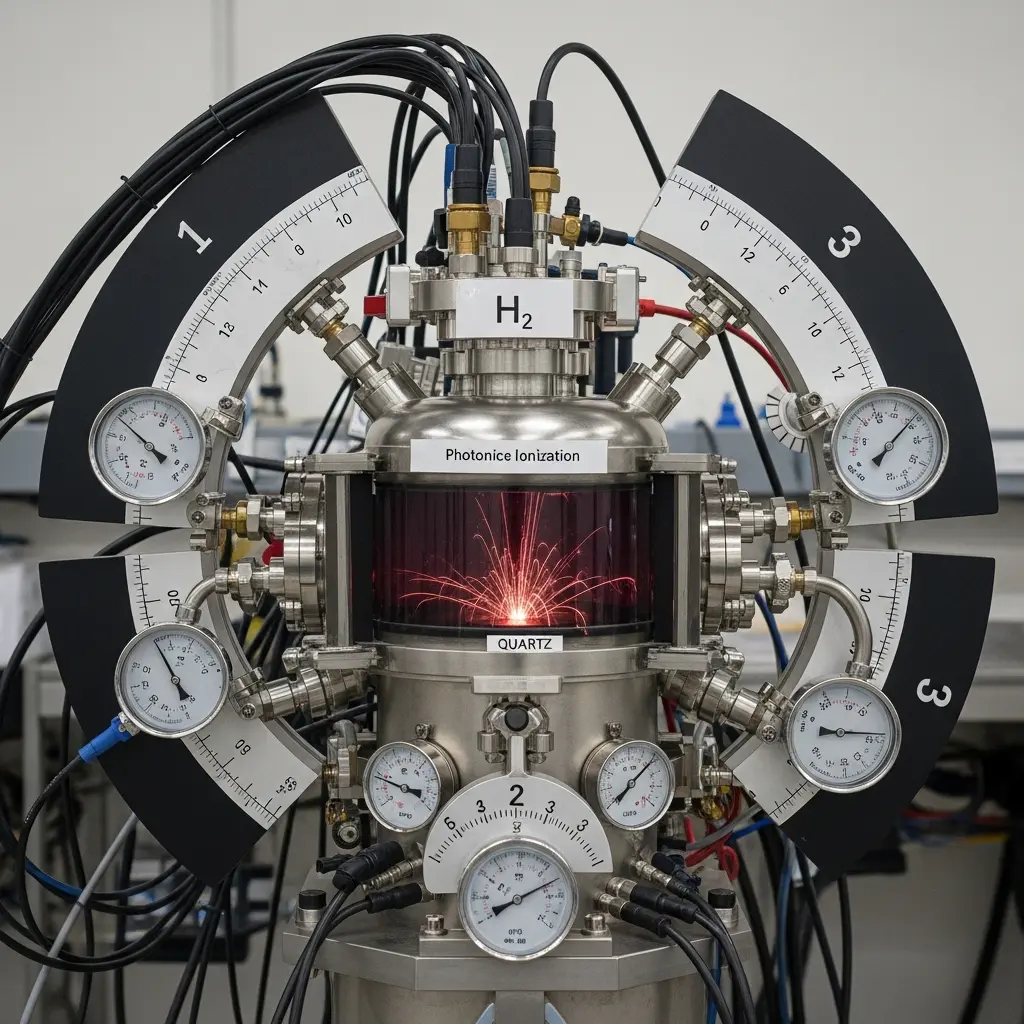
The fundamental process of ionizing a hydrogen molecule receives a thorough theoretical treatment in new work led by Hui-hui Miao from Lomonosov Moscow State University. This research establishes a comprehensive framework, combining electrodynamics with the Lindblad master equation, to describe how light and matter interact during ionization, while also accounting for energy loss and the addition of particles to the system. The team demonstrates a consistent tendency towards neutral hydrogen molecule formation across various conditions, revealing that the rate of energy dissipation from photons, electrons, and phonons critically controls system stability. Importantly, this work identifies how external particle influx redistributes energy, populating specific atomic states, and establishes a fundamental limit to ionization probability dictated by orbital hybridization, offering a unified theoretical foundation for controlling chemical reactions and informing future experiments in areas like cavity quantum electrodynamics and information processing.
The system’s evolution is systematically explored across three distinct scenarios: a closed system, a system losing energy to its surroundings, and a system receiving a continuous influx of particles. Results consistently demonstrate a tendency towards the formation of the stable neutral hydrogen molecule, regardless of the initial conditions. The rates at which photons, electrons, and phonons are lost from the system are identified as critical control parameters, with rapid photon loss significantly accelerating system stabilization. Furthermore, introducing a continuous influx of particles leads to a complex redistribution of energy, notably increasing the population of excited states within the system.
Hydrogen Molecule Stability and Dissipation Effects
This research presents a comprehensive investigation into the quantum dynamics of hydrogen molecule ionization, exploring both isolated systems and those subject to energy loss and particle influx. Key findings demonstrate a consistent tendency for the system to evolve towards the stable neutral hydrogen molecule, regardless of initial conditions. The study identifies the rates of energy loss related to photons, electrons, and phonons as critical parameters governing both the speed of stabilization and the final distribution of states, with photon loss playing a particularly significant role in promoting molecular stability. Furthermore, the introduction of particle influx leads to complex energy redistribution, notably enabling population retention in atomic states.
The ionization pathway proves highly sensitive to the initial quantum state, specifically the number of photons present, which dictates the accessible excitation channels for electrons with differing spins. This sensitivity is confirmed by modelling an anode, which reveals a theoretical maximum ionization probability of three-quarters, fundamentally limited by the way electron orbitals combine and the initial state configuration. The authors acknowledge limitations inherent in their model, specifically the assumption that the environment’s influence is immediate and memoryless, and suggest future research should explore scenarios where the environment retains memory and provides feedback. Extending the model to encompass more complex molecular systems, such as those with multiple electrons or differing atomic nuclei, represents another promising avenue for investigation. Ultimately, experimental verification of these theoretical predictions, potentially through ultracold atom experiments or quantum simulation platforms, will be crucial for harnessing this quantum-controlled chemistry in practical applications.
🗞 Quantum electrodynamic description of the neutral hydrogen molecule ionization
🧠 ArXiv: https://arxiv.org/abs/2511.21430