The quest for long-lived storage of single photons represents a critical hurdle in realising secure communication and fundamental tests of physics over vast distances, and researchers are now pushing the boundaries of what’s possible. You-Cai Lv, Yu-Jia Zhu, and Zong-Quan Zhou, alongside colleagues at the University of Science and Technology of China, demonstrate a significant advance in this field with the development of a photonic quantum memory capable of storing information for an unprecedented length of time. The team overcomes a long-standing limitation of suitable crystal materials, achieving storage lifetimes exceeding 27 seconds and demonstrating time-bin qubit storage fidelity of 88%, far surpassing the capabilities of existing classical methods. This breakthrough establishes a new regime for photonic memory, paving the way for the development of global-scale quantum networks and ambitious deep-space experiments.
While a global quantum network requires storage times of seconds to minutes, existing photonic quantum memories have been limited to subsecond lifetimes. Europium-doped yttrium silicate crystals offer extended spin coherence, but their weak optical absorption previously hindered successful implementation.
Europium Silicate Photon Storage Demonstration
This research demonstrates a significant advance in photonic quantum memory, achieving unprecedented storage times and high fidelity. Scientists have successfully stored single photons for up to 20 milliseconds, a substantial improvement over previous solid-state memories, and have demonstrated storage exceeding several seconds under specific conditions. This achievement paves the way for practical long-distance quantum communication and distributed quantum computing by utilizing europium-doped yttrium silicate crystals as the storage medium. The team employed advanced dynamical decoupling techniques, specifically a carefully designed pulse sequence, to suppress noise and extend coherence time.
This innovative approach allows for precise control over the stored photon’s quantum state, enabling efficient retrieval of information. The memory stores time-bin qubits, encoding quantum information in the arrival time of a photon, and researchers are actively working towards integrating these memories into compact, practical devices. This research is crucial for building long-distance quantum communication networks, overcoming the limitations of signal loss in optical fibres. The quantum memory can serve as a key component in quantum repeaters, extending communication range, and enabling distributed quantum computing systems. Furthermore, this work contributes to fundamental studies of quantum mechanics and the nature of coherence, with potential applications in deep-space exploration.
Photonic Memory Extends Lifetime Beyond Two Orders of Magnitude
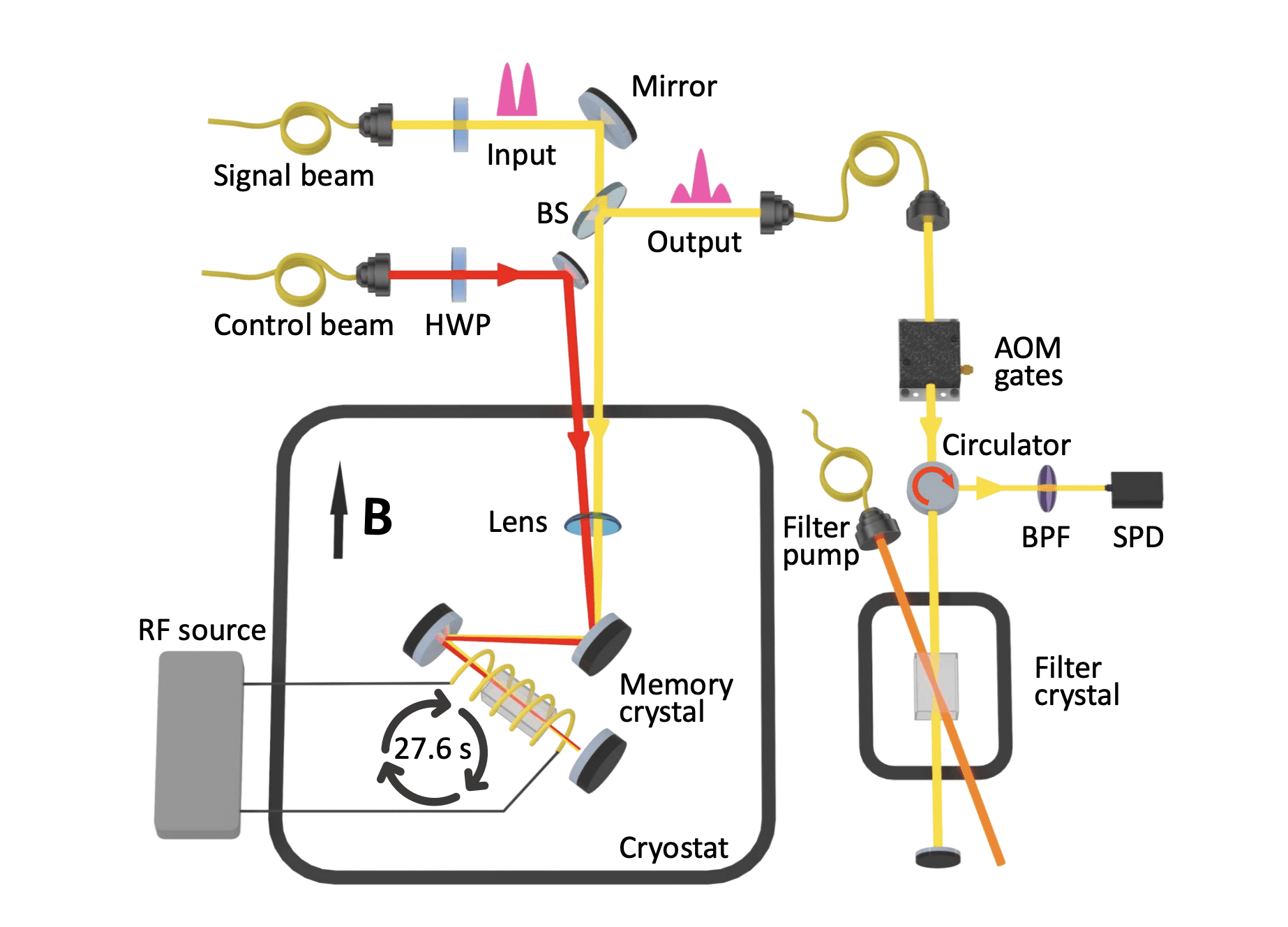
This work represents a breakthrough in photonic memory, achieving storage lifetimes previously unattainable. Scientists successfully stored single photons for 27. 6 seconds, extending storage time by over two orders of magnitude compared to previous technologies. This extended lifetime was achieved by integrating a noiseless photon echo protocol with a robust dynamical decoupling sequence, protecting nuclear spin coherence at a specific magnetic field. Experiments revealed a time-bin qubit storage fidelity of 88.0% at a storage time of 5. 6 seconds, surpassing the limits of classical strategies. The team measured storage efficiency of 9. 65% with a strong signal-to-noise ratio, using weak coherent input pulses. Further tests, extending storage to 42 seconds, yielded a single-photon-equivalent signal-to-noise ratio demonstrating performance above the fundamental operational threshold.
To quantify quantum performance, scientists encoded inputs with time-bin qubits, achieving high basis-state fidelities. The measured fidelity demonstrably violates the classical fidelity bound, unambiguously confirming operation in the true quantum regime. This achievement establishes photonic memory in the minute-scale regime, paving the way for global-scale quantum networks and deep-space experiments requiring long-duration photon storage.
Minute-Scale Photonic Memory with High Fidelity
This research demonstrates a significant advance in photonic memory, achieving single-photon storage lifetimes extending into the minute-scale regime. Scientists overcame the challenge of weak optical absorption in europium-doped yttrium silicate crystals by integrating a noiseless photon echo protocol with a robust dynamical decoupling sequence. This innovative approach protects nuclear spin coherence, enabling long-lived storage at a specific magnetic field and ultimately achieving a storage lifetime of 27. 6 seconds, with single-photon-level storage maintained for 42 seconds with a clear signal.
The team reports a time-bin qubit storage fidelity of 88. 0% at a storage time of 5. 6 seconds, exceeding the performance limits of conventional methods. This achievement establishes a crucial foundation for the development of global-scale quantum networks and facilitates deep-space communication experiments, which require extended photon storage capabilities.
👉 More information
🗞 Minute-Scale Photonic Quantum Memory
🧠 ArXiv: https://arxiv.org/abs/2511.12537