

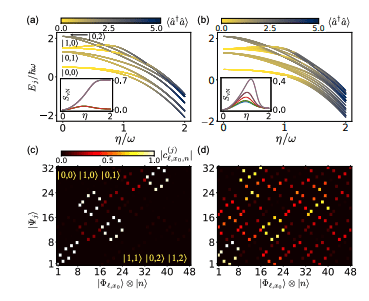
The behaviour of charged particles in magnetic fields forms the basis of many fundamental physical phenomena, and recent research explores this behaviour in a novel light-matter system. Farokh Mivehvar from Universität Innsbruck, and colleagues, demonstrate that coupling these magnetic effects to light within an optical cavity creates a system surprisingly well described by two interacting harmonic oscillators. This work reveals the formation of “Landau polaritons”, hybrid states inheriting properties from both the magnetic field and the light, and exhibiting characteristics like quantum entanglement and squeezing. By establishing a mechanical understanding of this complex interaction, the team opens new avenues for investigating driven-dissipative Landau-polariton physics and exploring unique quantum dynamics in light-matter systems.
Driven-Dissipative Landau Polaritons: Two Highly Nonlinearly-Coupled Quantum Harmonic Oscillators Landau levels, the discrete energy spectrum of a charged particle in a magnetic field, underpin many fascinating phenomena, including the quantum Hall effect and quantized vortices. This work investigates the coupling of two quantum harmonic oscillators exhibiting strong nonlinearities, specifically within the framework of driven-dissipative Landau polaritons. The research explores how external driving and dissipation shape the dynamics and properties of these coupled oscillators, moving beyond traditional equilibrium descriptions, offering insights into both fundamental physics and potential applications in quantum technologies.
Landau levels of a transversely driven, charge-neutral particle in a synthetic gauge potential couple to a quantized field within an optical cavity, creating a setting reminiscent of superradiant self-ordering in quantum gases. This complex system can be surprisingly described in terms of two highly nonlinearly-coupled quantum harmonic oscillators, enabling a full quantum mechanical treatment. Light-matter coupling mixes the Landau levels and the superradiant photonic mode, leading to the formation of hybrid states termed “Landau polaritons”. These polaritons partially inherit the degeneracy of the Landau levels and possess intriguing features, such as non-zero light-matter entanglement and quadrature squeezing.
Multistability Demonstrated in Strong Coupling Regime
This research demonstrates a remarkable multistability within the system, meaning it can evolve to different steady states depending on its initial conditions. This finding challenges many theoretical treatments that assume a unique steady state and reveals the complex dynamics leading to these different states. The team carefully examined the system’s behavior with specific parameters, including strong light-matter coupling, and compared the dynamics starting from different initial conditions. Detailed analysis reveals that the system’s evolution depends critically on its starting point. The results clearly demonstrate that different initial states lead to qualitatively different long-term behavior and distinct steady states, confirming the system’s multistability. This discovery has significant implications for understanding quantum systems, highlighting the importance of considering initial conditions and challenging the assumption of a single steady state in many theoretical models. The multistability could be exploited for quantum control applications, allowing researchers to steer the system towards a specific desired state.
Landau Polaritons And Quantum Steady States
This research demonstrates a novel coupling between Landau levels and the quantized field within an optical cavity, resulting in the formation of hybrid states termed Landau polaritons. The team uncovered that this complex system can be effectively modeled using two nonlinearly-coupled harmonic oscillators, allowing for a complete mechanical treatment of the interactions. These Landau polaritons exhibit partial degeneracy inherited from the original Landau levels and possess intriguing quantum properties, including light-matter entanglement and quadrature squeezing. The investigation revealed diverse, non-equilibrium dynamics and multiple co-existing quantum steady states depending on system parameters and initial conditions.
The atomic distributions displayed characteristics of Poisson, thermal, and squeezed states, demonstrating a rich variety of quantum behaviors. This model shares formal similarities with systems of trapped atoms within cavities, suggesting potential implementation in current cavity-QED experiments. Future work will focus on exploring the many-body topological aspects of this system and investigating potential applications in areas such as high-precision metrology and sensing, leveraging the observed light-matter entanglement and squeezed oscillators.
👉 More information
🗞 Driven-Dissipative Landau Polaritons: Two Highly Nonlinearly-Coupled Quantum Harmonic Oscillators
🧠 ArXiv: https://arxiv.org/abs/2509.12321


