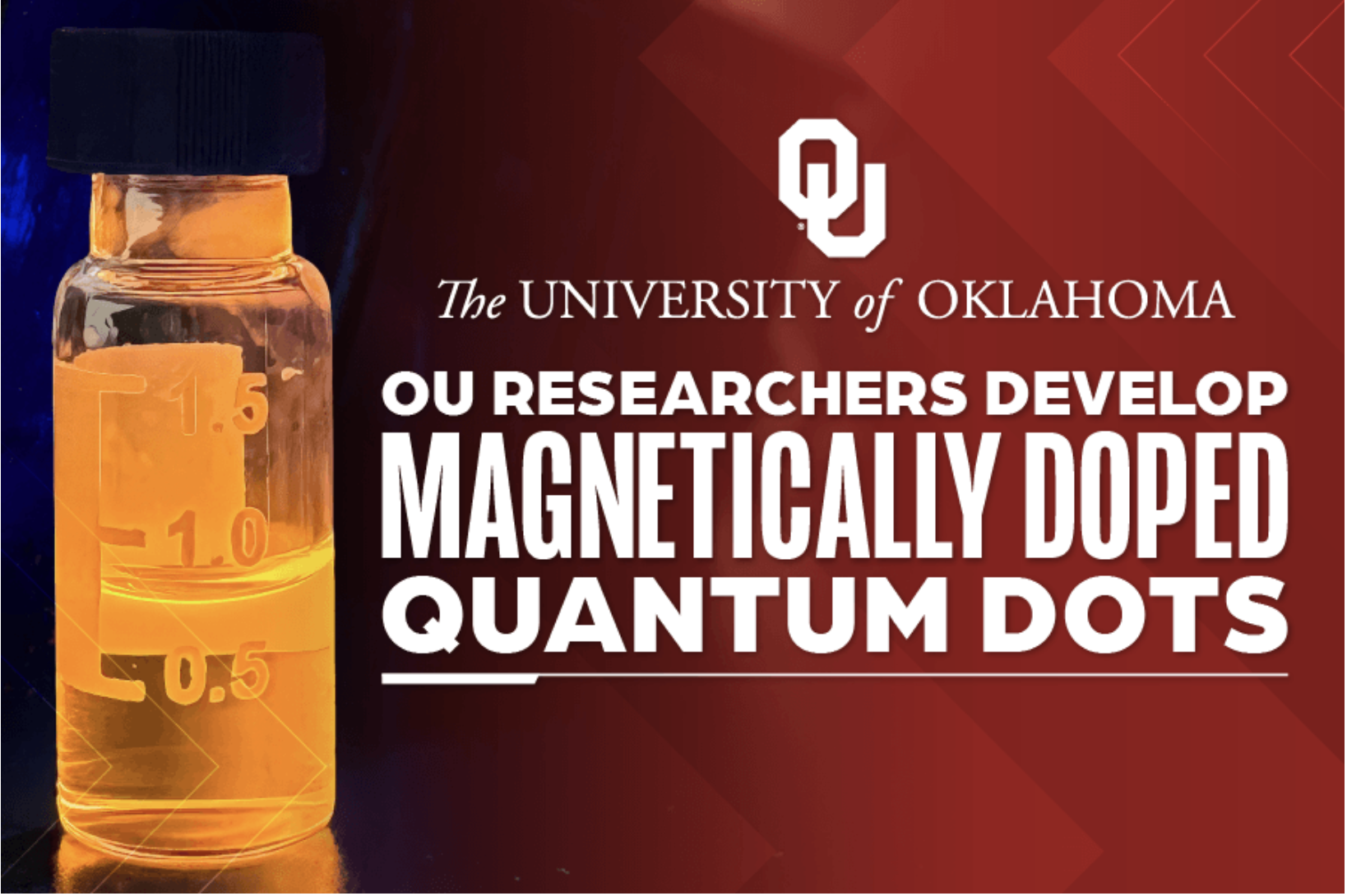
Yitong Dong and colleagues at the University of Oklahoma (OU) have achieved a breakthrough in materials science with the successful doping of manganese into perovskite nanoparticles. This innovation addresses a long-standing challenge by introducing manganese into a material previously considered undopable, resulting in magnetically doped quantum dots. The achievement represents a significant step forward in the field, potentially enabling new applications leveraging both quantum and magnetic properties within a single nanoparticle system. This doping process opens avenues for materials with previously unattainable characteristics.
Magnetically Doped Quantum Dot Development
Researchers at OU have achieved a breakthrough in materials science by developing magnetically doped quantum dots. Specifically, the team, led by Yitong Dong, successfully integrated manganese into perovskite nanoparticles. This accomplishment is significant because it represents a novel method for doping materials previously considered undopable, opening new avenues for materials design and potential applications leveraging both quantum and magnetic properties.
The core of this development lies in the successful “doping of the undopable.” This refers to the integration of manganese into the structure of perovskite nanoparticles. While the specific properties resulting from this doping aren’t detailed, the achievement itself is highlighted as a key advancement. This suggests potential for creating materials with combined quantum and magnetic functionalities not previously attainable.
This research demonstrates a significant step forward in manipulating material properties at the nanoscale. The team’s ability to introduce manganese into perovskite nanoparticles expands the possibilities for designing new materials. Further investigation into these magnetically doped quantum dots could lead to advancements in fields reliant on both quantum phenomena and magnetism.
Manganese Introduction into Perovskite Nanoparticles
Researchers at OU have achieved a significant advancement in materials science by successfully incorporating manganese into perovskite nanoparticles. This process, termed “doping the undopable,” represents a breakthrough because manganese introduction was previously considered difficult or impossible within this material class. The team, led by Yitong Dong, overcame existing challenges to achieve this crucial doping, opening new avenues for material property manipulation and potential applications.
This successful manganese introduction into perovskite nanoparticles signifies a key step toward creating materials with tailored magnetic properties. While the source does not detail how the doping was achieved, the result demonstrates a novel capability. This is important because doping allows scientists to modify a material’s characteristics without fundamentally altering its structure, leading to enhanced or entirely new functionalities.
The achievement by Dong and colleagues highlights a potential shift in quantum dot development. By successfully introducing manganese, researchers have created magnetically doped quantum dots – nanoscale semiconductors exhibiting both optical and magnetic characteristics. This combination could lead to innovations in areas reliant on both properties, although specific applications aren’t detailed in the provided source material.