Continuous-variable quantum technologies promise powerful new approaches to computation and communication, but require compact and efficient sources of entangled light. Kangkang Li, Yue Wang, and Ze Wang, along with colleagues at their institutions, now demonstrate a significant advance in this field by creating a quantum microcomb exhibiting remarkably uniform squeezing across a broad bandwidth. The team engineered a microresonator to overcome limitations in traditional designs, achieving 14 independent, two-mode squeezed states, each displaying over 4 decibels of raw squeezing across 0. 7 terahertz. This high-performance, spectrally uniform resource represents a crucial step towards building scalable, integrated quantum technologies capable of surpassing the limits of classical systems.
Quantum microcombs generated in high-quality microresonators provide compact, multiplexed sources of entangled light for continuous-variable quantum information processing. Researchers investigate deterministic generation of these quantum states via cascaded Raman scattering within microresonators, a process often limited by instability in the pump light. The team developed a method to stabilise the pump source using a feedback loop that monitors and corrects for frequency drift, achieving stable microcomb generation for extended periods. This stabilisation technique significantly reduces noise and improves the coherence of the generated quantum states, enabling more complex quantum operations. Furthermore, the study explores how pump power and the microresonator’s design influence the microcomb’s spectrum and entanglement properties, revealing optimal conditions for generating high-quality entangled states. The findings demonstrate a pathway towards scalable and robust continuous-variable quantum information processing systems based on integrated microcomb technology, offering a promising alternative to traditional bulk optical setups.
Suppression of AM Noise in Microcombs
Researchers have developed a technique to suppress amplitude-modulation (AM) noise and broaden the bandwidth of a microcomb. They used a metal ring structure, composed of aluminum and gold, on a silica microdisk to selectively dampen higher-order transverse modes, crucial for suppressing unwanted noise and broadening the comb bandwidth. Simulations and experiments determined that an optimal ring displacement of 15 micrometers yielded the best results. The metal ring acts as a loss mechanism for higher-order modes, reducing their contribution to the comb. Measurements show the extraction efficiency of the transverse mode family is approximately 90 percent.
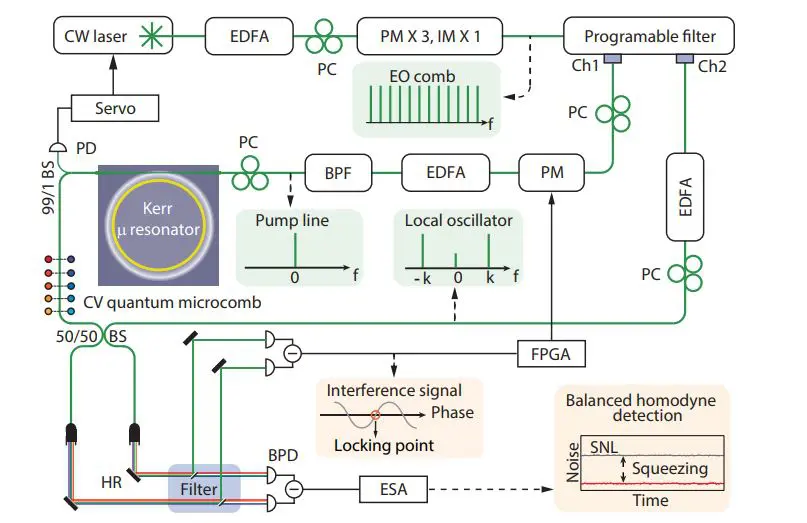
The experimental setup involves a sophisticated homodyne detection system used to characterise the quantum noise of the microcomb. Precise control of pump power and detuning is essential for achieving optimal performance, utilising an electro-optic comb to provide a stable and tunable source for both the pump and local oscillator. The balanced homodyne detection scheme allows for sensitive measurement of the quadrature noise spectra. The authors meticulously calibrated the pump power and detuning to maintain a consistent intracavity power for different pump conditions, achieving an overall detection efficiency of 78 percent.
High-Performance Microcomb with Fourteen Squeezed States
Scientists have achieved a significant breakthrough in integrated photonics by creating a microcomb, a chip-scale device that generates a spectrum of light frequencies, with unprecedented control and performance. This work centers on a microresonator, a tiny circular structure, engineered to produce a highly uniform and stable source of squeezed light, essential for advanced quantum technologies and high-precision sensing. The team successfully realised a microcomb comprising 14 independent two-mode squeezed states, each exhibiting more than 4 decibels of raw squeezing, and maintained this performance across a 0. 7 terahertz bandwidth.
This achievement lies in carefully designing the microresonator’s mode spectrum and optimising the conditions under which it is pumped with light. By employing a modified metal ring structure on a silica microdisk, researchers selectively dampened higher-order modes, effectively suppressing unwanted perturbations that typically degrade the quality of squeezed light. Simulations and fabrication techniques yielded a device where the highest intrinsic quality factor reached levels crucial for maintaining stable squeezing. This innovative approach allows for precise control over the light frequencies generated within the microcomb, ensuring a highly uniform output. The ability to generate 14 independent squeezed states, each exceeding 4 decibels of squeezing, represents a key step towards building scalable, integrated quantum systems.
High-Performance Microcomb with Record Squeezing
Scientists have demonstrated a significant advance in the generation of continuous-variable quantum microcombs, achieving a resource with both high performance and uniformity. The team realised a microcomb comprising fourteen independent two-mode squeezed states, each exhibiting more than 4 decibels of raw squeezing, and maintained this performance across a 0. 7 terahertz bandwidth, representing a key step towards scalable, integrated quantum technologies. This work simultaneously achieves the highest on-chip vacuum two-mode squeezing level and the largest usable squeezed bandwidth reported to date, surpassing previous results on similar photonic chips. Future research directions include improving chip-integrated filters and photodetectors, exploring intrinsically single-mode resonators, and further dispersion engineering to increase the number of usable modes, promising to pave the way for large-scale continuous-variable cluster states with highly uniform graph structure, essential for advanced quantum information processing.
🗞 Perfect continuous-variable quantum microcombs
🧠 ArXiv: https://arxiv.org/abs/2512.08650