Quantum machine learning offers potential advantages for complex pattern recognition, particularly in image classification where efficient feature extraction is paramount. Researchers are increasingly exploring how the principles of quantum mechanics, such as superposition and entanglement, can be harnessed within convolutional neural networks (QCNNs) to improve performance on challenging datasets. Shaswata Mahernob Sarkar, Sheikh Iftekhar Ahmed, and colleagues, from institutions including the Bangladesh University of Engineering and Technology and the University of Rochester, detail a novel approach to QCNN architecture and training in their article, “Selective Feature Re-Encoded Quantum Convolutional Neural Network with Joint Optimization for Image Classification”. Their work introduces a selective feature re-encoding strategy alongside a parallel-mode QCNN, designed to enhance feature processing and improve classification accuracy by leveraging complementary representations derived from Principal Component Analysis and Autoencoders. The team demonstrates the efficacy of their method using the MNIST and Fashion MNIST datasets, reporting improved performance compared to both individual QCNN models and traditional ensemble techniques.
Quantum machine learning (QML) is experiencing accelerated development, driven by improvements in Noisy Intermediate-Scale Quantum (NISQ) devices, and researchers are actively investigating its potential across diverse fields, including image recognition. This study examines quantum convolutional neural networks (QCNNs) for image classification, proposing a new strategy to refine feature processing and a novel QCNN architecture designed to improve classification accuracy. The aim is to demonstrate how the application of quantum principles can yield more efficient and accurate image classification models.
QCNNs represent a promising approach to harnessing quantum computation for image processing, potentially offering advantages over classical convolutional neural networks in terms of computational efficiency and representational capacity. While traditional convolutional neural networks have achieved considerable success, they can be computationally expensive and demand significant resources for training and deployment, particularly when dealing with large and complex datasets.
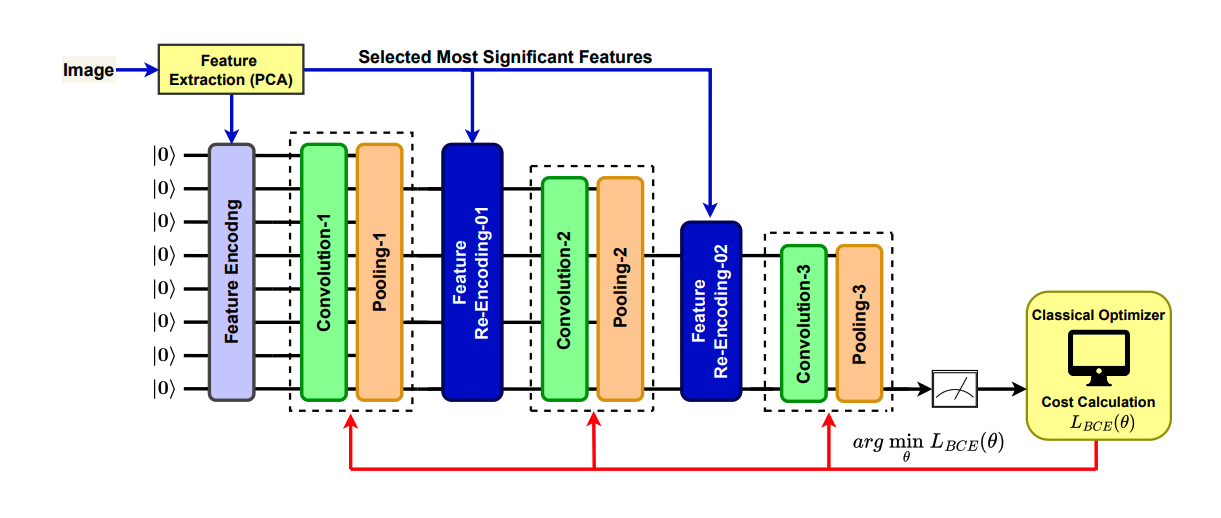
The research begins by introducing a selective feature re-encoding strategy, which directs quantum circuits to prioritise the most informative features, thereby navigating the Hilbert space – the complex vector space that describes all possible states of a quantum system – to identify optimal solutions. This approach carefully selects and encodes only the most relevant features from the input image, reducing computational load and improving the signal-to-noise ratio.
Next, a novel parallel-mode QCNN architecture was designed,
Next, a novel parallel-mode QCNN architecture was designed, simultaneously incorporating features extracted by two classical methods: Principal Component Analysis (PCA) and Autoencoders, within a unified training scheme. PCA is a dimensionality reduction technique that identifies the principal components of input data, capturing the most significant variations. Autoencoders, conversely, are neural networks that learn to reconstruct input data from a compressed representation, effectively extracting essential features. By combining these methods within a quantum framework, the research aims to leverage their complementary strengths and achieve a more robust and accurate representation of features.
To rigorously evaluate these methodologies, comprehensive experiments were conducted using the widely recognised MNIST and Fashion-MNIST datasets. These analyses revealed that the performance of the QCNN is sensitive to parameters such as the number of qubits – the quantum equivalent of bits – and the depth of the quantum circuit, highlighting the importance of careful optimisation and tuning.
Furthermore, the jointly optimised parallel QCNN architecture consistently outperforms both individual QCNN models and traditional ensemble approaches. This superior performance can be attributed to the synergistic effect of combining PCA and Autoencoders within a quantum framework, allowing the QCNN to capture a more comprehensive and robust feature representation.
The foundations of the work rely on established quantum computing principles, such as the decomposition of orthogonal matrices, as detailed by Wei and Di, and optimal circuit designs for two-qubit gates, as described by Vatan and Williams, ensuring the feasibility and efficiency of the proposed quantum circuits. The entire process benefits from the use of robust software tools and libraries for quantum simulation and machine learning, including TensorFlow Quantum and PennyLane, which facilitate the development and testing of quantum algorithms. The code and data used in this study are publicly available, promoting reproducibility and collaboration within the quantum machine learning community.
Looking ahead, the research plans to explore the
Looking ahead, the research plans to explore the application of the proposed QCNN architecture to more complex image classification tasks, such as object recognition and image segmentation, and investigate the potential of using more advanced quantum algorithms to enhance performance further. Furthermore, work is underway to develop hardware-efficient QCNN architectures that can be implemented on near-term quantum devices.
In conclusion, the research demonstrates the potential of quantum convolutional neural networks to achieve state-of-the-art performance in image classification tasks. By combining innovative feature encoding strategies with a novel parallel QCNN architecture, a robust and efficient image classification system has been developed that outperforms traditional approaches, paving the way for future advancements in quantum machine learning.
🗞 Selective Feature Re-Encoded Quantum Convolutional Neural Network with Joint Optimization for Image Classification
🧠 DOI: https://doi.org/10.48550/arXiv.2507.02086