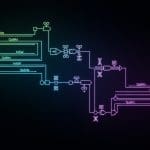
Scientists are increasingly focused on developing accessible tools to simulate quantum circuits and translate theoretical concepts into practical engineering applications. Murtaza Vefadar from Gebze Technical University, alongside colleagues, present a novel solution in their development of QuVI (Quantum Virtual Instrument), an open-source toolkit built within the NI LabVIEW environment. This research is significant because it moves beyond conventional text-based quantum programming languages, offering an intuitive, visual interface based on LabVIEW’s established “dataflow” paradigm. By directly mapping “Block Diagrams” to quantum state representations on “Bloch Spheres”, QuVI provides a powerful platform for both education and research, allowing users to prototype quantum logic and seamlessly integrate classical control structures within a familiar graphical workspace.
This architecture relies on a unique state management system utilizing LabVIEW Queues to efficiently manage the global quantum state without incurring significant memory overhead.
The toolkit’s capabilities are demonstrated through the construction and visualization of fundamental quantum algorithms, with results rigorously verified against established theoretical predictions. The simulation environment employs a Flat Sequence Structure as the canvas for circuit construction, beginning with qubit initialization and progressing through gate application. Independent single-qubit gates execute in parallel, leveraging LabVIEW’s native dataflow capabilities, while multi-qubit operations utilize a “Watch List” mechanism and LabVIEW Notifiers to enforce synchronization and maintain correct state evolution.
This synchronization ensures data dependencies between qubits are properly managed during entangling operations like controlled gates. The system requires only O(1) memory to store gate parameters, a significant advantage over approaches that would necessitate O(4n) memory for an n-qubit system. For each element (i) of the state vector, a “partner” index (j = i \oplus 2k) is identified, and the new amplitude (b_i) is calculated by mixing input amplitudes (a_i) and (a_j) according to the gate matrix (U).
This approach minimizes memory overhead, requiring only (O(1)) memory for storing the gate parameters while maintaining standard (O(N)) memory for the state vector. Controlled gates are handled using two bitmasks: an inclusion mask identifying control qubits and a value mask specifying their required states.
The update rule for each element (i) of the state vector is conditional, ensuring that operations proceed only if the control condition is met. This method ensures efficient parallel execution without race conditions. The SWAP gate implementation defines a direct mapping between input and output indices, allowing arbitrary control masks to be applied seamlessly. The toolkit utilizes wires representing data and nodes representing operations to provide a visual analog to standard quantum circuit notation.
QuVI enables seamless integration of classical control structures, such as loops and conditionals, for constructing complex algorithms. The simulation architecture relies on LabVIEW Queues of size 1, functioning as global storage buffers for the state vector and system parameters. Visual wires transmit references to these queues, allowing gates to access and modify the shared state vector “in-place”, avoiding memory copy overhead.
Circuit composition begins with initialization subVIs, each setting a qubit to the |0⟩ state, stacked vertically to define the register size. Horizontal connections from these initializations establish the “quantum wires” flowing through the circuit. Single-qubit gates execute independently via LabVIEW’s native parallelism, while multi-qubit operations require synchronization mechanisms.
A “Watch List” mechanism, implemented as a LabVIEW Queue, acts as a synchronization registry, storing an array of bits representing wire indices. When a controlled gate is executed, the target gate updates the global state vector and modifies the Watch List bits according to a control bitmask. This method avoids constructing the full Hilbert space operator, iterating linearly through the state vector for each index independently. This toolkit moves beyond basic models to provide a robust framework that utilises LabVIEW’s dataflow paradigm, where data is represented by wires and operations by nodes, mirroring standard quantum circuit notation and enabling the incorporation of classical control structures.
Demonstrations include the construction and visualisation of fundamental quantum algorithms, with results aligning with established theoretical predictions. The significance of QuVI lies in its accessibility for both educators and researchers, providing a platform to prototype and visualise quantum logic within a familiar graphical engineering workspace.
By directly translating graphical block diagrams into quantum state evolutions displayed as Bloch Spheres, the toolkit bridges the gap between abstract quantum concepts and practical implementation. A four-qubit Grover search was successfully simulated, achieving greater than 96% probability of measuring a dynamically selected target state, and quantum teleportation was also implemented and verified.
The authors acknowledge the current simulator’s limitation to pure state vector simulations. Future development will extend QuVI to support mixed states using the density matrix formalism, allowing for the simulation of noisy quantum systems through the inclusion of decoherence channels. Further planned enhancements include diagnostic tools to quantify entanglement, such as von Neumann entropy and concurrence, and the computation of reduced density matrices via partial traces, expanding the toolkit’s capabilities for advanced quantum system analysis.
👉 More information
🗞 From Block Diagrams to Bloch Spheres: Graphical Quantum Circuit Simulation in LabVIEW
🧠 ArXiv: https://arxiv.org/abs/2602.00643