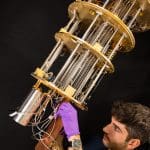
Researchers successfully modelled chromatin organisation using quantum annealing. They embedded an epigenetic Ising model – representing nucleosome states and genomic interactions – onto quantum processors. This approach efficiently sampled chromatin configurations, addressing limitations of classical modelling techniques used to understand gene regulation.
The intricate organisation of DNA within the cell nucleus is increasingly recognised as fundamental to gene regulation. Topologically Associating Domains (TADs) – discrete, spatially segregated regions of the genome – play a critical role in this process by controlling interactions between genes and their regulatory elements. Understanding how one-dimensional patterns of epigenetic markers – chemical modifications to DNA and its associated proteins – translate into these three-dimensional chromatin structures remains a significant challenge. Researchers at Forschungszentrum Jülich and the University of Northern Iowa, led by Tobias Kempe, S.M. Ali Tabei, and Mohammad H. Ansari, detail a novel application of quantum annealing to model and sample the complex energy landscapes governing TAD formation, as presented in their article: “Intermediate State Formation of Topologically Associated Chromatin Domains using Quantum Annealing”. Their work embeds an epigenetic Ising model – a mathematical framework representing interacting ‘spins’ – onto quantum processors to efficiently explore the possible configurations of chromatin organisation.
Quantum Annealing Models Chromatin Conformation
Researchers are investigating the relationship between epigenetic modifications and three-dimensional chromatin organisation by employing quantum annealing to model and sample the possible conformations of chromatin. Chromatin, the complex of DNA and proteins that makes up chromosomes, doesn’t exist as a linear strand; instead, it folds into intricate structures that regulate gene expression. Epigenetic modifications – alterations to DNA that don’t change the sequence itself – play a crucial role in dictating this folding.
The study formulates a computational model where nucleosomes – the basic repeating units of chromatin – are treated as discrete variables interacting with each other. The strength of these interactions is derived from genomic and epigenomic data. This interaction network is then translated into an Ising model, a well-established mathematical framework in statistical mechanics used to describe systems of interacting ‘spins’ (in this case, representing nucleosome states). The Ising model is then ‘embedded’ onto a quantum processor for computation.
Quantum annealing is a metaheuristic optimisation technique that leverages quantum-mechanical effects to find the low-energy states of a system. In this context, these low-energy states represent stable, biologically plausible chromatin conformations. The researchers utilise the D-Wave Advantage quantum annealing processor.
The choice of ‘target topology’ – the physical connectivity of qubits on the quantum processor – significantly impacts the size of the model that can be embedded. The D-Wave Advantage offers Chimera, Pegasus, and Zephyr topologies. Results demonstrate that Pegasus and Zephyr topologies require fewer qubits than Chimera when modelling full-scale epigenetic systems, suggesting they are more efficient for representing the complex interactions within chromatin.
Optimisation strategies, such as employing open boundary conditions (allowing chain ends to move freely) and removing weak interactions between nucleosomes (through a process called coupling thresholding), demonstrably reduce the embedding size, enabling simulations of more complex chromatin structures. The full-scale model, defined by parameters [12, 25, 5] – representing system size – presents a substantial computational challenge. Careful manipulation of the model, including coupling thresholding, is required to successfully map it onto the D-Wave processor.
Scaling behaviour analysis reveals relationships between the number of nucleosomes, epigenetic marks, and maximum coupling length for medium-scale models, providing insights into the model’s sensitivity to these factors. The implementation of boundary conditions also influences embedding size, with open boundary conditions consistently yielding smaller chain lengths compared to periodic boundary conditions. Analysis of binarized epigenetic mark datasets informs model construction and validates its representation of biological data.
Researchers acknowledge the specific annealing functions of the D-Wave Advantage machine, highlighting the importance of aligning the model with the capabilities of the chosen quantum hardware. This work provides valuable insights into the organisation of the genome and the role of epigenetic modifications in gene expression, with implications for understanding a range of biological processes and potentially developing new therapies for genetic diseases. Future work will focus on exploring more complex chromatin structures and incorporating additional biological factors into the model.
👉 More information
🗞 Intermediate State Formation of Topologically Associated Chromatin Domains using Quantum Annealing
🧠 DOI: https://doi.org/10.48550/arXiv.2505.23289