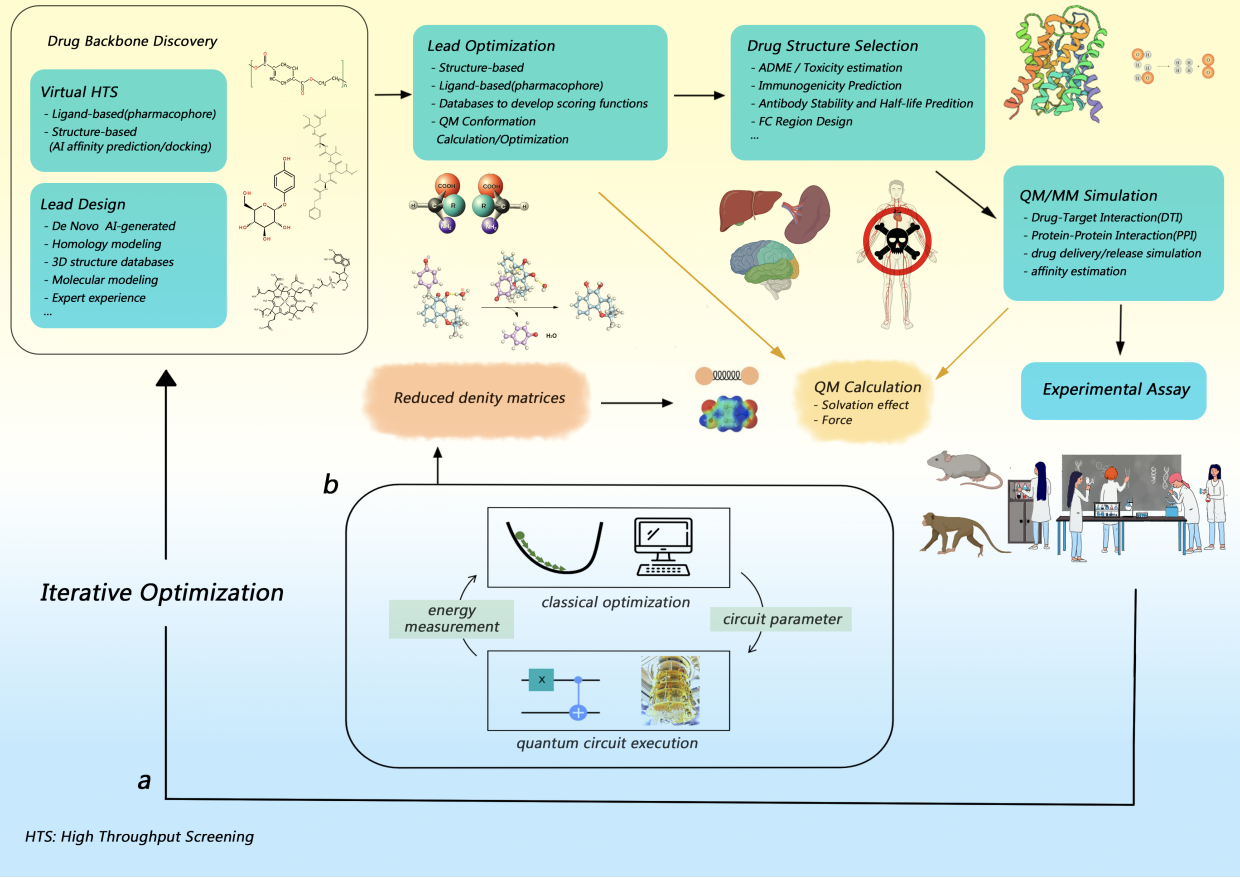
Researchers from Tencent Quantum Lab, AceMapAI Biotechnology, AceMapAI Joint Lab China Pharmaceutical University, and the School of Science Ningbo University of Technology have developed a quantum computing pipeline for drug discovery. The pipeline is designed to address two key tasks in drug discovery: the precise determination of Gibbs free energy profiles for prodrug activation and the accurate simulation of covalent bond interactions.
Quantum Computing in Drug Discovery
A team of researchers from Tencent Quantum Lab, AceMapAI Biotechnology, AceMapAI Joint Lab China Pharmaceutical University, and School of Science Ningbo University of Technology have developed a quantum computing pipeline for real-world drug discovery. The team’s approach diverges from conventional investigations by tailoring the pipeline to address genuine drug design problems. The pipeline is designed to address two critical tasks in drug discovery: the precise determination of Gibbs free energy profiles for prodrug activation involving covalent bond cleavage, and the accurate simulation of covalent bond interactions.
Quantum Computing’s Superior Computational Capabilities
Quantum computing, with its superior computational capabilities compared to classical approaches, holds the potential to revolutionize numerous scientific domains, including pharmaceuticals. Quantum computers, operating with quantum bits (qubits), have the potential to execute complex calculations at speed and levels of precision that traditional supercomputers cannot achieve. The realm of drug discovery, characterized by its need for meticulous molecular modeling and predictive analytics, stands as an ideal candidate to benefit from this quantum leap.
Integration of Quantum Computing into Drug Design
Recent endeavors have commenced the integration of quantum computing into drug design research, marking a progressive stride in the application of advanced computational technologies to drug discovery. In drug design, existing classical computational chemistry methods are not able to compute exact solutions and the required computational cost grows exponentially as the scale of the system grows. Quantum algorithms, exemplified by the Variational Quantum Eigensolver (VQE), hold the potential to advance classical methods like Hartree-Fock (HF) towards more accurate solutions within the quantum computing paradigm.
Quantum Computing Pipeline for Real-World Drug Discovery
The team’s versatile quantum computing pipeline for real-world drug discovery addresses the gap in the current landscape by investigating two pertinent case studies rooted in actual clinical and preclinical contexts. The key step for quantum computation of molecular properties is to prepare the molecular wave function on a quantum device. To this end, the VQE framework is suitable for near-term quantum computers. The core of VQE is to employ parameterized quantum circuits to measure the energy of the target molecular system.
Case Studies: Prodrug Activation and Covalent Inhibition
The first case study focuses on a carbon-carbon bond cleavage prodrug strategy, which investigates an innovative prodrug activation approach applied to β-lapachone for cancer-specific targeting. The second case study turns to the covalent inhibition of KRAS (Kirsten rat sarcoma viral oncogene), a protein target prevalent in numerous types of cancers. Quantum computing can enhance our understanding of such drug-target interactions through Quantum Mechanics-Molecular Mechanics (QMMM) simulations, which are vital for drug discovery.
The article titled “Generalizable Quantum Computing Pipeline for Real World Drug Discovery” was published on January 9, 2024. The authors of the article are Weitang Li, Zhi Yin, Xiaoran Li, Dongqiang Ma, Zhenxing Zhang, C. L. Zou, Kunliang Bu, Maochun Dai, Jie Ye, Yu Zong Chen, Xiaojin Zhang, and Shengyu Zhang.