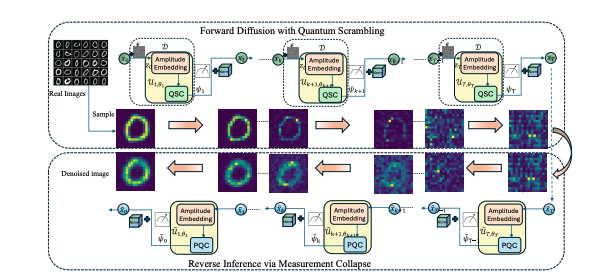
Quantum generative modelling advances with QSC-Diffusion, a fully quantum image generation framework. It utilises quantum scrambling and measurement-induced collapse for denoising, bypassing classical neural networks. This approach achieves competitive image quality, measured by FID scores, with significantly fewer parameters than existing methods, demonstrating enhanced efficiency.
Quantum computing increasingly offers potential advantages for artificial intelligence, particularly in generative modelling where the creation of complex data, such as images, is paramount. Researchers are now exploring methods to harness quantum mechanics not simply as an accelerator to existing classical algorithms, but as a fundamentally different approach to data generation. A team comprising Yihua Li, Jiayi Chen, and Tamanna S. Kumavat from the University of Zurich, alongside Kyriakos Flouris affiliated with both the University of Cambridge and ETH Zürich, detail such a method in their paper, “Unitary Scrambling and Collapse: A Quantum Diffusion Framework for Generative Modeling”.
Their work introduces QSC-Diffusion, a novel framework utilising quantum principles – specifically, unitary scrambling, a process where quantum information rapidly spreads throughout a system, and measurement-induced collapse, a quantum phenomenon where a superposition of states resolves into a single definite state – to generate images directly, bypassing reliance on conventional classical neural networks and associated pre-processing. The team demonstrate competitive performance with significantly reduced computational demands compared to existing methods, suggesting a pathway towards more efficient and scalable quantum generative models.
Quantum generative modelling is experiencing notable development with the emergence of frameworks capable of producing high-quality images utilising fully quantum circuits. Researchers demonstrate a departure from conventional techniques by removing reliance on classical neural networks and pre-processing stages, enabling end-to-end image sampling. This work details QSC-Diffusion, a framework integrating Gaussian noise with quantum circuit scrambling, achieving competitive results across various datasets while significantly reducing the parameter count compared to existing methods.
QSC-Diffusion represents a foundational step towards scalable quantum
QSC-Diffusion represents a foundational step towards scalable quantum generative modelling, highlighting the potential of native quantum approaches to image synthesis. Researchers successfully implement a diffusion-based approach, utilising parameterized quantum circuits (PQCs) for both the forward and reverse processes, achieving comparable image quality to established methods. A PQC is a quantum circuit whose behaviour is controlled by a set of adjustable parameters, allowing it to learn and perform complex tasks.
The model achieves this with a substantially reduced parameter count compared to existing methods, even surpassing some hybrid quantum-classical baselines in efficiency, a crucial advantage for practical implementation on near-term quantum hardware. This reduction in parameters addresses the limitations imposed by qubit availability, making quantum generative modelling more feasible within the current technological landscape. The number of qubits, the fundamental units of quantum information, remains a significant constraint in current quantum computers.
Researchers address the inherent challenges in training deep quantum models by introducing a hybrid loss function, designed to optimise both the fidelity and diversity of generated images. This loss function, coupled with a divide-and-conquer training strategy, effectively mitigates the problem of barren plateaus, a phenomenon where gradients vanish during training, hindering learning. Barren plateaus arise in deep quantum circuits due to the exponential decay of gradients as the number of qubits increases, making it difficult to optimise the circuit parameters. This innovative approach enables the training of deeper, more complex quantum circuits.
The study reveals a crucial relationship between circuit architecture and generative performance, establishing that circuit depth and width significantly impact the ability to generate higher-resolution images. Shallower circuits prove effective for lower-resolution outputs, while deeper architectures are essential for achieving quality in higher-resolution images, necessitating more careful training procedures. This underscores the importance of capacity-aware design, where circuit complexity is tailored to the data’s inherent complexity, ensuring optimal performance and efficient resource utilization.
Researchers demonstrate that higher initial stateentropyleads to more
Researchers demonstrate that higher initial state entropy leads to more diverse generated images, suggesting that the initial randomness significantly influences the variety of outputs. Entropy, in this context, refers to the degree of randomness or uncertainty in the initial quantum state. This observation informs the design of effective generative models, indicating that controlling the initial state’s entropy is a valuable strategy for enhancing output diversity and expanding the range of generated content. By carefully manipulating the initial state, researchers can influence the characteristics of the generated images and tailor them to specific applications.
Future research will focus on exploring more advanced circuit architectures and training strategies to further improve the performance of quantum generative models. Researchers plan to investigate the use of novel quantum algorithms and optimization techniques to overcome the challenges associated with training deep quantum circuits. The ultimate goal is to develop quantum generative models that can produce high-quality images with minimal computational resources, paving the way for new applications in areas such as image synthesis, data augmentation, and creative content generation.
🗞 Unitary Scrambling and Collapse: A Quantum Diffusion Framework for Generative Modeling
🧠 DOI: https://doi.org/10.48550/arXiv.2506.10571