

Arguably it was google that set the Quantum Computing world ablaze with their 2019 announcement that had achieved quantum supremacy. Even though the announcement had garnered a lot of controversy, it did signal to the world that Quantum Computing is a now firmly on the map and a target for many tech companies.
Google’s Quantum developments have been a number of years in the works. Companies like Google have a vested interest in exploring Quantum technologies as the purported benefits could have real tangible benefits on their business units such as search or mapping for example where finding a way to crunch through myriad possibilities faster would be of a huge benefit.
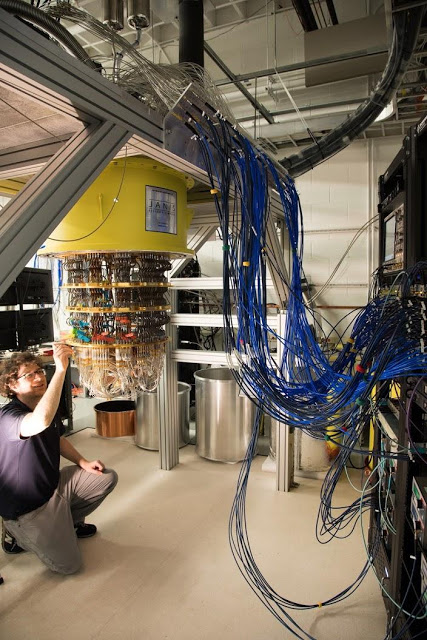
Google AI Quantum research team as you would expect focuses on hardware and software efforts. It has its own superconducting Bristlecone and Sycamore qubit processors which enable up to 54 qubits to be used. Of course that still is not a large enough number to tackle larger problems, it is enough to indicate as they did in their paper (Quantum Supremacy using a Programmable Superconducting Processor) illustrating quantum supremacy.
…quantum supremacy is the goal of demonstrating that a programmable quantum device can solve a problem that classical computers practically cannot (irrespective of the usefulness of the problem)
wikipedia
Quantum speed-up
The whole point of using a Quantum Computer and going to all of these elaborate lengths to be build exotic hardware, which often run just above absolute zero, is to do a task faster in real time. Up until Google with their announcement researchers could program, solve problems and use a Quantum Computer, but the benefits of running the task on the Quantum Computer may not have yielded a speed advantage. Google’s 2019 announcement changed that by stating that a general purpose gated based Quantum Computer could perform a task faster than classical processors.
Google AI expertise areas of Quantum Computing
Alongside Google’s efforts in Hardware, they are working on the tooling around Quantum Computing and that means investing resources into Quantum Algorithms (Quantum Simulation, Quantum Neural Networks, Quantum Optimization).
There are some parallels with the quantum computing developments of IBM, also are working on Hardware and Software around it. IBM has been busy making their Quantum efforts accessible to the masses, but Google so far does not open their platform for external users.
Quantum Open Source Software
Google sits behind cirq, an open source platform for simulating and manipulating Quantum Computers and this does parallel with qiskit where IBM supports this open source resource. Both are open source but receive support. This is somewhat different from Microsoft’s efforts where is only recently chose to open source its Q# quantum language.
Cirq is growing in popularity (well at least anecdotally), we see more interest in the language against the traditionally dominant qiskit which has more uptake. To a certain degree, as Quantum Hardware is nascent, what matters is the software, its ease of use and ability to simulate. Circ could be winning minds on that front, although one of the most immature projects it has still to reach even a Beta and remains in Alpha.
What is next for Google?
Clearly Google has achieved some momentum with its announcement and managed to take the Quantum Crown from the likes of IBM. No doubt they will push on all fronts including increasing the number of qubits in their repertoire and their fidelity.
That is given, however Google will likely be working on aggregating the best talent to work on finding useful routines that can be applied to the hardware – something the entire field realises is crucial to supporting the viability of Quantum Computing.
Interestingly the Google Quantum team is named: Google AI Quantum, which tells you that are looking at ways to utilize Quantum Computers in Machine Learning Tasks, which is somewhat of an obvious statement, but now they will want prove some useful algorithm can be employed that has speed up.
Cirq is likely to become more popular as a Quantum computing framework and we suspect that Google may also work on a more public/researcher accessible quantum cloud to compete with the likes AWS from Amazon and IBM who have already been offering Quantum Computing on the cloud since 2017 – open to just about anyone.