Imagine a world where the seemingly impossible becomes reality. Imagine where calculations that would take today’s fastest supercomputers millennia are solved in mere minutes. This is the tantalizing promise of quantum computing, a revolutionary field poised to redefine the very limits of computation. This multidisciplinary area ventures into the bizarre yet powerful quantum mechanics realm. It takes inspiration from computer science, physics, and mathematics. It aims to tackle problems currently beyond our reach.
At its core, quantum computing harnesses the strange and counter-intuitive principles governing the universe at the atomic and subatomic levels. These principles enable quantum computers to achieve computational feats unattainable by classical machines. The excitement about this emerging technology comes from its potential to solve humanity’s most challenging problems. These include designing life-saving drugs and optimizing complex logistical networks.
The Quantum Leap: Introducing the Qubit
To truly grasp the power of quantum computing, it’s essential to understand its fundamental building block: the qubit. In the familiar classical computing world, information is stored and processed using bits. These bits can exist in one of two states: 0 or 1. This is much like a light switch being either off or on.
Quantum computing introduces the qubit, a quantum bit that transcends this binary limitation . Thanks to the principles of quantum mechanics, a qubit can exist in a state of 0. It can also exist in a state of 1. Moreover, it can be in a superposition of both states simultaneously. This is akin to a dimmer switch that can be fully off, fully on, or anywhere in between. It is like a coin spinning in the air. The coin represents both heads and tails before it lands. Mathematically, this superposition is represented as a linear combination of the |0⟩ and |1⟩ states. It is expressed as |ψ⟩ = α|0⟩ + β|1⟩. Here, α and β are complex numbers known as probability amplitudes.
This seemingly simple difference has profound implications for the amount of information that can be stored and processed. A classical bit can only hold a single value. In contrast, a qubit in superposition can represent many possibilities at the same time. For instance, a mere 500 qubits have the potential to hold more information. This is more than all the atoms in the known universe could represent using classical bits. Quantum computers have an inherent parallelism due to their ability to exist in multiple states concurrently. This allows them to perform many calculations at once. Their classical counterparts, however, must tackle problems sequentially. These quantum bits are not just theoretical constructs. They are being realized physically using a variety of quantum systems. These include the spin of electrons, the polarization of photons, trapped ions, superconducting circuits, and even individual atoms.
Superposition
The concept of superposition is central to the power of quantum computing. It dictates that a quantum system, like a qubit, can exist in a blend of all its possible states. This superposition continues until the moment it is measured. Imagine a flipped coin before it lands. In the quantum realm, it’s neither definitively heads nor tails. It is rather a combination of both. The famous thought experiment of Schrödinger’s cat is both simultaneously alive and dead in a sealed box. It provides another, albeit more unsettling, analogy for this principle.
The state of a qubit in superposition isn’t just a random mix. Probability amplitudes describe it. These are complex numbers (α and β). They dictate the likelihood of finding the qubit in a specific state upon measurement.
The square of the magnitude of these amplitudes corresponds to the probability of observing a particular outcome. It is |α|² for the |0⟩ state. It is |β|² for the |1⟩ state. What’s truly fascinating is that measurement forces the qubit to “choose” a state. This act causes its superposition to collapse into a definite 0 or 1.
This probabilistic nature of quantum reality allows multiple possibilities to exist until observation. It fundamentally departs from the deterministic world of classical computing. Quantum algorithms are cleverly designed to manipulate these probability amplitudes. They increase the likelihood of obtaining the desired solution when the final measurement is performed.
Entanglement: Spooky Action at a Distance
Adding another layer of quantum weirdness and power is the phenomenon of entanglement. This occurs when two or more qubits become inextricably linked. They share a unified quantum state regardless of the physical distance separating them. Albert Einstein famously referred to this as “spooky action at a distance” due to its seemingly instantaneous correlation. Imagine two entangled photons; their polarization will be perfectly correlated.
If you measure one and find it to be vertically polarized, you instantly know the other is also vertically polarized. This happens even if the second one is light-years away. This interconnectedness allows quantum computers to perform complex calculations with remarkable efficiency. Entangled qubits act as a single system. Their joint quantum state is described by a single wavefunction. This wavefunction captures the intricate correlations between them. This unique resource allows quantum algorithms to explore information in new ways. They can manipulate information beyond the capabilities of classical systems. It paves the way for solutions to problems that would otherwise remain intractable.
Quantum Gates and Circuits: The Language of Quantum Computation
To harness the power of qubits, quantum computers employ quantum gates . These basic operations manipulate the quantum states of qubits. They perform similarly to how logic gates (AND, OR, NOT) manipulate bits in classical computers. However, quantum gates operate based on the principles of quantum mechanics, allowing for transformations that have no classical equivalent. For example, the Hadamard gate (often denoted as ‘H’) can take a qubit in a definite state (0 or 1). It puts it into a superposition of both. The Controlled-NOT gate (CNOT) is a two-qubit gate crucial for creating entanglement between qubits.
Pauli gates (X, Y, and Z) are single-qubit gates. They carry out rotations of the qubit’s state on the Bloch sphere. This sphere is a visual representation of a qubit’s state. A sequence of these quantum gates applied to a set of qubits forms a quantum circuit. These circuits are the quantum equivalent of classical programs. They are designed to implement specific quantum algorithms. These algorithms are sets of instructions that leverage superposition and entanglement to solve particular problems.
Interestingly, quantum gates are often reversible. This means that the entry state can be uniquely determined from the output state, a property fundamental to quantum evolution. Quantum evolution is described by unitary transformations, which are represented mathematically by unitary matrices.
The Race to Build a Quantum Computer: Diverse Technologies
Researchers are on a quest to build a practical quantum computer. This has led to the exploration of various physical systems to realize qubits. There isn’t a single dominant technology, and each approach presents its advantages and challenges.
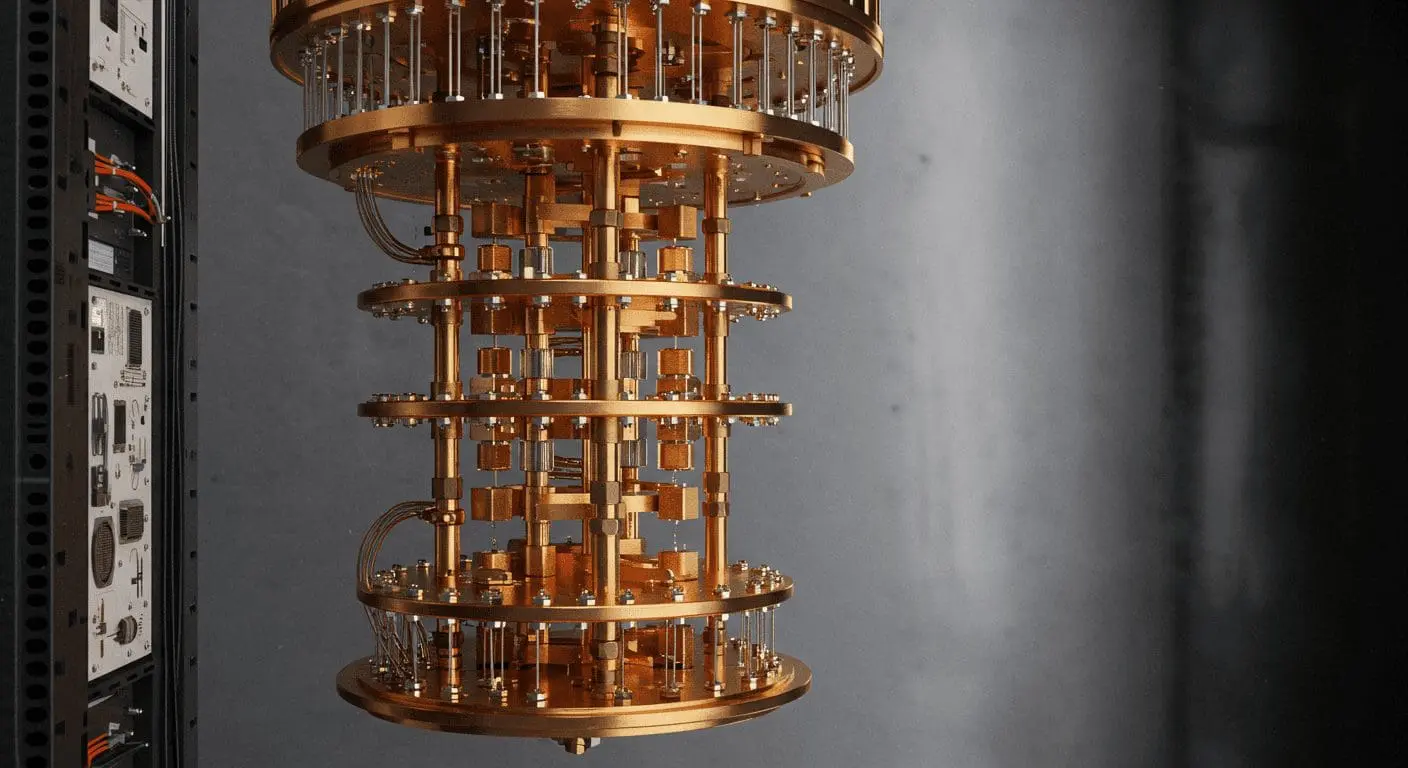
Superconducting qubits, employed by industry giants like IBM and Google, use superconducting circuits. These circuits are cooled to temperatures colder than outer space. These qubits are known for their fast operation speeds. Maintaining their delicate quantum states requires extremely low temperatures. They are also susceptible to a phenomenon called decoherence, in which they lose their quantum properties.
Trapped ion qubits are utilized by companies like IonQ and Quantinuum. They involve trapping ions using electromagnetic fields. Their states are manipulated with lasers. These qubits boast remarkably long coherence times. They also have high fidelity in quantum gate operations. Hence, they are excellent candidates for error correction. The primary challenge with trapped ions lies in scaling up the number of qubits in a single system.
Photonic qubits encode information in photon properties, like their polarization. They can operate at room temperature. These qubits are naturally suitable for transmitting quantum information over long distances, making them ideal for quantum communication. Companies like Xanadu and ORCA are heavily invested in this technology. Nonetheless, manipulating and detecting individual photons efficiently remains a complex task.
Beyond these leading contenders, researchers are also exploring other promising qubit technologies. These include spin qubits, which leverage the intrinsic spin of electrons or nuclei. They have the potential for high qubit density. Topological qubits aim to achieve inherent protection against certain types of errors. Neutral atom qubits use neutral atoms trapped in optical lattices. They offer high scalability potential.
The diverse landscape of qubit technologies highlights ongoing innovation in the field. Scientists and engineers strive to find the most robust and scalable path towards building powerful quantum computers.
A Timeline of Quantum Progress: Key Milestones
The journey of quantum computing from a theoretical concept to a tangible technology has been marked by several pivotal moments. The seeds of this revolution were sown in 1980. American physicist Paul Benioff provided the first description of a quantum computer. He outlined how a laptop can operate under the laws of quantum mechanics.
A year later, in 1981, the legendary Richard Feynman passionately advocated for the need for quantum computers. He explained that they are essential to simulate the quantum nature of the physical world accurately. This task is fundamentally challenging for classical computers.
In 1985, David Deutsch made a groundbreaking contribution. He formulated the concept of a universal quantum computer, which is capable of simulating any physical process. The field truly took off in 1994 with Peter Shor’s discovery of a quantum algorithm. This algorithm could factorize large numbers exponentially faster than the best-known classical algorithms. This was a breakthrough with profound implications for cryptography.
1996 marked Lov Grover’s development of a quantum algorithm for unstructured search. This offered a significant speedup over classical search methods.
The late 1990s and early 2000s saw the first experimental implementations of these algorithms on rudimentary quantum computers. In the subsequent decades, building and controlling quantum hardware advanced rapidly. Companies like IBM, Google, and Rigetti became key players. A significant milestone was reached in 2019 when Google claimed “quantum supremacy.” Google’s 53-qubit Sycamore processor performed a specific calculation in minutes, a calculation that would take the most powerful classical supercomputers thousands of years.
More recently, in 2023, QuEra achieved a record in the number of logical qubits, which are more resistant to errors. IBM also unveiled its Condor processor, boasting an impressive 1,121 superconducting qubits. This historical progression highlights the remarkable journey of quantum computing from abstract theory to increasingly sophisticated hardware. It signals a rapidly maturing field and inching closer to practical applications.
The Quantum Revolution: Applications Across Industries
The unique capabilities of quantum computers are poised to revolutionize a multitude of industries. In medicine, quantum computing holds the potential to accelerate drug discovery dramatically. It enables highly accurate simulations of molecular interactions. This allows researchers to design new drugs more effectively and efficiently. It can also lead to personalized medicine. By analyzing vast amounts of genomic data, treatments can be tailored to an individual’s genetic makeup.
Furthermore, quantum algorithms could enhance medical imaging techniques, leading to earlier and more accurate diagnoses. The finance sector benefits immensely from quantum computing’s ability to tackle complex optimization problems. Applications include optimizing investment portfolios for maximum returns and minimal risk.
They also involve developing more sophisticated risk management strategies. Other applications involve detecting fraudulent activities with greater accuracy. Additionally, they aim to improve the speed and efficiency of algorithmic trading. Quantum computers can process massive datasets in financial modelling. They identify patterns and anomalies that classical computers might miss.
The field of artificial intelligence is also on the cusp of a quantum-powered transformation. Quantum machine learning algorithms can greatly improve AI capabilities. They excel in areas such as natural language processing. These algorithms enhance image recognition and predictive analytics. They enable the training of more complex models and the analysis of larger datasets. In materials science, quantum computing offers a powerful tool for designing and discovering new materials. These materials have specific desired properties. They include high-temperature superconductors for energy-efficient grids and advanced materials for electronics and batteries.
By accurately simulating the behavior of materials at the quantum level, researchers can unlock breakthroughs in various technological domains. The logistics and supply chain industries can leverage quantum computing. This technology helps solve complex optimization problems. These include route optimization for delivery fleets, efficient warehouse management, and accurate demand forecasting. These improvements lead to significant cost savings and improved efficiency. Quantum algorithms can consider a multitude of variables. They also assess constraints to find optimal solutions.
These solutions are beyond the reach of classical methods. Beyond these key areas, quantum computing also holds immense promise for enhancing cryptography with quantum-resistant encryption methods. It offers the potential for optimizing energy consumption and production. Additionally, it aids in developing more accurate climate models.
The Road Ahead: Challenges and Opportunities
Despite the tremendous excitement surrounding quantum computing, significant challenges remain on the path to realizing its full potential. Quantum decoherence is one of the most formidable hurdles. It involves the loss of the delicate quantum state of a qubit due to interactions with its environment. Environmental factors like radiation, temperature fluctuations, and electromagnetic fields can cause qubits to lose their superposition and entanglement. This effectively collapses them into classical bits and disrupts the computation. This fragility requires highly advanced engineering solutions. Engineers need to isolate qubits from their surroundings. They build specialized structures to shield them from external fields. Additionally, qubits are operated at extremely low temperatures.
Another critical challenge is the need for quantum error correction. Quantum computations are inherently prone to errors. Developing robust methods to detect and correct these errors is essential for building reliable quantum computers. The current generation of quantum computers is often called the NISQ (Noisy Intermediate-Scale Quantum) era. A limited number of qubits characterizes it. These qubits are prone to noise and errors. This limitation affects the complexity of algorithms they can execute effectively.
Achieving scalability involves building quantum computers with many high-quality, stable, and interconnected qubits. This process presents a significant engineering challenge and a scientific challenge. Overcoming these hurdles requires continued and intensive research and development efforts, which span various disciplines. The focus is on improving qubit stability, increasing qubit counts, and devising more effective error correction techniques and quantum algorithms.
Dive into the Quantum World: Online Learning Resources
The burgeoning field of quantum computing is becoming increasingly accessible. A wealth of online resources is now available for those eager to learn. Whether you’re a seasoned programmer or a curious scientist, there are courses for you. If you’re fascinated by the future of technology, these courses will introduce you to this exciting domain.
Quantum computing is interdisciplinary. It draws from fields like computer science, physics, and mathematics. A variety of learning paths cater to different backgrounds and interests. The following table presents a choice of unique online courses. These courses will help you embark on your journey into the quantum realm.
| Course Name | Platform / Institution | Tutors / Instructors | Price | Unique Details/Focus | URL |
|---|---|---|---|---|---|
| Quantum Computing for Everyone – An Introduction | Coursera (Fractal Analytics) | Srinjoy Ganguly, Shalini Devendrababu | Paid certificate available (audit option might be free) | Demystifies quantum computing, covers core principles, and provides hands-on experience with IBM Qiskit. Suitable for beginners and tech enthusiasts . | https://www.coursera.org/learn/quantum-computing-for-everyone-an-introduction |
| Introduction to Quantum Information | Coursera (Korea Advanced Institute of Science and Technology – KAIST) | Not specified | Paid certificate available (audit option might be free) | Explores quantum information processing from fundamental concepts to applications in computing and communication. More advanced level . | https://www.coursera.org/learn/introduction-to-quantum-information |
| Hands-on quantum error correction with Google Quantum AI | Coursera (Google Quantum AI) | Not specified | Paid certificate available (audit option might be free) | Focuses specifically on the practical aspects of quantum error correction using Google’s tools. Intermediate level . | https://www.coursera.org/learn/quantum-error-correction |
| Practical Quantum Computing with IBM Qiskit for Beginners | Coursera (Packt) | Not specified | Paid certificate available (audit option might be free) | Provides a practical introduction to quantum computing using IBM’s Qiskit framework, suitable for beginners . | https://www.coursera.org/learn/packt-beginners-guide-to-practical-quantum-computing-with-ibm-qiskit-w6mos |
| Quantum Mechanics for Engineers | Coursera (University of Colorado Boulder) | Not specified | Paid certificate available (audit option might be free) | Applies quantum mechanics principles specifically for an engineering audience. Intermediate level . | https://www.coursera.org/specializations/quantum-mechanics-for-engineers |
| Quantum Computing I | Stanford Online | Adam Bouland (PI), Jayson Docter (TA), Huijia Li (TA), Jerry Yeh (TA) | $4,542.00 | Introduces the basics of quantum computing, including qubits, entanglement, quantum gates, and basic algorithms. Requires knowledge of linear algebra, discrete probability, and algorithms OR quantum mechanics. Instructor-led, 10 weeks . | https://online.stanford.edu/courses/cs259q-quantum-computing |
| Quantum Computing Graduate Certificate | URI Online (University of Rhode Island) | Professor Leonard M. Kahn (Program Director) | $887 per credit (4 courses, 12 credits total) | A 4-course graduate certificate program providing grounding in quantum information science and practical knowledge in quantum algorithms, sensing, cryptography, etc . | https://web.uri.edu/online/programs/certificate/quantum-computing/ |
| IBM Quantum Learning | IBM | Various experts including John Watrous | Free | Offers learning paths, courses, and tutorials on the basics of quantum computing and using IBM Quantum services and Qiskit . | https://learning.quantum.ibm.com/ |
| Quantum Mechanics and Quantum Computation | edX (University of California, Berkeley) | Umesh Vazirani | Free (certificate available for a fee) | A comprehensive course starting with fundamental principles of quantum mechanics and progressing to quantum algorithms. Suitable for undergraduates, including computer science majors with no prior quantum mechanics knowledge. 26 weeks, 5-12 hours/week . | https://www.edx.org/learn/quantum-computing/university-of-california-berkeley-quantum-mechanics-and-quantum-computation |
| Quantum Computer Systems Design Professional Certificate | edX (UChicagoX – University of Chicago) | Fred Chong, Jonathan Baker, Yongshan Ding | $540 (for the full certificate) | A professional certificate program focusing on the design of quantum computer systems. Includes three courses . | https://www.edx.org/professional-certificate/uchicagox-quantum-computer-systems-design |
| Quantum Technology: Computing and Sensing MicroMasters® Program | edX (PurdueX – Purdue University) | Not specified | $4,275 USD (for 4 courses) | A MicroMasters program covering quantum detectors, sensors, networking, and the fundamentals of quantum computing. Instructor-paced, 8 months . | https://www.edx.org/masters/micromasters/purduex-quantum-technology-computing-and-sensin |
| Discovering Quantum Computing Online Courses | Udacity | Matthew Versaggi, Carl Dukatz | $120 USD (application fee might apply) | A non-degree program providing an overview of quantum computing concepts, possibilities, and risks. Project-based learning . | https://www.udacity.com/catalog/discovery-courses |
| Quantum Computing Fundamentals | MIT xPRO (Massachusetts Institute of Technology) | Isaac Chuang, William Oliver, Peter Shor, Aram Harrow | $2,419 USD (for 2 courses) | A two-course professional certificate program covering the business and technical implications of quantum computing and its applications. Instructor-led, 4 weeks per course . | https://xpro.mit.edu/catalog/?topic=Technology%3AQuantum%20Computing |
The realm of quantum computing is a testament to human curiosity and our relentless pursuit of computational power. While still in its nascent stages, the fundamental principles of superposition and entanglement show promise. These principles are harnessed through the logic of quantum gates and circuits. They offer a tantalizing glimpse into a future where previously intractable problems become solvable. Quantum computing has the potential to revolutionize medicine and finance. It also unlocks new possibilities in artificial intelligence, materials science, and logistics. The applications are vast and transformative.
The journey ahead is not without its challenges. We must overcome the hurdles of decoherence. Building scalable, error-corrected quantum computers is another obstacle. Yet, the rapid pace of innovation and the increasing accessibility of learning resources online signal a field brimming with promise. As we continue to explore this exciting frontier, our ability to understand the quantum revolution will grow in value. Contributing to this revolution will also become increasingly important. The online courses highlighted in this report provide a fantastic starting point. They are ideal for anyone eager to embark on this mind-bending journey into the future of computation.