As scientists strive to harness the power of superconducting quantum computers, a critical issue has emerged: their vulnerability to background radiation. These delicate devices, with their fragile quantum states, are susceptible to even the slightest external influences, including cosmic and terrestrial radiation sources.
Researchers have now characterized the naturally occurring background radiation hitting a typical quantum circuit, shedding light on this previously unknown threat. By developing a validated model to predict the effects of background radiation, scientists can design more robust and reliable quantum computing systems, unlocking new possibilities for solving complex problems that elude classical computers.
Quantifying the Background Radiation Hitting Superconducting Qubits
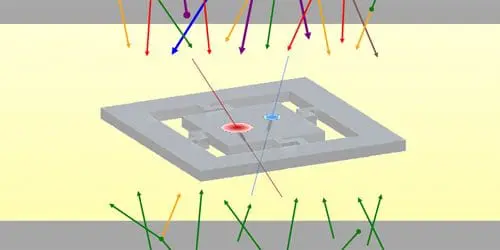
With their delicate quantum states, superconducting quantum computers are even more sensitive to background radiation than classical computers. An energetic particle or photon need only strike the computer’s substrate to cause multiple qubits to lose coherence. To understand the impact of this effect, researchers have used a detector resembling a quantum circuit to characterize the spectrum of naturally occurring background radiation in the circuits’ environment.
The superconducting quantum circuit is typically formed from a few hundred nanometer thick film, which presents a small target for photons and energetic particles that are far more likely to strike the thick underlying substrate. However, the energy deposited in the substrate can generate particles that propagate to the superconducting layer, where they can break up the superconducting electron pairs and cause the qubits to decohere.
Fowler and colleagues used a radiation model to predict the effect of both cosmic and terrestrial radiation sources on a circuit. They then validated this model with measurements made using thermal kinetic inductance detectors (TKIDs). A TKID measures the energy of incoming particles through their effect on the inductance of a superconductor, which changes because of the breakup of electron pairs – the same phenomenon causing decoherence in a superconducting qubit.
By fabricating their TKIDs on substrates similar to those used in quantum circuits, they determined the rate of energy deposition in a typical device, finding good agreement with the model’s predictions. The validated model will guide researchers in designing quantum computers that are less sensitive to background radiation, the researchers say.
Understanding the Impact of Background Radiation
Understanding the Impact of Background Radiation
Classical computers have a well-known vulnerability to background radiation, such as that produced by cosmic rays, which can cause undesired bit flips. Superconducting quantum computers, with their delicate quantum states, are even more sensitive. An energetic particle or photon need only strike the computer’s substrate to cause multiple qubits to lose coherence.
To understand the impact of this effect, researchers have used a detector resembling a quantum circuit to characterize the spectrum of naturally occurring background radiation in the circuits’ environment. This has involved fabricating thermal kinetic inductance detectors (TKIDs) on substrates similar to those used in quantum circuits and measuring the energy deposition rate in these devices.
The results of this research have shown that the validated model can predict the effect of both cosmic and terrestrial radiation sources on a circuit, providing valuable insights for researchers designing quantum computers that are less sensitive to background radiation. By understanding the impact of background radiation, researchers can develop strategies to mitigate its effects and improve the performance of superconducting quantum computers.
The Role of Radiation Models in Quantum Computing
Radiation models have played a crucial role in understanding the impact of background radiation on superconducting quantum computers. Researchers have used these models to predict the effect of both cosmic and terrestrial radiation sources on a circuit, providing valuable insights for researchers designing quantum computers that are less sensitive to background radiation.
The validated model developed by Fowler and colleagues has been shown to accurately predict the energy deposition rate in a typical device, finding good agreement with measurements made using thermal kinetic inductance detectors (TKIDs). This has provided a powerful tool for researchers to design quantum computers that are less sensitive to background radiation, improving their performance and reliability.
The use of radiation models in quantum computing is expected to continue to play an important role in developing this technology. By understanding the impact of background radiation, researchers can develop strategies to mitigate its effects and improve the performance of superconducting quantum computers.
The Importance of Experimental Validation
The Importance of Experimental Validation
Experimental validation has played a crucial role in researching background radiation and superconducting quantum computers. Researchers have used thermal kinetic inductance detectors (TKIDs) to measure the energy deposition rate in devices similar to those used in quantum circuits, providing valuable insights for researchers designing quantum computers less sensitive to background radiation.
The experimental validation of the radiation model developed by Fowler and colleagues is crucial in understanding the impact of background radiation on superconducting quantum computers. By measuring the energy deposition rate in devices similar to those used in quantum circuits, researchers have validated the predictions made by the model, providing a powerful tool for designing quantum computers that are less sensitive to background radiation.
The importance of experimental validation cannot be overstated in this research area. By combining theoretical models with experimental measurements, researchers can gain a deeper understanding of the impact of background radiation on superconducting quantum computers and develop strategies to mitigate its effects.
The Future of Superconducting Quantum Computing
Superconducting quantum computing is an exciting area of research that has the potential to revolutionize the field of quantum computing. Researchers can improve their performance and reliability by developing quantum computers that are less sensitive to background radiation, making them more suitable for a wide range of applications.
The validated model developed by Fowler and colleagues provides a powerful tool for researchers designing quantum computers less sensitive to background radiation. By understanding the impact of background radiation, researchers can develop strategies to mitigate its effects and improve the performance of superconducting quantum computers.
The future of superconducting quantum computing looks bright, with many research groups worldwide actively working on this technology. The development of more robust and reliable quantum computers will be crucial in realizing this technology’s full potential and making it suitable for a wide range of applications.
Publication Date: 2024-11-12
Authors: Marric Stephens
Source: Physics
DOI: https://doi.org/10.1103/physics.17.s140