

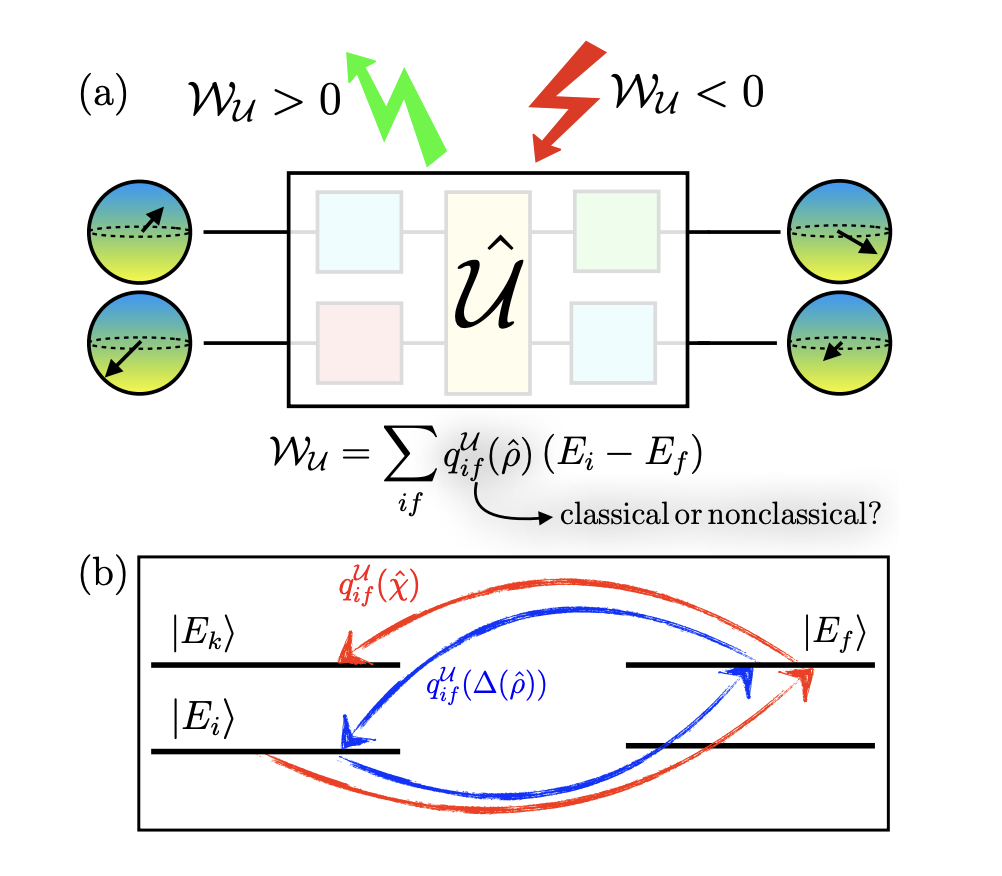
The fundamental link between quantum coherence and energy transfer presents a long-standing challenge in physics, and recent research sheds new light on how this relationship manifests in quantum computation. Francesco Perciavalle, Nicola Lo Gullo, and Francesco Plastina, all from the Dipartimento di Fisica at the Università della Calabria, investigate the surprising possibility of extracting work from quantum systems even when individual steps appear to gain energy. Their work establishes a theoretical framework to quantify coherence’s contribution to work extraction during quantum processes, revealing specific conditions under which this “anomalous” energy exchange occurs in qubits undergoing complex gate operations. By analysing the underlying quasiprobabilistic structure of quantum circuits, the team demonstrates a way to connect the thermodynamic behaviour of entire circuits to the behaviour of their individual components, offering a new understanding of the thermodynamics of computation and a systematic approach to evaluating the energy efficiency of quantum designs.
Quantum Work, Fluctuation Theorems, Thermodynamics
The negativity of quasiprobability distributions signals non-classicality and is often linked to enhanced performance in quantum technologies. Measuring work statistics and reconstructing the underlying quantum state are crucial for both theoretical understanding and experimental verification. The Kirkwood-Dirac (KD) distribution is gaining prominence, offering advantages in certain scenarios due to its non-positivity. The Margenau-Hill distribution provides an alternative analytical approach. Key concepts include Jarzynski’s equality, fluctuation theorems, and various quasiprobability distributions like the Wigner function, KD distribution, Margenau-Hill distribution, and Husimi Q-function.
Researchers also investigate state reconstruction, weak measurements, and algorithms like the Solovay-Kitaev algorithm. Understanding non-positivity, quantum batteries, and quantum engines are also central themes. The Wigner function, while widely used, can be difficult to interpret due to its negativity. The KD distribution is highlighted as a promising alternative for analyzing work statistics, with its non-positivity seen as a resource for enhancing performance. Experimental and computational aspects, including reconstruction of work distributions, quantum state tomography, interferometry, and quantum computer simulations, are also explored.
Recent research directions focus on exploring quasiprobability distributions, developing new distributions with improved properties, investigating the connection between non-positivity and performance, and applying these concepts to quantum batteries, engines, and refrigerators. In summary, this compilation provides a comprehensive overview of a cutting-edge field, highlighting the importance of quasiprobability distributions for understanding and manipulating quantum systems, with a particular focus on their potential applications in quantum technologies. The emphasis on the Kirkwood-Dirac distribution suggests it is a particularly active area of investigation, and the inclusion of computational and experimental aspects underscores the growing maturity of the field.
Quantum Coherence Drives Anomalous Work Extraction
This work presents a framework for quantifying the contribution of quantum coherence to work extraction during cyclic processes, focusing on scenarios where work can be extracted even when individual processes involve energy gain. Researchers developed a method using Kirkwood-Dirac quasiprobability distributions to analyze work statistics in quantum systems, specifically qubits undergoing sequences of gate operations. The team identified conditions under which these anomalous work exchanges occur, demonstrating a link between the quasiprobabilistic structure of complex quantum circuits and the work statistics of their individual gates. The study establishes a way to decompose quasiprobabilities into contributions from individual gates within a larger circuit, allowing for detailed analysis of how each component influences work extraction.
Applying this decomposition to two-qubit circuits, scientists observed that the quasiprobabilities simplify when the initial state is factorized, and remain simplified even with initial entanglement for certain gates. Analysis of a representative two-qubit circuit revealed how the decomposition of quasiprobabilities and the properties of individual gates contribute to the overall thermodynamic behaviour. Researchers demonstrated that quasiprobabilities can be split into population and coherent parts, where the population part always contributes positively to work extraction, while the coherent part, arising from quantum coherence, can be negative or complex. This negativity, termed a negative Margenau-Hill quasiprobability, signals the presence of anomalous processes. The team showed that these anomalous processes can contribute to work extraction in a counterintuitive manner, even when individual steps appear to gain energy. The framework allows for quantifying the role of coherence in the thermodynamics of computation and provides a systematic approach to studying the thermodynamic relevance of specific quantum circuits.
Quantum Coherence Drives Work Extraction Thermodynamics
This work presents a new framework for analyzing the thermodynamics of quantum circuits, grounded in the mathematical formalism of Kirkwood-Dirac quasiprobabilities. Researchers successfully demonstrate how to quantify the contribution of quantum coherence to work extraction during cyclic processes, identifying conditions under which work can be extracted even from processes that individually appear energetically unfavorable. The method involves decomposing the quasiprobabilities of entire circuits into those of their constituent gates, establishing a clear link between the thermodynamic behaviour of complex circuits and the properties of their fundamental components. Notably, the team found that certain gate sequences, such as the HTH gate for single qubits, exhibit genuinely nonclassical behaviour not present in the individual gates themselves, revealing anomalous thermodynamic features.
Analysis of two-qubit gates, including the CNOT gate, showed that these gates often behave classically, but entanglement can introduce quantum features requiring specific investigation. While the current analysis focuses on specific gate examples, the researchers establish a foundation for investigating quantum thermodynamics within quantum computation using quasiprobability theory, with potential applicability to broader studies of nonclassical thermodynamic phenomena. The authors acknowledge that further research is needed to fully explore the implications of this framework for more complex circuits and many-body quantum systems.
🗞 Quantum Coherence and Anomalous Work Extraction in Qubit Gate Dynamics
🧠 ArXiv: https://arxiv.org/abs/2509.09320


