Quantum information relies on protecting encoded data from errors, and researchers continually seek more robust methods for manipulating quantum bits, or qubits. Eric Huang from NIST/University of Maryland, Pierre-Gabriel Rozon from McGill University, and Arpit Dua from Virginia Tech, alongside Sarang Gopalakrishnan from Princeton University and Michael Gullans from NIST/University of Maryland, demonstrate a significant advance in this field by identifying a phase where continuous, precise control of logical qubits is possible. Their work reveals a region of stable operation within quantum stabilizer codes, specifically the surface code, where logical unitaries can be tuned continuously using transversal operations and decoding. This achievement is crucial because it allows for exponentially suppressed errors in logical rotations, dramatically reducing the overhead required for complex quantum computations like simulations that demand numerous small-angle adjustments, and represents a step towards more practical and scalable quantum computers.
Surface Code Logical Dephasing Correction Policy
Refining Error Correction for Fault-Tolerant Computation
Scientists are refining techniques to protect quantum information from errors, a crucial step towards building practical quantum computers. This research focuses on improving error correction within the surface code, a promising architecture for fault-tolerant computation. The team developed a strategy to minimize errors affecting the phase of quantum information, known as logical dephasing, by carefully controlling how qubits are rotated, combining surface codes with a policy optimization technique where the system learns the best way to apply rotations based on observed error patterns. The core of this work lies in understanding concepts like the syndrome, which reveals the type of errors that have occurred, and the logical qubit, which represents the encoded quantum information.
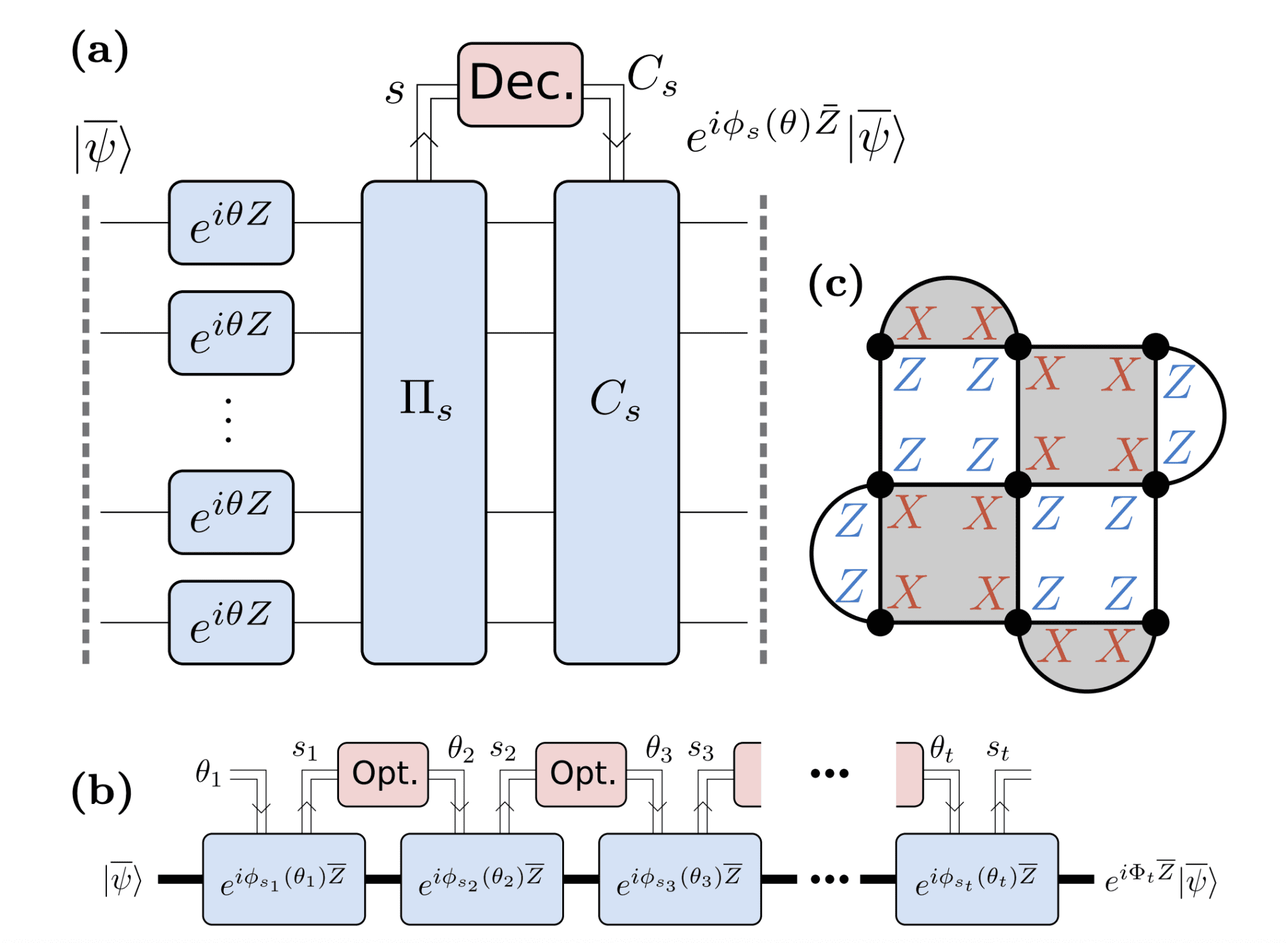
The team uses a ‘policy’, a set of actions applied based on the syndrome, to minimize logical dephasing, refining this policy through a process similar to reinforcement learning. Advanced mathematical tools, including tensor networks, are employed to accurately model how errors transform quantum information. The research involved developing an efficient algorithm to simulate the effects of both intentional rotations and unintentional dephasing, allowing the team to calculate the logical quantum channel, which describes how quantum information is transformed during error correction. They then used value iteration, a dynamic programming technique, to find the optimal policy for applying rotations, demonstrating that this approach effectively minimizes errors, even in the presence of noise. By developing a more robust error correction scheme, this research paves the way for more reliable and scalable quantum computation, demonstrating the potential for building quantum computers that can perform complex calculations without being overwhelmed by errors.
Tunable Logical Unitaries Within Surface Codes
Controlling Tunable Logical Unitaries in Surface Codes
Scientists have achieved a significant advance in fault-tolerant quantum computing by demonstrating a method for precisely controlling logical qubits within the surface code. This breakthrough enables the creation of continuously tunable logical unitaries, essential for performing complex quantum algorithms, allowing for manipulations of logical qubits with exponentially suppressed errors. The team designed a protocol for performing continuous-angle logical rotations, particularly beneficial for applications requiring numerous small-angle rotations, such as quantum simulation. By applying coherent rotations to a specific type of quantum code and measuring the resulting errors, the team could implement a logical channel that performs a known rotation, remaining robust even in the presence of errors due to the inherent error-correcting properties of the surface code.
Detailed analysis focused on the impact of dephasing, a common source of errors in quantum systems, modeled as an unintentional loss of phase information during coherent rotations. Using advanced mathematical tools, including tensor networks, they calculated the resulting logical dephasing rates and rotation angles, demonstrating that a stable logical coherent phase exists within a specific range of physical parameters, where the mean relative dephasing approaches zero as the code size increases. This breakthrough delivers a pathway towards practical, fault-tolerant quantum computation by mitigating the detrimental effects of dephasing and enabling more complex quantum algorithms, representing a crucial step towards building quantum computers that can solve problems beyond the reach of classical computers.
Tunable Logical Unitaries with Exponentially Decreasing Infidelity
Demonstrating Robust Gates with Exponentially Decreasing Infidelity
Researchers have demonstrated a robust operational phase within the surface code, enabling continuously tunable logical unitaries through transversal gates and decoding techniques. This achievement addresses a key challenge in fault-tolerant quantum computing, where manipulating logical qubits universally requires methods beyond simple transversal operations, achieving infidelity that diminishes exponentially with increasing code size. The protocol introduces a low-cost adaptive method for implementing tunable, fault-tolerant gates using only transversal operations and syndrome measurements, avoiding the need for complex postselection procedures, and is particularly beneficial for applications requiring numerous small-angle rotations, such as quantum simulation. The team acknowledges a limitation in the protocol’s scalability, noting that the range of reachable logical rotation angles decreases as the code size increases, making it most advantageous for algorithms where many small rotations are required. Future research directions include assessing performance with realistic noise models and exploring applications to more efficient quantum codes, ultimately aiming to demonstrate this protocol experimentally, paving the way for practical, fault-tolerant quantum computation.
🗞 A robust phase of continuous transversal gates in quantum stabilizer codes
🧠 ArXiv: https://arxiv.org/abs/2510.01319