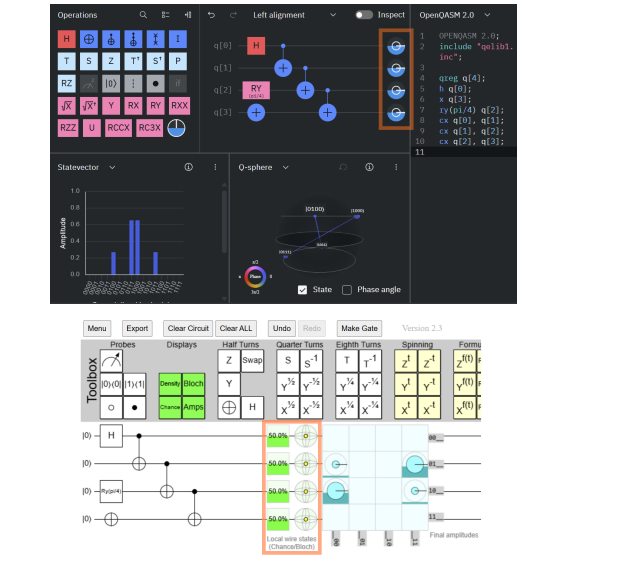
Visualizing the complex behaviour of quantum circuits presents a significant challenge, particularly for those learning the fundamentals of quantum computing. Michael J. McGuffin and Jean-Marc Robert, from École de technologie supérieure, alongside their colleagues, address this issue by developing new methods to display quantum information more effectively. Their work introduces two innovative visual approaches, designed to provide a more complete picture of how quantum circuits manipulate information, than existing methods allow. The team’s “state vector difference highlighting” technique illustrates changes in quantum amplitudes, while a novel “half-matrix” visualization displays relationships between pairs of qubits, offering a clearer understanding of circuit operations and quantum entanglement. This research represents a substantial step towards making quantum computing more accessible and intuitive for students and researchers alike.
Visualizing Complexity in Quantum Circuit Design
This research addresses the challenge of effectively visualizing increasingly complex quantum circuits, hindering debugging and analysis. To overcome these limitations, the team developed MuqcsCraft, a new web-based graphical simulator and visualizer. This tool allows users to simulate quantum circuits and observe their behavior through an interactive graphical representation, utilizing matrix reordering borrowed from established methods in table and network visualization to improve clarity. MuqcsCraft also utilizes glyphs, visual symbols representing complex data and relationships within the circuit, and is designed to handle larger circuits than many existing methods.
MuqcsCraft is implemented as a web application, accessible from any device with a web browser, and utilizes a JavaScript library called Muqcs. js for core functionality. This work contributes to the field of quantum computing visualization, aiming to make these systems more accessible and understandable to researchers and developers.
Visualizing Quantum State Evolution and Correlations
This study introduces two novel visualization techniques to enhance understanding of quantum circuits, implemented in the open-source software MuqcsCraft. Researchers moved beyond traditional methods by visualizing the complete state vector and illustrating how amplitudes change layer-by-layer under the influence of quantum gates. This “state vector difference highlighting” uses a carefully chosen set of colors, arrows, and symbols to clearly depict the effect of gates like Hadamard and SWAP, even with complex combinations of control and anticontrol qubits. Complementing this, the team developed a triangular “half-matrix” visualization to display pairwise relationships between qubits, revealing patterns of entanglement and correlation not visible in single-qubit displays.
MuqcsCraft is a web-based application allowing users to define and visualize circuits without software installation. The methodology emphasizes scalability; the half-matrix’s 2D structure avoids the difficulties of visualizing extensions of the Bloch sphere to multiple qubits. Furthermore, the system employs “wrapping” to manage the vertical space required for state vector visualization, making it more scalable than existing tools. The team provides the complete source code, facilitating further development and adaptation by other researchers. This work represents a significant step toward more intuitive and effective tools for understanding and designing quantum algorithms.
State Vector Difference Highlighting Reveals Quantum Evolution
The research team developed novel visual approaches to represent quantum circuit states, addressing the limitations of existing methods that provide incomplete information. Their work centers on a new visualization technique called “state vector difference highlighting”, which illustrates how quantum amplitudes change with each gate applied to the circuit. This method displays the complete state vector, allowing users to track the evolution of probabilities across different quantum states. Experiments demonstrate that the technique effectively elucidates the impact of common gates, including Hadamard and SWAP, even with complex combinations of control and anticontrol qubits.
For example, the team showed how Hadamard gates distribute a single non-zero amplitude across multiple base states, and how these distributions can be cancelled out by subsequent gates. Analysis reveals that a Hadamard gate transforms a probability pair into a specific distribution, demonstrating the even distribution of probability when one value equals zero. Further analysis focused on SWAP gates, which exchange amplitudes between qubits, visualized by showing how amplitudes are swapped between corresponding base states. For a four-qubit system, the visualization displays 16 base states, and the researchers demonstrated how the SWAP gate affects these states depending on the qubits involved. The team also established a definition of “visual universality”, demonstrating that their set of visual primitives can represent any single-qubit unitary gate with arbitrary control and anticontrol qubits. This work delivers a powerful new tool for understanding and visualizing quantum circuits, enabling more intuitive exploration of quantum computation.
Visualizing Quantum Circuits and Entanglement Patterns
This research presents two new visualization techniques designed to improve understanding of quantum circuits. The team developed ‘state vector difference highlighting’, a method that illustrates how gate operations change the quantum state of qubits using color, arrows, and symbols. Complementing this, they introduced a ‘triangular half-matrix’ visualization to display pairwise relationships between qubits, revealing patterns of entanglement and correlation not readily apparent in standard displays of individual qubit states. These techniques were implemented in MuqcsCraft, an open-source web-based simulator allowing users to design and visualize circuits without software installation.
The researchers demonstrate that their approach provides a more complete picture of quantum circuit behavior than existing methods, offering insights into the effects of various gates and the relationships between qubits. The authors acknowledge that scalability to circuits with a large number of qubits remains a challenge, as the half-matrix visualization’s area grows quadratically with the number of qubits. Future work may focus on adapting the techniques to handle larger circuits, potentially by focusing on subsets of qubits or by developing methods to cluster and display only the most relevant qubit pairs. Extending the visualization to illustrate the effects of more complex multi-qubit gates and higher-level algorithm blocks is also planned.
🗞 Visualizing Quantum Circuits: State Vector Difference Highlighting and the Half-Matrix
🧠 ArXiv: https://arxiv.org/abs/2510.00895