The quest for quantum supremacy has long fascinated scientists and engineers. In recent years, researchers have proposed various quantum learning algorithms that may offer potential quantum advantages over their classical counterparts. However, most of these algorithms either rely on complexity assumptions or are limited by noisy near-term devices. To address this problem, a team of researchers constructed a classification problem defined by a noiseless constant-depth quantum circuit and proved that any classical neural network with bounded connectivity requires logarithmic depth to output correctly.
Can Quantum Machine Learning Outperform Classical Algorithms?
The quest to harness the power of quantum computing for machine learning has led researchers to explore the intersection of these two fields. In recent years, various quantum learning algorithms have been proposed, promising potential advantages over their classical counterparts. However, most of these algorithms rely on complexity assumptions or are limited by the capabilities of noisy near-term quantum devices.
One approach to overcome these limitations is to focus on shallow quantum circuits, which can be implemented using current technology. These circuits consist of a constant number of layers, making them more feasible for experimental implementation. Variational quantum algorithms, for instance, train a parameterized shallow quantum circuit with classical optimizers. While these algorithms are experiment-friendly, they lack rigorous proof of their advantages over classical algorithms.
The question remains: can we rigorously prove an unconditional quantum advantage in machine learning feasible for near-term quantum devices? To address this challenge, researchers have turned to the study of quantum-classical representation power separations.
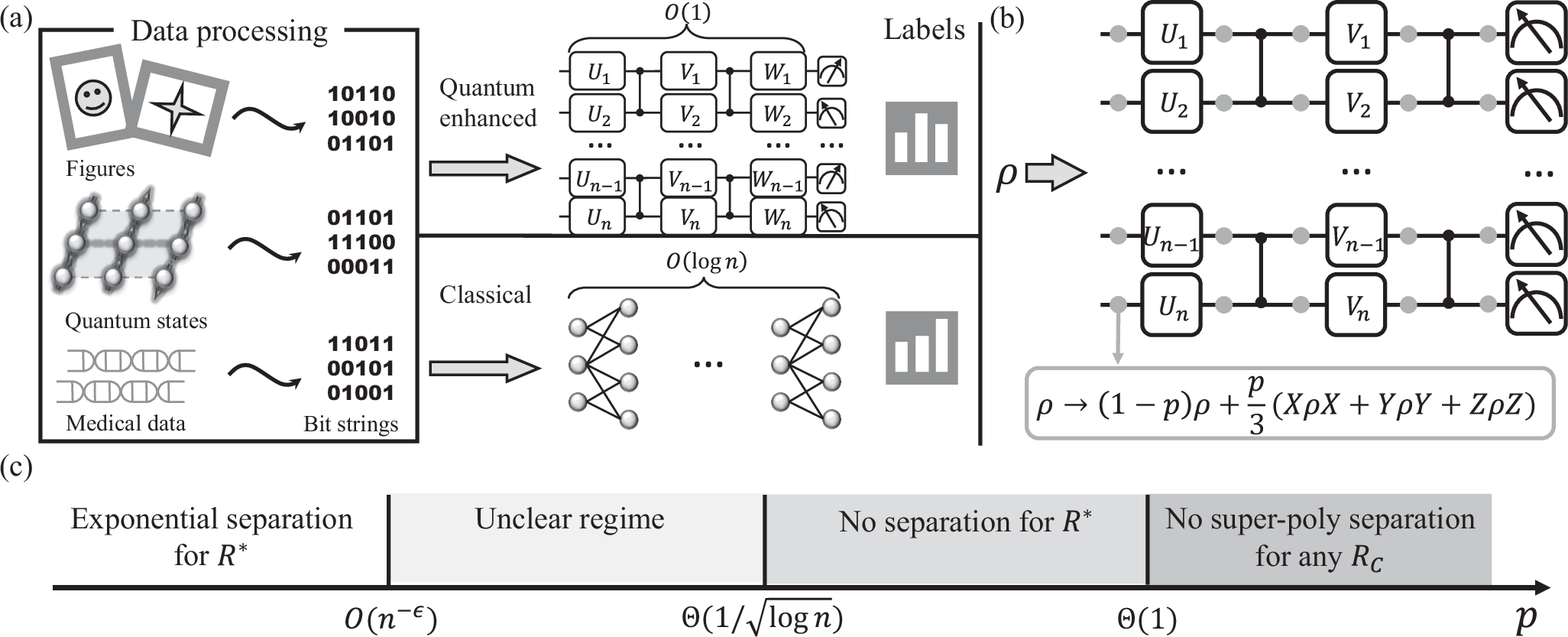
A crucial problem in quantum machine learning is finding quantum-classical separations between learning models. However, rigorous and unconditional separations are lacking for supervised learning. In a groundbreaking study, researchers Zhihan Zhang, Weiyuan Gong, Weikang Li, DongLing Deng, and their colleagues have constructed a classification problem defined by a noiseless constant-depth (shallow) quantum circuit.
The team rigorously proved that any classical neural network with bounded connectivity requires logarithmic depth to output correctly with a larger-than-exponentially small probability. This unconditional near-optimal quantum-classical representation power separation originates from the quantum nonlocality property that distinguishes quantum circuits from their classical counterparts.
The researchers further characterized the noise regimes for demonstrating such a separation on near-term quantum devices under the depolarization noise model. They showed that, in the presence of noise, the quantum-classical representation power separation can be preserved or destroyed depending on the noise strength.
In addition, the team proved that no super-polynomial classical-quantum separation exists for any classification task defined by Clifford circuits independent of the structures of the circuits that specify the learning models. This result has significant implications for the development of machine learning algorithms using shallow quantum circuits.
The study’s findings have far-reaching implications for the field of quantum machine learning. The results demonstrate that, under certain conditions, shallow quantum circuits can exhibit a genuine advantage over classical algorithms. This knowledge can inform the design of new machine learning algorithms and experimental protocols.
Moreover, the study highlights the importance of understanding the noise regimes in which quantum-classical separations can be observed or destroyed. This knowledge is crucial for developing fault-tolerant and deep quantum circuits, which are essential for scaling up quantum computing capabilities.
As researchers continue to explore the intersection of machine learning and quantum physics, this study’s findings will serve as a foundation for future work. The development of rigorous and unconditional quantum-classical representation power separations will be critical in establishing the potential advantages of quantum machine learning over classical algorithms.
In conclusion, the study by Zhihan Zhang, Weiyuan Gong, Weikang Li, DongLing Deng, and their colleagues has made significant progress in understanding the quantum-classical representation power separation for shallow circuit-based learning. The results demonstrate that, under certain conditions, shallow quantum circuits can exhibit a genuine advantage over classical algorithms.
The study’s findings have far-reaching implications for the development of machine learning algorithms using shallow quantum circuits and highlight the importance of understanding the noise regimes in which quantum-classical separations can be observed or destroyed. As researchers continue to explore the intersection of machine learning and quantum physics, this study’s findings will serve as a foundation for future work.
Publication details: “Quantum-classical separations in shallow-circuit-based learning with and without noises”
Publication Date: 2024-08-29
Authors: Zhihan Zhang, Weiyuan Gong, Weikang Li, Dong-Ling Deng, et al.
Source: Communications Physics
DOI: https://doi.org/10.1038/s42005-024-01783-7