Understanding strong correlation, a key challenge in accurately describing chemical behaviour, remains a significant hurdle in designing new materials and molecules. Arpan Choudhury, Sonaldeep Halder, Rahul Maitra, and Debashree Ghosh, from institutions including the Indian Association for the Cultivation of Science and the Indian Institute of Technology Bombay, present a new approach to tackle this problem. Their research introduces a method that breaks down complex systems into smaller, manageable fragments, builds entanglement between them, and then consolidates the information to create a comprehensive understanding of electronic correlation. This innovative scheme demonstrates high accuracy and flexibility in modelling strongly correlated systems, potentially unlocking new possibilities for rational chemical design and materials discovery by efficiently capturing both static and dynamic correlation effects.
Quantum Chemistry with Shallow Depth Circuits
Recent research focuses on advancements and challenges in applying quantum computing to solve problems in quantum chemistry, specifically calculating molecular energies and properties. Scientists are exploring various approaches to overcome limitations of current quantum computers, such as limited qubit count and noise, with a major goal of achieving accurate results with shallow-depth quantum circuits, which are less susceptible to errors. Variational Quantum Algorithms (VQAs), such as the Variational Quantum Eigensolver (VQE), are a prominent approach, employing a hybrid quantum-classical strategy where a quantum computer prepares a trial wave function and a classical computer optimizes its parameters. The design of this wave function, called an ansatz, is crucial for both accuracy and efficiency, with researchers exploring chemistry-inspired and hardware-efficient designs, as well as dynamic ansatz that adapt during optimization.
Fragment-based approaches and embedding methods offer further improvements by breaking down large molecules into smaller fragments or treating critical parts with high-level quantum calculations and the rest with lower-level calculations, reducing computational cost. Localized quantum chemistry focuses on localized orbitals to reduce the number of qubits needed, and efficient state preparation techniques like adiabatic state preparation and symmetry exploitation prove beneficial. Several software packages, including Molpro, PySCF, and Qiskit, are used for these quantum chemistry and quantum computing calculations. Ultimately, quantum computing holds the potential to revolutionize quantum chemistry, but significant challenges remain, including developing accurate and trainable ansatz, addressing the barren plateau problem, and reducing computational cost through fragment-based approaches and efficient state preparation.
Bi-folded Ansatz for Correlated Molecular Systems
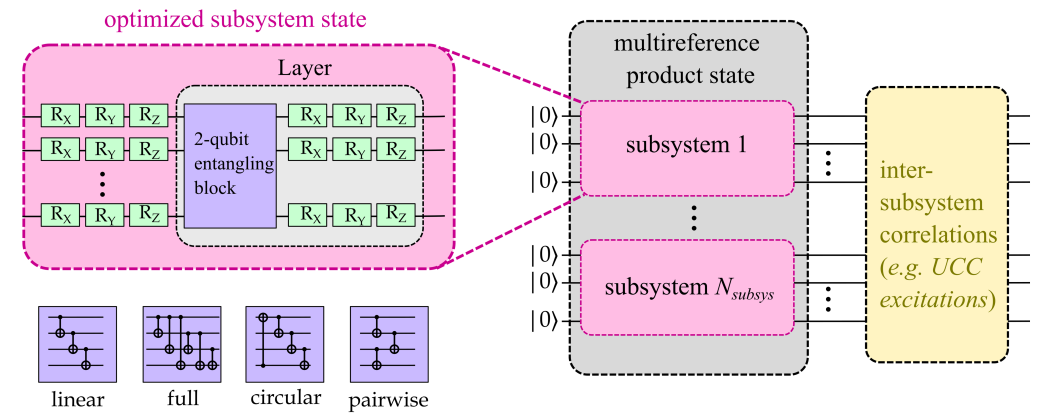
Scientists have developed a novel bi-folded approach to simulate strongly correlated molecular systems, overcoming limitations inherent in traditional variational quantum algorithms. The study pioneers a method that decomposes complex molecular problems into smaller, more manageable subsystems, enabling efficient construction of multireference states while adhering to the constraints of current quantum hardware. Researchers initially form a product state composed of individual entangled states, each generated using a shallow-depth Hardware Efficient Ansatz (HEA) applied to specific molecular sub-parts, guided by problem-inspired decomposition based on orbital symmetries or localizations. This two-step process offers considerable flexibility in ansatz design, allowing researchers to treat subsystems separately within restricted qubit spaces and span the full Hilbert space through a multireference product state (MRPS).
The resulting MRPS proves crucial for accurately describing chemical phenomena such as bond breaking, where single-reference ansatz often fall short. Furthermore, the subsystem-wise optimization allows for the inclusion of both static and dynamic correlation through separate ansatz in disconnected optimization cycles, reducing the exponential complexity of calculations for large chemical systems. This approach achieves ground state energies within chemical accuracy, less than or equal to 1 kcal/mol.
Entangled Subsystems Simulate Correlated Quantum Systems
Scientists have developed a new computational scheme to accurately simulate the behavior of strongly correlated quantum systems, a crucial step towards designing novel materials and chemical processes. This work addresses a significant challenge in quantum chemistry, where accurately capturing the complex interactions between electrons has remained elusive. The team’s approach centers on a method of problem decomposition, strategically breaking down a complex system into smaller, more manageable subsystems, allowing for efficient construction of a multireference state. Researchers then incorporated inter-subsystem correlations using an adaptive algorithm, building upon the initial multireference product state without disrupting the optimized states within each fragment, effectively “stitching” the subsystems together to recover the complete wavefunction of the molecule. This approach demonstrates the flexibility and robustness of the method, successfully decomposing systems into multiple subsystems and mapping each onto qubits for parallel processing, resulting in an effective Hamiltonian for each subsystem.
Fragment Entanglement Accurately Models Molecular Correlation
This research presents a novel computational strategy for accurately modelling strong electronic correlation in complex molecular systems, a longstanding challenge in quantum chemistry. The team developed a two-stage approach that first decomposes a molecule into chemically intuitive fragments, then uses specialized algorithms to build entanglement within and between these fragments, efficiently constructing highly accurate representations of multireference states. The researchers demonstrate the effectiveness of their approach by achieving chemical accuracy in calculations of potential energy curves, dissociation energies, and reaction barriers, proving both accurate and efficient, particularly when employing qubit-based adaptations of the algorithms, making it well-suited for implementation on near-term quantum devices.
🗞 Fragment, Entangle, and Consolidate: Strong Correlation through Bi-fold Quantum Circuits
🧠 ArXiv: https://arxiv.org/abs/2510.15678