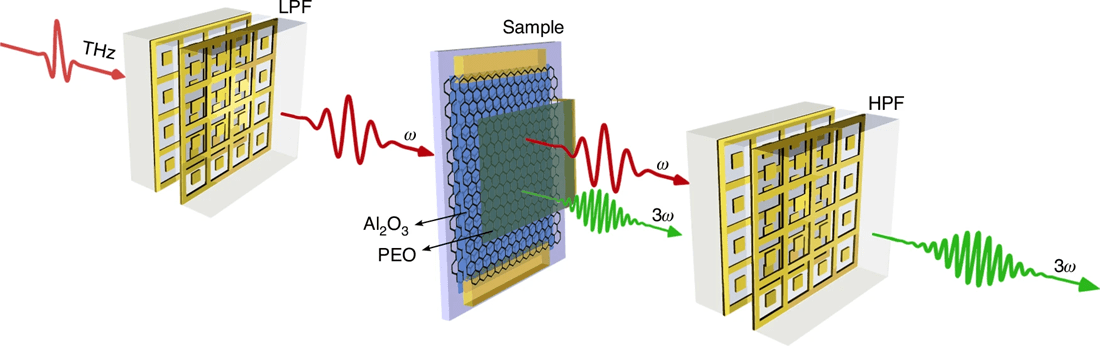
Pursuing faster and more efficient wireless communication technologies has led researchers to explore the untapped potential of terahertz waves, a region of the electromagnetic spectrum nestled in the far-infrared range. By harnessing the unique properties of graphene, a quantum material composed of a single layer of carbon atoms, scientists have made strides in enhancing frequency conversion of these waves, paving the way for developing high-speed wireless communication and signal processing systems.
The innovative methods developed by a team of researchers from the University of Ottawa have demonstrated the ability to upconvert electromagnetic signals to higher oscillation frequencies, effectively bridging the gap between GHz electronics and THz photonics, and unlocking new possibilities for 6G technologies and beyond. With terahertz technologies poised to play a critical role in various fields, including health, communication, security, and quality control, this research marks a crucial step forward in improving the efficiency of THz frequency converters, and has significant implications for the future of communication systems.
Introduction to Terahertz Waves and Their Applications
Terahertz (THz) waves are a type of electromagnetic radiation located in the far-infrared region of the electromagnetic spectrum. These waves have frequencies between 100 GHz and 10 THz, placing them between microwaves and infrared light on the electromagnetic spectrum. Due to their unique properties, THz waves can be used for non-invasive imaging through opaque materials, making them suitable for security and quality control applications. Additionally, THz waves hold great promise for wireless communication, particularly in the development of high-speed wireless communication and signal processing systems for 6G technologies and beyond.
The potential of THz waves is vast, but their application is hindered by the difficulty in generating and manipulating these waves efficiently. Current technologies struggle to convert electromagnetic signals from lower frequencies (such as those used in conventional electronics) to the higher frequencies of THz waves. This conversion process, known as frequency conversion, is essential for bridging the gap between GHz electronics and THz photonics. Researchers have been exploring various materials and methods to enhance this conversion efficiency, with a focus on nonlinear optics – the study of how light interacts with matter in ways that change its frequency or phase.
Recent advances in THz nonlinear optics are crucial for the development of high-speed wireless communication systems. The ability to efficiently convert electromagnetic signals to higher frequencies would enable faster data transfer rates and more efficient signal processing, which are key requirements for next-generation communication technologies like 6G. To achieve this, researchers have been investigating innovative materials and techniques that can enhance THz nonlinearities, thereby improving the efficiency of frequency conversion.
Harnessing Graphene for Enhanced Terahertz Nonlinearities
Graphene, a quantum material made of a single layer of carbon atoms, has emerged as a promising candidate for enhancing THz nonlinearities. Its unique optical properties make it an attractive material for integrating into devices aimed at signal processing and communication applications. Previous studies combining THz light with graphene have primarily focused on fundamental light-matter interactions, often examining the effect of a single parameter in the experiment. However, these efforts resulted in extremely weak nonlinear effects, limiting their practical application.
To overcome this limitation, researchers from the University of Ottawa, led by Associate Professor Jean-Michel Ménard, have developed innovative methods to enhance frequency conversion of THz waves in graphene-based structures. By combining multiple approaches, they have successfully leveraged graphene’s unique properties to achieve significant enhancements in nonlinear effects. This breakthrough is crucial for developing devices capable of upconverting electromagnetic signals to higher oscillation frequencies, effectively bridging the gap between GHz electronics and THz photonics.
The research, published in Light: Science & Applications, demonstrates the potential of graphene-based devices for multi-spectral THz applications, particularly in the future of communication systems like 6G. The innovative strategies developed by Professor Ménard and his team offer a pathway to improving the efficiency of THz frequency converters, which is a critical aspect for high-speed wireless communication and signal processing systems. Furthermore, their experimental platform and novel device architectures provide the possibility to explore a vast range of materials beyond graphene, potentially identifying new nonlinear optical mechanisms that could further enhance THz technologies.
Enhancing Terahertz Frequency Conversion Techniques
The development of efficient THz frequency conversion techniques is essential for integrating this technology into practical applications. Current research focuses on refining these techniques to enable efficient, chip-integrated nonlinear THz signal converters that will drive future communication systems. The work by Professor Ménard and his colleagues marks a crucial step forward in this direction, showcasing methods to leverage the unique optical properties of graphene and other materials for enhanced THz nonlinearities.
To achieve high-efficiency frequency conversion, researchers must carefully design and optimize device architectures. This involves understanding the complex interactions between THz waves and the material properties of graphene or other quantum materials used in these devices. By combining theoretical models with experimental approaches, scientists can identify optimal conditions for enhancing nonlinear effects, thereby improving the efficiency of THz frequency converters.
The potential applications of enhanced THz frequency conversion techniques are vast, ranging from wireless communication and signal processing to security screening and quality control. As researchers continue to develop and refine these technologies, they are poised to play a critical role in shaping the future of high-speed data transfer and signal processing, enabling faster, more efficient, and more reliable communication systems.
The rapid evolution of THz technologies is expected to significantly impact various fields, including health, communication, security, and quality control. As researchers continue to push the boundaries of what is possible with THz waves, they are exploring new materials, techniques, and applications that could further enhance the efficiency and versatility of these technologies.
External Link: Click Here For More