Holography takes a leap forward with the experimental realisation of Bell-state holograms, a new method for encoding images within the quantum properties of light. Qinmiao Chen, Guangzhou Geng, and Hong Liang, working with colleagues, demonstrate how meticulously designed metasurfaces, materials built from nanoscale structures, can generate and project these complex holographic patterns. The team achieves this by manipulating the polarisation of photons, encoding distinct images within entangled Bell states, and then reconstructing these images pixel by pixel using a novel technique called hologram tomography. This breakthrough unifies metasurface photonics with quantum state reconstruction, paving the way for significantly more secure and high-capacity communication, encryption, and advanced information processing using light.
Entangled Photons and Metasurface Holography
This research introduces a novel approach to holography by combining quantum imaging with metasurface technology. Scientists demonstrate a method to create holographic images using entangled photons and specially engineered materials called metasurfaces, potentially leading to enhanced resolution, improved security, and entirely new functionalities. The team successfully implemented a quantum holography scheme, leveraging the unique properties of entangled photons to reconstruct three-dimensional images. This technology could lead to the development of high-resolution, secure, and energy-efficient holographic displays, as well as novel applications in quantum communication, imaging, computing, and secure data storage. In essence, this research bridges the gap between quantum optics and metamaterials, paving the way for a new generation of holographic displays and quantum imaging technologies, harnessing the power of quantum entanglement for practical applications in imaging, communication, and information processing.
Dielectric Metasurface for Bell-State Hologram Generation
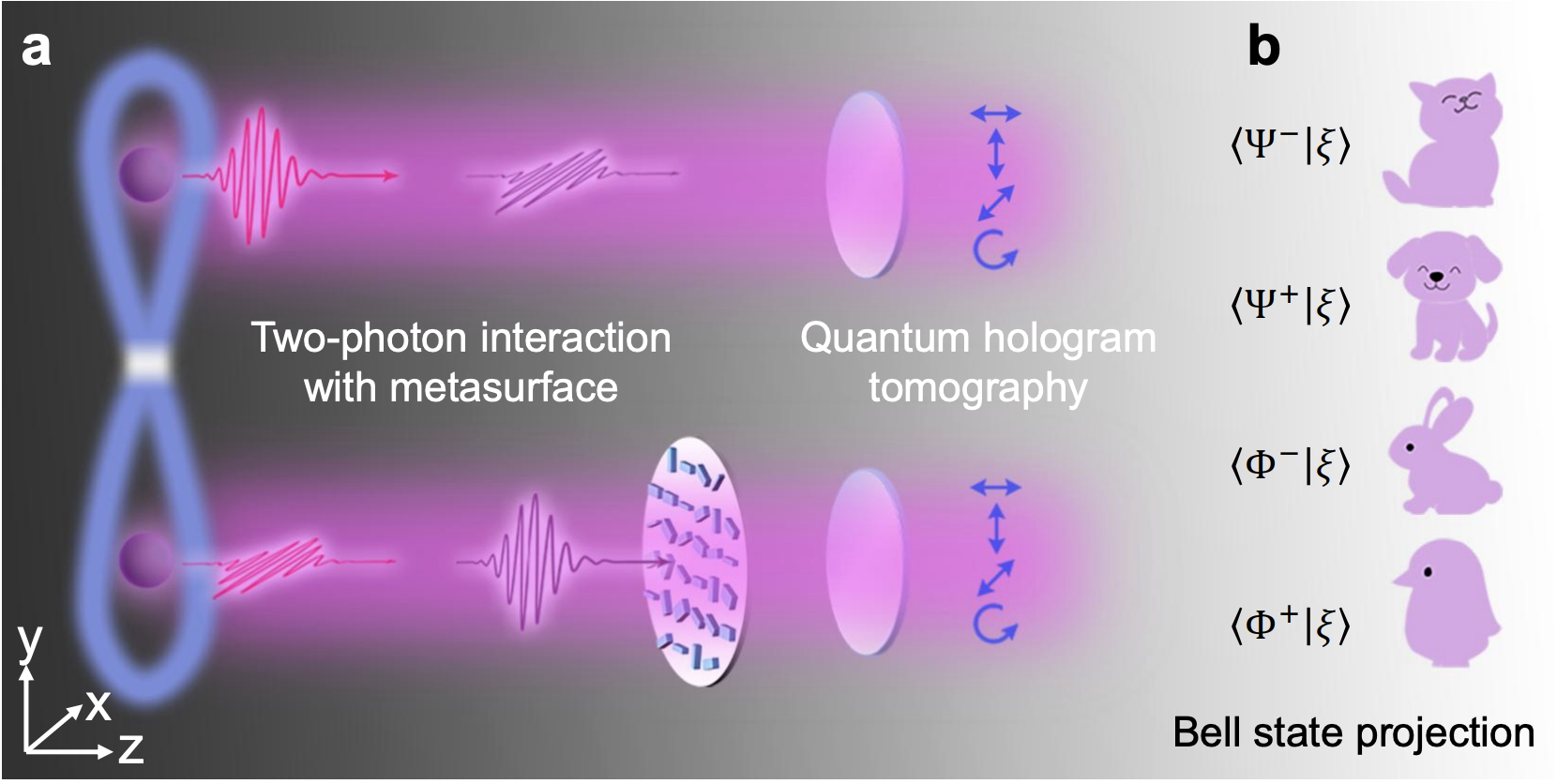
Scientists engineered a dielectric metasurface to generate Bell-state holograms, encoding holographic images within the polarization of photon pairs. This metasurface simultaneously controls polarization and wavefront, creating spatial modes dependent on both input and output polarization, effectively building the holographic pattern with a two-photon state. To fully characterize these holograms, researchers developed a quantum hologram tomography protocol, reconstructing the quantum hologram at the density-matrix level to reveal how holographic symbols are distributed across the two-photon state. This method employs a spatially resolved detection system, utilizing a camera to achieve pixel-by-pixel reconstruction of the density matrix. The study pioneered a method for quantifying contrast in these holograms, rescaling probabilities using a mathematical function as a “quantum contrast”, allowing the team to demonstrate contrast values for the holographic symbols “×”, “+”, and “=”. Simulations further validated the design and performance of the silicon nanopillars, establishing density-matrix holography as a powerful characterization technique and demonstrating Bell-state holograms as a new resource for high-dimensional quantum technologies.
Polarization Entanglement Creates Holographic Density Matrix
Scientists have achieved a breakthrough in holographic information storage by creating a system that encodes data onto the polarization of entangled photons. This work demonstrates the experimental realization of Bell-state holograms, where distinct holographic images are encoded within the different polarization states of photon pairs. A dielectric metasurface was designed and fabricated to generate spatial modes dependent on both input and output polarization, effectively creating a holographic pattern linked to the two-photon state. To fully characterize these holograms, researchers developed a technique called hologram tomography, enabling the reconstruction of the complete density matrix of the holographic state pixel by pixel.
The resulting density-matrix hologram reveals tailor-made holographic symbols attached to individual Bell states, with contrast built up between the different polarization components. Sixteen holographic images were recorded, allowing for detailed analysis of the encoded information, and measurements demonstrate how holographic sub-patterns appear and disappear based on the joint polarization projections of the entangled photons. The team reconstructed the pixel-resolved two-photon density matrix, analyzing data obtained from sixteen polarization-projected holographic images, and further analysis revealed that the metasurface encodes distinct holographic symbols into specific Bell components of the two-photon state. Quantitative analysis of the holographic quantum states reveals high fidelities, demonstrating the high quality of the encoded information and paving the way for high-dimensional communication, encryption, and information processing.
Bell-State Holography Enables Photonic Encoding
This research demonstrates a new approach to holography, termed Bell-state holography, where distinct holographic images are encoded onto different entangled states of light, known as Bell states. Scientists achieved this by designing a metasurface that manipulates the polarization of photons to link specific polarization states with unique spatial wavefronts, effectively creating holographic patterns conditioned on the quantum state of the photons. Unlike traditional optical methods, this technique utilizes holograms themselves as information carriers, significantly expanding the potential for high-dimensional photonic encoding. To fully characterize these complex holograms, the team developed a method called quantum hologram tomography, which reconstructs the hologram at the level of the density matrix, revealing the distribution of holographic symbols across the two-photon state. Experiments confirmed strong non-classical correlations, exceeding the classical limit, and demonstrated a visibility of over 90% in the reconstructed holograms.
🗞 Bell-State Quantum Holography with Metasurfaces
🧠 ArXiv: https://arxiv.org/abs/2510.14138