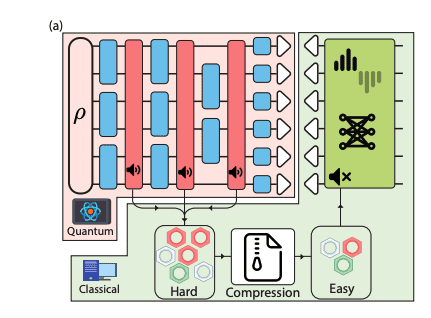
Extracting reliable results from quantum processors presents a significant challenge, as inherent noise corrupts computations, and current error mitigation techniques often demand substantial resources or rely on oversimplified assumptions. Dayue Qin, Ying Li, and You Zhou from Fudan University address this problem with a new framework called Classical Noise Inversion, which fundamentally alters how we approach error mitigation. This innovative method inverts accumulated noise during classical post-processing, completely removing the need for repeated circuit sampling and maintaining effectiveness even when noise varies between quantum gates. The team also introduces noise compression, an optimisation technique that further reduces computational overhead, and integrates these advances with shadow estimation to create a robust protocol for learning quantum properties, demonstrably reducing statistical variance and providing unbiased estimates where previous methods struggle, ultimately paving the way for more scalable and practical quantum applications.
This approach bypasses the need for extensive sampling of quantum circuits, a major limitation of existing techniques, by classically simulating noise propagation and inverting its effects during post-processing. The study demonstrates that CNI eliminates the quantum-circuit-sampling cost, reducing overhead and enabling practical scalability. To further enhance efficiency, the team introduced Noise Compression, a method that groups distinct errors exhibiting identical effects on measurement outcomes, transforming complex noise into simpler forms and reducing overall cost.
The integrated CNI and Noise Compression scheme leverages classical computation to simulate and invert noise, offering a significant advantage over methods reliant on restrictive noise assumptions. Researchers demonstrated the efficacy of CNI across a range of applications, including simultaneous estimation of commuting observables for many-body Hamiltonian learning, physical implementation of fault-tolerant logical measurements, and randomized measurement protocols for system learning. CNI is particularly effective for circuits composed of classically simulable gates, such as Clifford or matchgates, and shallow-depth circuits, encompassing a wide range of practically important scenarios. The study also pioneered a CNI-based robust shadow estimation protocol, which enables unbiased estimates in practical situations where previous methods fail. This protocol leverages the framework to learn quantum properties under general noise conditions, demonstrating a substantial reduction in statistical variance and improved accuracy. CNI establishes a promising pathway towards scalable and practical quantum applications by transforming a key quantum overhead into a manageable classical cost.
Classical Noise Inversion Achieves Optimal Error Mitigation
Scientists have developed Classical Noise Inversion (CNI), a groundbreaking method for mitigating errors in quantum computations using only classical post-processing, eliminating the need for costly quantum circuit sampling. This work addresses a critical limitation in noisy intermediate-scale quantum technology, offering a pathway towards scalable and practical applications. The CNI method effectively inverts accumulated noise during classical post-processing, remaining effective even under realistic conditions of gate-dependent noise, a significant advancement over previous techniques. The team demonstrated that CNI, when combined with noise compression, achieves optimal performance in error mitigation.
Noise compression groups noise components with equivalent effects on measurement outcomes, transforming difficult-to-mitigate noise into easily manageable forms. This integration substantially reduces statistical variance while providing unbiased estimates in scenarios where prior methods fail. Experiments reveal that CNI is particularly effective for circuits comprised of classically simulable gates, such as Clifford or matchgates, and shallow-depth circuits. Furthermore, the researchers integrated CNI with shadow estimation, a technique for learning quantum states, to create a robust framework for quantum state learning.
By applying CNI to every random measurement within the shadow estimation process, they achieved unbiased estimation even under challenging gate-dependent noise, while maintaining low variance. Numerical simulations demonstrate that this CNI-based framework outperforms existing methods, which either introduce bias or exhibit greater variance. The team’s analysis confirms that the method’s performance is directly related to the ideal shadow norm and the noise model, providing a clear understanding of its capabilities.
Noise Inversion Reduces Quantum Variance Unbiasedly
This research introduces Classical Noise Inversion (CNI), a new framework for quantum error mitigation that fundamentally shifts computational overhead from quantum processors to classical resources. By inverting accumulated noise during classical post-processing, CNI eliminates the need for extensive circuit sampling and remains effective when noise varies between different operations, a limitation of previous methods. The team also developed a noise compression technique, grouping noise components to minimize overhead and achieve optimal efficiency, and integrated CNI with shadow estimation to create a robust protocol for learning quantum properties. Analysis and numerical results demonstrate that this approach significantly reduces statistical variance while providing unbiased estimates in practical scenarios where existing methods struggle. CNI’s versatility extends beyond state learning, being applicable to a broad range of quantum protocols involving classically simulable circuits followed by measurements, including Hamiltonian evaluation, fault-tolerant measurement, and randomized characterization of quantum systems. The authors acknowledge that their current implementation uses Monte Carlo methods, and future work could explore more powerful classical simulators, such as tensor networks, to further enhance accuracy and scalability.
👉 More information
🗞 Classical Noise Inversion: A Practical and Optimal framework for Robust Quantum Applications
🧠 ArXiv: https://arxiv.org/abs/2510.20686