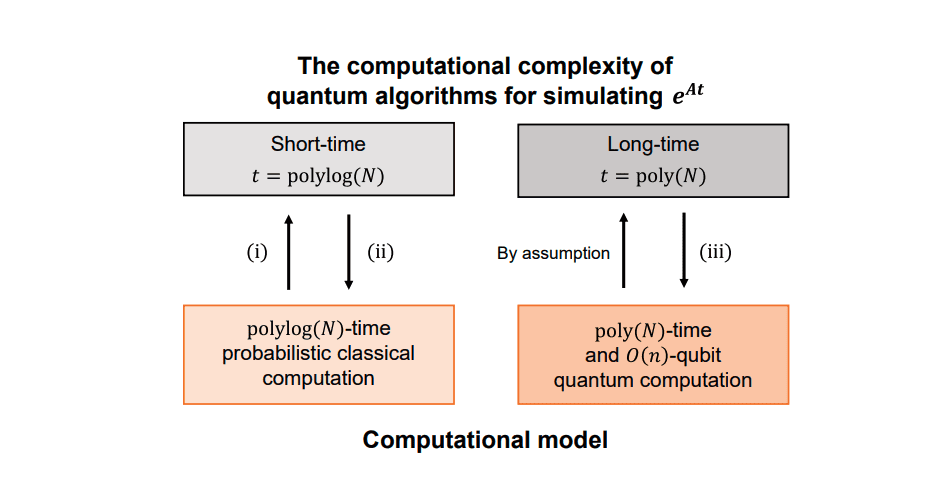
Research demonstrates that quantum algorithms, while offering potential benefits for simulating classical systems, do not guarantee exponential speedup when applied to systems exhibiting only local interactions – those governed by partial differential equations. Simulations of short-time dynamics present computational complexity equivalent to probabilistic classical algorithms. Long-time dynamics, however, reveal a super-polynomial time advantage when constrained to polynomial space, or an exponential space advantage otherwise, suggesting a pathway towards practical quantum advantage.
The efficient simulation of classical systems remains a central challenge in computational physics and chemistry, with applications ranging from materials science to fluid dynamics. Researchers are increasingly investigating whether quantum computation offers advantages over classical methods for modelling these systems, particularly those governed by partial differential equations and exhibiting geometrically local interactions. A new analysis by Sakamoto and Fujii, et al., from the University of Osaka and RIKEN, details the computational complexity of quantum algorithms designed to simulate such classical dynamics. Their work, entitled ‘On the quantum computational complexity of classical linear dynamics with geometrically local interactions: Dequantization and universality’, establishes limitations to potential quantum speedups for short-time simulations, while outlining conditions under which a super-polynomial time advantage, or exponential space advantage, may be realised for long-time dynamics.
The Boundaries of Quantum Advantage: Classical Simulation of Local Quantum Systems
The promise of quantum computation hinges on the ability to outperform classical computers on specific tasks. However, pinpointing when a quantum computer truly offers an advantage remains a central challenge. Recent research has rigorously investigated the computational complexity of simulating quantum systems, specifically focusing on the time evolution dictated by the Schrödinger equation, and has delineated the boundaries where classical methods remain surprisingly competitive. This work establishes a clear understanding of when quantum resources are genuinely needed, and when classical algorithms suffice.
The study centers on geometrically local Hamiltonians – those describing systems where interactions between components are restricted to nearby locations, mirroring many physical scenarios arising from partial differential equations. The core finding is striking: simulating the short-time dynamics of these systems does not necessitate a quantum computer. Classical algorithms, utilizing polynomial-time probabilistic methods, achieve equivalent complexity, effectively negating any potential exponential speedup offered by quantum approaches. This result is significant because it establishes a clear condition where classical computation remains viable, and challenges the assumption that any quantum simulation inherently requires quantum hardware.
The researchers demonstrate that the computational cost for simulating non-interacting particles scales polynomially with relevant parameters. Specifically, the complexity is approximately ˜O( (t(D²/a² + Vmax))² + D log(1/δ) ) / ε², where t represents simulation time, D is spatial dimension, a denotes lattice spacing, Vmax is the maximum potential, δ controls the probability of success, and ε defines the desired precision. This detailed analysis reveals that the complexity is fundamentally determined by the simulation time, kinetic energy (represented by D²/a²), potential energy (Vmax), spatial dimension, desired accuracy, and the acceptable error probability.
This finding is particularly impactful because it highlights a crucial distinction: classical algorithms can efficiently model isolated quantum systems. The absence of interactions allows for a straightforward mapping onto classical computational resources. However, the story changes dramatically when interactions are introduced.
Further investigation reveals that while algorithms offer a super-polynomial time advantage when constrained to polynomial space for long-time dynamics, this advantage diminishes if unrestricted space is available. This highlights a trade-off between computational time and memory requirements when employing algorithms for extended simulations. The researchers achieved this understanding through a process of ‘dequantization’ – adapting quantum algorithmic techniques for classical implementation. This adaptation allows for precise bounding of the runtime complexity, providing a detailed understanding of the limitations and capabilities of classical simulation.
The core contribution lies in formally characterizing the conditions under which classical algorithms can efficiently simulate quantum systems with local interactions. By establishing a rigorous framework based on geometrically local matrices, the study clarifies that interactions are pivotal for realizing exponential quantum speedups. This isn’t simply a theoretical observation; it has profound implications for the development of quantum algorithms and the identification of practical applications.
This work offers valuable insights for both physicists and computer scientists. It guides the development of algorithms by focusing efforts on problems where quantum computers are genuinely needed, and informs the strategic allocation of computational resources in the pursuit of solving complex quantum mechanical problems. It also suggests that the search for quantum advantage should prioritize systems with strong, complex interactions.
The findings contribute to a growing body of knowledge that is essential for guiding the development of quantum algorithms and hardware, and for identifying the most promising applications of this emerging technology. The ability to efficiently simulate non-interacting quantum systems with classical algorithms frees up quantum resources for tackling problems that are truly beyond the reach of classical computation.
Future research should focus on exploring the implications of these findings for specific physical systems governed by partial differential equations. Investigating how these insights can guide the development of algorithms tailored to exploit the limitations of classical simulation and unlock the potential of quantum computation remains a key area of investigation. Ultimately, understanding the boundaries of quantum advantage is crucial for realizing the full potential of this transformative technology.
👉 More information
🗞 On the quantum computational complexity of classical linear dynamics with geometrically local interactions: Dequantization and universality
🧠 DOI: https://doi.org/10.48550/arXiv.2505.10445