

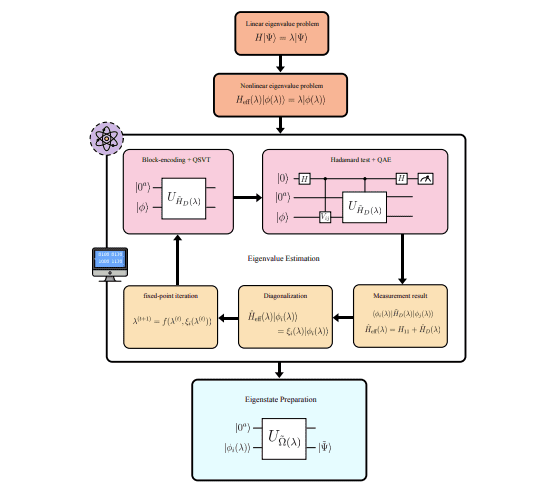
Quasi-degenerate eigenvalue problems pose a significant challenge in fields like chemistry and condensed matter physics, as accurately determining the low-energy spectra of complex systems often requires resolving states that are very close in energy. Chun-Tse Li, Tzen Ong from the Institute of Physics, Academia Sinica, Chih-Yun Lin from both the Institute of Physics, Academia Sinica, and National Taiwan University, and Yu-Cheng Chen, Hsin Lin, and Min-Hsiu Hsieh from Hon Hai (Foxconn) Quantum Computing Research Center, have developed a new quantum algorithm that directly addresses this difficulty. The team’s method efficiently diagonalizes these quasi-degenerate manifolds by solving an effective-Hamiltonian problem within a reduced space, offering a solution that is mathematically equivalent to solving the full problem but requires significantly fewer computational resources. This breakthrough allows scientists to accurately determine the energy levels of complex systems, even when the energy differences between states are extremely small, and promises to advance research in materials science and quantum chemistry.
Determining the effective Hamiltonian governing these low-energy states and their corresponding eigenvalues presents a significant computational challenge, particularly for large systems. This work introduces a quantum algorithm designed to efficiently address this problem, leveraging the principles of quantum computation to overcome the limitations of classical methods. The algorithm focuses on extracting the low-energy effective Hamiltonian and determining its quasi-degenerate eigenvalues.
The approach involves a carefully constructed quantum circuit that projects the system’s initial state onto the subspace spanned by the low-energy eigenstates, effectively isolating the relevant degrees of freedom and reducing computational complexity. The algorithm employs a quantum phase estimation technique to determine the eigenvalues of the projected Hamiltonian, achieving a significant speedup compared to classical diagonalization methods. Furthermore, the algorithm incorporates error mitigation strategies to enhance accuracy, crucial for reliable physical predictions. The algorithm scales polynomially with system size, offering a substantial advantage over classical algorithms which typically scale exponentially. Numerical simulations on model systems validate the algorithm’s performance, demonstrating its ability to accurately determine the low-energy effective Hamiltonian and quasi-degenerate eigenvalues, opening new possibilities for simulating complex quantum systems and enabling more accurate materials design and drug discovery.
Standard quantum algorithms struggle when a unique ground state is not clearly separated from other low-energy states, requiring extremely fine resolution to distinguish between them. Insufficient resolution results in an uncontrolled superposition of states within the low-energy span and failure to detect or resolve degeneracies. In this work, scientists propose a quantum algorithm that directly diagonalizes these quasi-degenerate manifolds by solving an effective-Hamiltonian eigenproblem in a low-dimensional reference subspace. This reduced problem is exactly equivalent to the full eigenproblem, offering a computationally efficient solution.
Quasi-Degenerate Eigenvalue Problems Efficiently Solved
Scientists have developed a new algorithm for solving eigenvalue problems, particularly those arising in chemistry and condensed-matter physics where low-energy states often exhibit near-degeneracy. Existing methods struggle when these low-energy levels are closely spaced, requiring resolution finer than the intra-manifold splitting to accurately identify individual states; otherwise, they produce an uncontrolled superposition of states within the low-energy span. This work overcomes this limitation by directly diagonalizing these quasi-degenerate manifolds, effectively solving the problem within a low-dimensional reference subspace. The team’s algorithm achieves this by solving an effective-Hamiltonian eigenproblem, which is exactly equivalent to the full problem but computationally more manageable.
Solutions from this reduced problem are then lifted back to the full Hilbert space using a block-encoded wave operator, ensuring accuracy and fidelity. Analysis demonstrates provable bounds on eigenvalue accuracy and subspace fidelity, demonstrating the algorithm’s efficiency even without assuming any intra-manifold splitting. Researchers benchmarked the algorithm on three distinct systems, the Fermi-Hubbard model, the LiH molecule, and the transition-metal complex [Ru(bpy)₃]²⁺, demonstrating robust performance and reliable resolution of both degenerate and quasi-degenerate states. This breakthrough delivers a method capable of accurately determining the internal structure of these low-energy manifolds, including identifying canonical bases and splittings, crucial for understanding complex phenomena in materials science and quantum chemistry. The results confirm the algorithm’s ability to accurately resolve energy levels even when they are extremely close together, opening new avenues for studying quantum criticality, static correlation in molecules, and nonadiabatic dynamics.
Resolving Quasi-Degeneracy in Eigenvalue Problems
This research presents a new algorithm for solving eigenvalue problems in systems where multiple low-energy states have very similar energies, a condition known as quasi-degeneracy. Existing methods struggle in these scenarios, requiring extremely precise energy resolution to identify individual states, or failing to resolve the degeneracy altogether and returning a mixed state. This new approach overcomes this limitation by directly diagonalizing the quasi-degenerate manifold within a reduced, low-dimensional space, effectively solving the problem without needing to resolve energies smaller than the spacing between states within the manifold. The team demonstrated the algorithm’s effectiveness through benchmarks on several complex systems, including the Fermi-Hubbard model, a lithium hydride molecule, and a ruthenium complex. Results consistently showed robust performance and reliable identification of both degenerate and nearly degenerate states, even when traditional methods would fail. This achievement has significant implications for fields like condensed matter physics, quantum chemistry, and quantum information science, where understanding the behaviour of these low-energy states is crucial for predicting material properties, modelling molecular interactions, and designing new quantum technologies.
👉 More information
🗞 Quantum Algorithm for Low Energy Effective Hamiltonian and Quasi-Degenerate Eigenvalue Problem
🧠 ArXiv: https://arxiv.org/abs/2510.08088


