The vulnerability of modern cryptography to quantum computers hinges on algorithms like Shor’s, which threatens the security of widely used systems by efficiently solving complex mathematical problems. Quan Gu, Han Ye, and Junjie Chen from Tsinghua University, along with Xiongfeng Ma, present a detailed analysis of the resources required to implement Shor’s elliptic curve algorithm on a realistic quantum computer architecture. Their work focuses on improving the efficiency of quantum addition, a critical component of the algorithm, by developing a new adder design that minimises the number of qubits needed without sacrificing speed. This advancement, combined with sophisticated circuit techniques, allows the team to estimate that breaking the cryptographic curve P-256, which secures much of today’s digital infrastructure including Bitcoin, requires approximately logical qubits and a logical Toffoli fidelity of, establishing new benchmarks and bringing the practical realisation of quantum cryptanalysis closer to reality.
Estimates for factoring-based cryptanalysis are well established, but comparable evaluations for Shor’s elliptic curve algorithm under realistic architectural constraints remain limited. This work proposes a carry-lookahead quantum adder that achieves Toffoli depth log n + log log n + O(1) with only O(n) ancillas, matching state-of-the-art performance in depth while avoiding the prohibitive space overhead of existing approaches. Importantly, the design is naturally compatible with two-dimensional nearest-neighbor architectures and introduces only a constant-factor overhead. Further, a comprehensive resource analysis of Shor’s elliptic curve algorithm on two-dimensional architectures is performed.
Quantum Algorithms and Computational Complexity Analysis
Researchers are actively exploring quantum algorithms like Shor’s and Grover’s, which promise speedups over classical methods for specific problems. Simultaneously, significant effort focuses on post-quantum cryptography, creating algorithms resistant to attacks from both classical and future quantum computers, including investigations into lattice-based, code-based, and hash-based cryptographic approaches. Quantum error correction is also central, as quantum computers are inherently susceptible to noise, with scientists developing methods such as surface codes and topological codes to protect quantum information and build fault-tolerant systems. This work encompasses cryptography standards and security analysis, ensuring the development of secure and reliable systems, alongside challenges in building quantum hardware using platforms like superconducting qubits and trapped ions, and exploring applications like quantum simulation and machine learning.
Efficient Adder Simplifies Quantum Factorization
Scientists have achieved a breakthrough in quantum computation, demonstrating a new carry-lookahead adder that significantly reduces the resources needed to break modern encryption. The team developed an adder with a Toffoli depth of log n + log log n + O(1) while utilizing only O(n) ancillas, matching state-of-the-art performance but avoiding the substantial space requirements of previous designs. This adder is particularly well-suited for implementation on two-dimensional nearest-neighbor quantum architectures, introducing only a constant-factor overhead in these systems. Building on this improved adder, researchers performed a comprehensive resource analysis of Shor’s elliptic curve algorithm, specifically tailored for two-dimensional lattices.
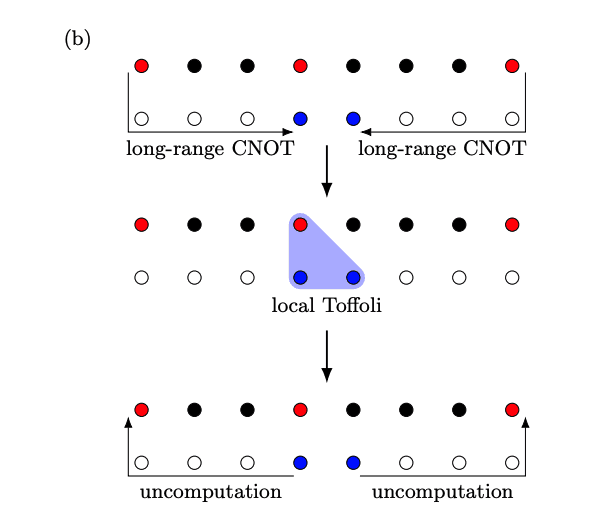
The work incorporates algorithmic techniques such as the windowed method, Montgomery representation, and quantum tables, alongside dynamic circuit techniques with mid-circuit measurements and classically controlled operations, to substantially reduce the overhead associated with long-range gates. The results demonstrate that breaking the NIST P-256 elliptic curve, which underpins most modern public-key infrastructures and the security of Bitcoin, requires approximately 4300 logical qubits and a logical Toffoli fidelity of 10−9. This precise resource estimate establishes new benchmarks for efficient quantum arithmetic and provides concrete guidance toward the experimental realization of Shor’s elliptic curve algorithm.
Breaking P-256 With Realistic Quantum Resources
This work presents a new carry-lookahead adder design and a comprehensive resource analysis of Shor’s elliptic curve algorithm, advancing the feasibility of quantum computation for cryptographic applications. The team achieved a carry-lookahead adder with minimal ancilla overhead, matching state-of-the-art performance while avoiding substantial space requirements. The analysis establishes concrete benchmarks for resource requirements, demonstrating that breaking P-256 necessitates approximately 5n logical qubits and a logical Toffoli fidelity of around 0. 5. The researchers also developed an in-place quantum adder with a carry-bit computation exhibiting Toffoli depth and linear ancilla overhead, representing the best known trade-off to date. Further improvements in quantum hardware, particularly in qubit fidelity and scalability, are essential to realize these computational goals. Future research directions include exploring optimizations in circuit design and developing error correction strategies to mitigate the impact of noise on quantum computations.
👉 More information
🗞 Resource analysis of Shor’s elliptic curve algorithm with an improved quantum adder on a two-dimensional lattice
🧠 ArXiv: https://arxiv.org/abs/2510.23212