Environmental noise presents a significant challenge to the development of sensitive solid-state technologies, including quantum dots and advanced electrical circuits, as these devices operate at extremely low energies. Rajat Bharadwaj, Parvathy Gireesan, and Harikrishnan Sundaresan, alongside colleagues at the Universität Regensburg and other institutions, now demonstrate a novel active noise cancellation technique that directly addresses this problem. Their method overcomes the limitations of conventional filtering by dynamically injecting a precisely timed ‘anti-noise’ signal into the device itself, effectively cancelling out unwanted interference. This automated feedback protocol, validated on a silicon-germanium quantum dot subjected to common 50Hz powerline noise, achieves substantial noise suppression and stabilises device performance, representing a crucial step towards enhancing the fidelity and reliability of sensitive solid-state measurements and broadening the scope of future quantum technologies.
ee 149, Hamburg 22761, Germany, and the Fakultät für Physik, Universität Regensburg, Regensburg 93040, Germany. Solid-state quantum technologies, including quantum dot qubits and quantum electrical metrology circuits, rely on quantum phenomena at ultra-low energies, making them highly susceptible to environmental noise. Conventional passive filtering effectively reduces high-frequency noise, but often proves ineffective against low-frequency interference, such as that from powerlines or instrumentation. Extending these filters to lower frequencies introduces practical challenges, including prolonged stabilization times, diminished system response, and increased Johnson noise, which subsequently impedes low-frequency transport measurements.
Active Noise Cancellation in Quantum Dots
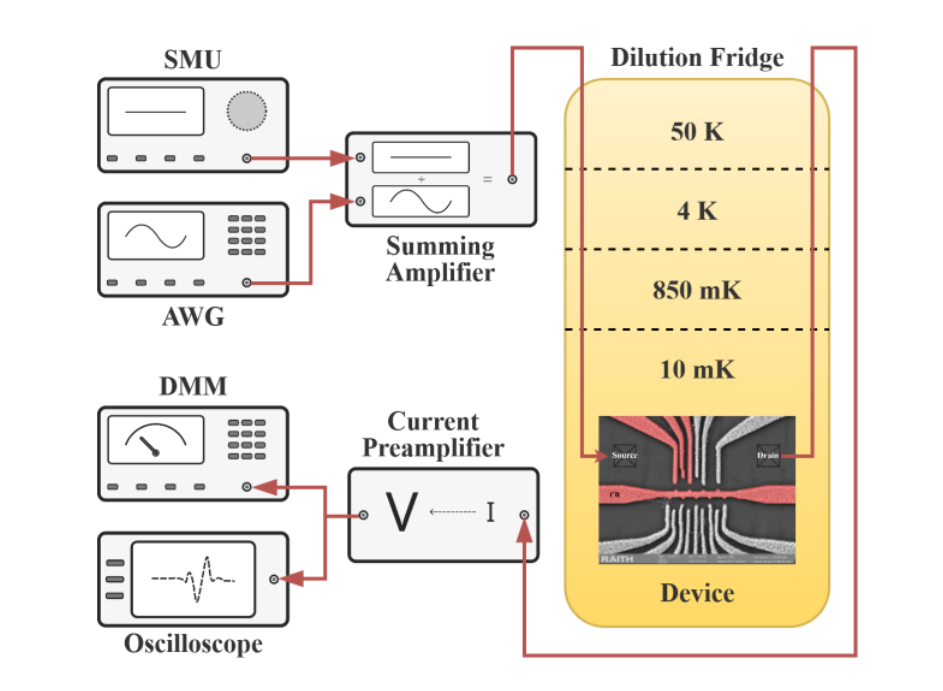
This research details a method for actively reducing low-frequency noise in Silicon/Silicon-Germanium (Si/SiGe) gated quantum dots. Low-frequency noise significantly limits the performance of these quantum dots, hindering their potential for use in quantum computing and advanced technologies. The researchers developed a system that injects an ‘anti-noise’ signal to cancel existing noise, substantially improving the stability and coherence of the quantum dot. The system continuously monitors the noise spectrum and dynamically adjusts the anti-noise signal’s amplitude and phase to minimize noise at specific frequencies. Key findings demonstrate that the active noise cancellation system effectively reduces low-frequency noise across a broad bandwidth, improving the stability and coherence of the quantum dot. This research demonstrates a practical and effective method for mitigating a major obstacle in the development of Si/SiGe quantum dot-based technologies, offering a promising pathway towards building more stable and reliable quantum devices.
Active Noise Cancellation Stabilizes Quantum Dots
Scientists have developed a new active noise cancellation scheme for solid-state devices operating at ultra-low temperatures, achieving substantial suppression of environmental interference and enhancing device fidelity. This work addresses a critical limitation in sensitive quantum technologies, where even small amounts of noise can disrupt measurements and hinder performance. The team successfully implemented this technique on a silicon-based quantum dot subject to strong 50Hz powerline interference, demonstrating its effectiveness through comparative measurements of transport characteristics. Measurements reveal a significant reduction in both targeted interference and the overall noise floor, stabilizing the device’s performance and improving data quality. This breakthrough delivers a versatile strategy for advancing noise-resilient quantum measurement platforms, paving the way for more accurate and reliable quantum technologies. The method’s ability to suppress noise at the device level, without introducing additional delays, represents a significant advancement over traditional filtering techniques.
Real-Time Noise Cancellation Stabilizes Quantum Dots
This research demonstrates a novel active noise cancellation technique for solid-state devices operating at extremely low temperatures. Scientists successfully suppressed unwanted periodic interference by dynamically injecting a precisely timed and tuned ‘anti-noise’ signal directly into a silicon-based quantum dot. This approach overcomes limitations of conventional filtering methods, which struggle with low-frequency noise and can introduce unwanted delays or amplify other noise sources. The team implemented an automated feedback system that adapts to changing noise conditions in real time, stabilizing the device’s performance and enhancing the fidelity of measurements.
The effectiveness of this technique was validated through the acquisition of clear measurements, demonstrating a substantial reduction in both targeted interference and the overall noise floor. While demonstrated on a quantum dot experiencing 50Hz powerline interference, the framework is broadly applicable to a wide range of solid-state devices where deterministic noise presents a significant challenge. Future work could explore extending the technique to compensate for a wider range of noise sources and integrating it into more complex quantum circuits.
🗞 Active Noise Reduction in Si/SiGe Gated Quantum Dots
🧠 ArXiv: https://arxiv.org/abs/2511.06373