

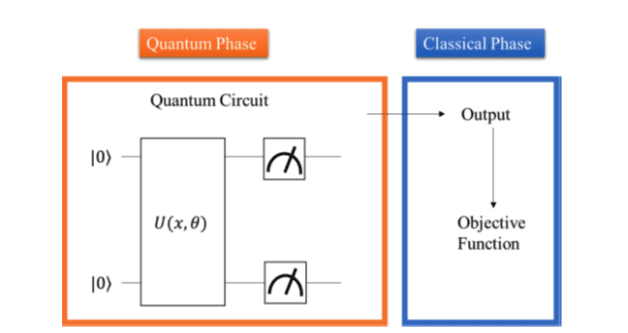
On April 16, 2025, researchers Chi-Chuan Hwang and Yi-Ang Hong published A study on B-cell epitope prediction based on QSVM and VQC, exploring quantum computing techniques in bioinformatics. Their work compared Quantum Support Vector Machine (QSVM) and Variational Quantum Classifier (VQC), achieving accuracies of 70% and 73%, respectively, while addressing computational challenges for future advancements.
This study evaluates Support Vector Machine (QSVM) and Variational Classifier (VQC) for B-cell epitope prediction, demonstrating machine learning’s potential in bioinformatics. QSVM employs kernel functions, achieving 70% accuracy, while VQC uses parameterized circuits, reaching 73%. QSVM excels in class balance despite computational demands and hardware limitations. Results suggest promising applications with future advancements.
The application of Quantum Support Vector Machines (QSVM) in predicting B-cell epitopes represents a significant advancement in immunology and vaccine development. Here’s a structured summary of the key points:
- B-Cell Epitopes: These are critical regions on proteins that trigger immune responses, essential for developing vaccines and understanding immunity.
- Quantum Computing Advantage: QSVM leverages quantum properties like qubits and parallelism to handle high-dimensional biological data more efficiently than classical methods. This capability is particularly beneficial for complex or large datasets.
- Encoding Antigenic Sequences: The process involves encoding protein sequences into quantum states, allowing quantum operations to analyze these sequences more effectively, potentially revealing patterns missed by classical algorithms.
- Feature Selection and Preprocessing: Enhancing prediction accuracy requires careful selection of relevant data features and preprocessing, which benefits both classical and quantum models.
- Scalability and Challenges: While QSVM shows promise, current quantum technology limitations such as error rates, decoherence, and hardware accessibility may hinder widespread application. However, improvements in quantum computing could expand its use.
- Impact on Vaccine Development: Accurate and rapid prediction of B-cell epitopes could accelerate vaccine creation, particularly against emerging pathogens, enhancing public health responses to outbreaks.
- Personalized Medicine: Improved understanding of immune recognition could lead to tailored vaccines, increasing effectiveness for individuals or populations.
In conclusion, QSVM’s application in predicting B-cell epitopes offers a promising approach with potential to revolutionize immunology and vaccine development, despite current technological challenges.
👉 More information
🗞 A study on B-cell epitope prediction based on QSVM and VQC
🧠 DOI: https://doi.org/10.48550/arXiv.2504.11846


