

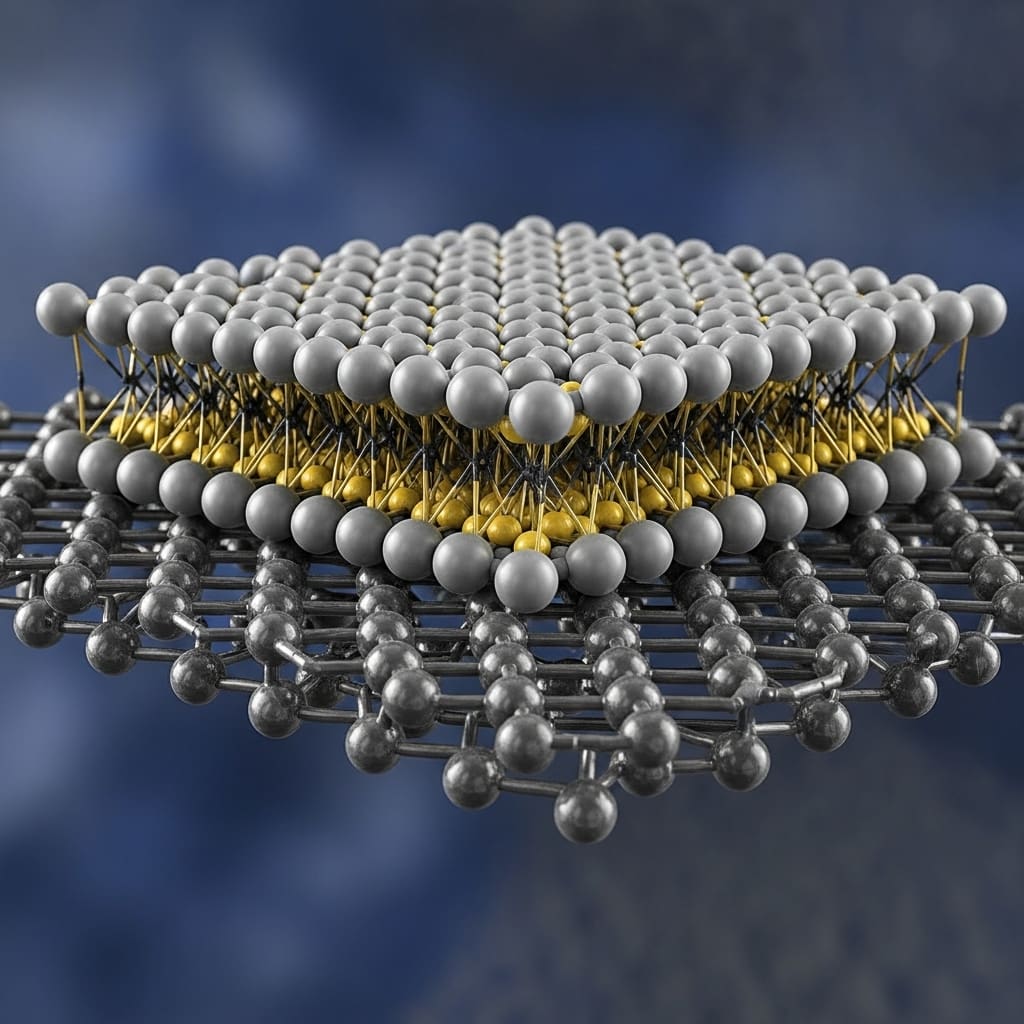
Van der Waals heterostructures, created by combining two-dimensional materials with differing properties, represent a promising frontier for novel quantum technologies. Meryem Bouaziz, Samir El Masaoudi, and Aymen Mahmoudi, alongside Eva Desgue, Marco Pala, and Pavel Dudin, investigate the electronic behaviour of platinum diselenide (PtSe2) when grown on both hexagonal boron nitride and graphene substrates. Their work reveals a crucial difference in how PtSe2 interacts with each material, demonstrating significant interlayer hybridization with graphene that is absent when grown on hexagonal boron nitride. This hybridization manifests as distinct changes in the material’s electronic structure, and the team’s findings highlight the critical role of the substrate in tailoring the properties of these heterostructures for future nanoelectronic devices. This research represents a substantial step forward in understanding and controlling the electronic characteristics of two-dimensional materials assembled in van der Waals heterostructures.
This research focuses on understanding how the choice of substrate influences the electronic behaviour of PtSe₂, a crucial step towards designing advanced electronic devices. The team employed a combination of experimental measurements and theoretical calculations to achieve this, providing a comprehensive understanding of the material’s properties. The research demonstrates that the substrate significantly affects the electronic structure of PtSe₂.
Selecting the appropriate substrate is critical for controlling the resulting material’s properties. Specifically, the band structure of PtSe₂ changes depending on whether it’s placed on h-BN or graphene, a finding confirmed by both experimental data and theoretical modelling. Furthermore, the study reveals evidence of hybridization, or mixing, of electronic states between the PtSe₂ and the substrate, particularly graphene, which alters the band structure. The number of PtSe₂ layers also plays a role, with monolayer and bilayer structures exhibiting different electronic characteristics. The team used angle-resolved photoemission spectroscopy (ARPES) to directly measure the electronic band structure of the materials, providing information about the energy and momentum of electrons. They also employed density functional theory (DFT), a theoretical method used to calculate the electronic structure of materials based on quantum mechanics, allowing them to predict material properties and understand their behaviour. This research provides valuable insights for designing van der Waals heterostructures with tailored electronic properties, crucial for developing advanced electronic devices such as transistors and photodetectors.
Van der Waals Heterostructure Growth and Characterisation
Scientists engineered van der Waals heterostructures by combining platinum diselenide (PtSe₂) with hexagonal boron nitride (h-BN) and graphene substrates using molecular beam epitaxy (MBE). This precise growth technique allows for excellent control over layer growth and interface quality. The team grew both monolayer and bilayer PtSe₂ directly onto these substrates within an ultra-high vacuum environment, ensuring well-defined orientations and sharp interfaces. To characterize the electronic properties of these heterostructures, researchers employed angle-resolved photoemission spectroscopy (ARPES) and density functional theory (DFT) calculations.
ARPES measurements utilized a focused nanoscopic beam to study the electronic band structures specifically within small h-BN flakes. This technique probes the energy and momentum of emitted electrons, revealing details about the material’s electronic structure. Complementing the experimental work, DFT calculations modelled the heterostructures, accounting for lattice mismatch and predicting electronic behaviour. Comparative analysis of the band structures revealed subtle differences in the electronic properties of 1ML PtSe₂/h-BN and 1ML PtSe₂/graphene. The team observed overlapping zones between the electronic states of h-BN and PtSe₂, and five distinct overlapping peaks in the 1ML PtSe₂/graphene system, indicating hybridization between the materials. These overlaps arise from the mixing of atomic orbitals, mediated by the selenium atoms, and are stronger in the graphene heterostructure. These findings demonstrate strong electronic hybridization for both single and bilayer PtSe₂ on graphene, highlighting the crucial role of the substrate in tailoring the electronic properties of these two-dimensional materials.
PtSe2 Heterostructures Reveal Minigap Formation
Scientists have achieved a detailed understanding of the electronic behaviour of platinum diselenide (PtSe₂) when combined with hexagonal boron nitride (h-BN) and graphene substrates, creating van der Waals heterostructures with precisely controlled layers. The research team investigated these structures using a combination of molecular beam epitaxy (MBE) for growth and angle-resolved photoemission spectroscopy (ARPES) to map the electronic band structure. Density functional theory (DFT) calculations supported and clarified the experimental findings, providing a comprehensive picture of electronic interactions. Experiments reveal that the electronic structure of PtSe₂ grown directly on h-BN differs significantly from that on graphene.
Specifically, the team observed the opening of minigaps within the electronic states of graphene when combined with PtSe₂, demonstrating a clear hybridization effect between the two materials. DFT calculations confirm this hybridization, identifying overlapping zones between the electronic bands of PtSe₂ and the substrate materials. These overlapping zones arise from the mixing of atomic orbitals, fundamentally altering the electronic properties of both materials. Measurements of the valence band maximum (VBM) of monolayer PtSe₂ show different binding energies when grown on h-BN and graphene, highlighting the substrate’s crucial role in tuning the electronic properties of the PtSe₂ layer. Furthermore, the team demonstrated that bilayer PtSe₂ exhibits even stronger hybridization effects when combined with graphene, indicating a greater degree of electronic interaction. These findings demonstrate the potential for precise control over electronic properties in two-dimensional materials through careful selection of substrate materials and layer thickness, delivering a pathway for designing novel electronic devices with tailored characteristics.
Substrate Controls 2D Heterostructure Electronic Properties
This research demonstrates the successful growth of platinum diselenide (PtSe₂) on both graphene and hexagonal boron nitride (h-BN) substrates using a van der Waals epitaxy technique. Detailed analysis of these heterostructures reveals significant differences in their electronic properties depending on the underlying substrate. Specifically, the team observed that PtSe₂ grown on h-BN maintains electronic characteristics similar to free-standing PtSe₂, whereas PtSe₂ on graphene exhibits interlayer hybridization, leading to the opening of minigaps in the graphene’s electronic band structure. These findings highlight the crucial role of the substrate in tailoring the electronic properties of two-dimensional van der Waals heterostructures. The observed hybridization and minigap formation demonstrate a pathway for manipulating the electronic characteristics of these materials, offering potential for advanced nanoelectronic applications. This work establishes a foundation for future research focused on designing and controlling the electronic properties of van der Waals heterostructures through careful substrate selection and material combinations.
👉 More information
🗞 Hybridization in van der Waals epitaxy of PtSe2/h-BN and PtSe2/graphene heterostructures
🧠 ArXiv: https://arxiv.org/abs/2510.17464

