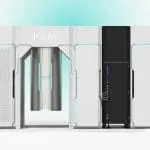
Alex Mack from PsiQuantum announced that the company has secured $1 billion in Series E funding to build the world’s first commercially useful, fault‑tolerant quantum computers at million‑qubit scale, with plans to break ground on utility‑scale sites in Brisbane and Chicago and deploy large‑scale prototype systems to validate system architecture and integration.
On 17 September 2025, PsiQuantum Corp announced a $1 billion Series E investment, the largest capital raise in its history. The funding will enable construction of the world’s first commercially useful fault‑tolerant quantum computers at dedicated sites in Brisbane, Australia, and Chicago, Illinois, USA. Capital will be used to break ground on utility‑scale quantum‑computing facilities, deploy large‑scale prototype systems to validate system architecture and integration, and accelerate performance of the company’s quantum photonic chips and fault‑tolerant architecture. The company claims that its Active Volume Architecture can cut operational costs for factoring algorithms by roughly fifty‑fold compared with conventional approaches, positioning the firm to deliver processors that tackle industry‑relevant problems within practical timeframes. The Series E funding marks a pivotal moment, bridging the gap between laboratory demonstrations and real‑world quantum applications, potentially reshaping industries that rely on complex optimisation, cryptography, and simulation.
Construct Software Suite Enables Design and Optimization of Large Scale Fault Tolerant Quantum Algorithms
On 17 September 2025, PsiQuantum introduced Construct, a dedicated software platform for the design, development and optimisation of large‑scale fault‑tolerant quantum algorithms. Built by its Software and Quantum Applications teams, Construct supports the full lifecycle of an algorithm: from high‑level specification, through automatic mapping onto the company’s surface‑code error‑correction framework, to optimisation of qubit routing across the photonic chip and evaluation of resource estimates such as logical qubit count and circuit depth. Integrated with PsiQuantum’s proprietary compiler back‑end, the suite generates executable circuit tapes ready for fabrication on the Omega photonic chipset. Its modular architecture allows developers to plug in alternative error‑correction codes or hardware models, facilitating rapid iteration and comparative studies across different fault‑tolerant strategies. Construct addresses the bottleneck that has historically limited progress in fault‑tolerant quantum computing, enabling modelling and optimisation at the scale required for practical applications such as factoring, quantum chemistry and optimisation, and accelerating validation of the company’s hardware roadmap.
Linde Engineering Provides Largest Cryogenic Plant for Utility Scale Quantum Computer in Brisbane
On 8 May 2025, PsiQuantum announced a partnership with Linde Engineering to deliver the largest cryogenic plant ever planned for a quantum computer. The plant will be constructed and tested by Linde before installation at PsiQuantum’s Brisbane campus, providing the cryogenic foundation required for a million‑qubit photonic processor. The facility will cool PsiQuantum’s Omega photonic chipset to the millikelvin temperatures necessary for low‑loss photon generation and interference, enabling surface‑code error‑correction schemes that underpin fault‑tolerant operation. The project also involves development of next‑generation high‑power cryogenic modules in collaboration with the UK’s Daresbury Laboratory and the Science and Technology Facilities Council (STFC), ensuring the thermal environment can support the optical components at the Brisbane site’s millikelvin infrastructure.
Omega Photonic Chipset and DARPA Collaboration Accelerate Production Scale Quantum Computing
Omega, the purpose‑built photonic quantum‑chipset unveiled on 26 February 2025, is designed for a million‑qubit processor and fabricated on a 200‑mm silicon‑on‑insulator wafer by GlobalFoundries and other foundry partners. Reviewed in a recent Nature paper, its design incorporates densely packed waveguides, integrated phase shifters and low‑loss couplers, and GlobalFoundries is producing the wafers at scale, with a transition to production‑grade wafers expected within the next 18 months. Omega’s silicon‑photonic platform incorporates modular error‑correction blocks that can be tiled across the wafer, allowing logical qubits to be assembled from many physical photonic qubits while maintaining low error rates. High‑power cryogenic modules developed with Daresbury Laboratory integrate with the Omega architecture to keep optical components operating at millikelvin temperatures required for coherent photon generation and interference. The Chicago facility will host the first U.S.‑based utility‑scale quantum computer, where PsiQuantum will assemble and test prototype systems incorporating Omega, validating the integration of cryogenic infrastructure, photonic interconnects and error‑correction protocols at scale. PsiQuantum secured a $10.8 million contract with the Air Force Research Laboratory (AFRL) in Rome, New York, on 15 April 2025, granting the U.S. Air Force dedicated design space for comparative quantum circuits on PsiQuantum’s circuit tapeout, accelerating validation of error‑correction protocols and optimisation of logical‑qubit layouts. On 6 February 2025, DARPA selected PsiQuantum to advance to the final phase of its Utility‑Scale Quantum Computing Program, focusing on production‑scale technology and high‑impact use cases, providing funding and oversight to move Omega from prototype to commercial‑grade systems and unlocking additional resources for rapid scaling of wafer‑level fabrication, yield optimisation and system‑level integration.
Global Partnerships and Open Source Tools Position PsiQuantum at the Forefront of Quantum Technology Development
PsiQuantum’s global ecosystem includes several strategic partnerships and open‑source initiatives. The company announced a partnership with the UK’s Daresbury Laboratory and the Science and Technology Facilities Council (STFC) on 6 March 2023 to develop next‑generation high‑power cryogenic modules. In 2024, PsiQuantum partnered with Queensland universities on 15 July 2024 to bolster research and talent pipelines. A joint venture with Mitsubishi UFJ Financial Group and Mitsubishi Chemical, announced on 24 January 2024, explores energy‑efficient materials for the fault‑tolerant quantum computer. Open‑source projects QREF and Bartiq were unveiled on 7 May 2024, providing libraries, tools and datasets that benchmark and optimise quantum circuits. Construct, introduced in September 2025, further complements these efforts by enabling large‑scale algorithm design and optimisation. These collaborations position PsiQuantum at the forefront of quantum technology development, integrating cryogenic, photonic, materials and software innovations to accelerate the transition from prototype to commercial‑grade quantum processors.
Original Source
Publisher: PsiQuantum Corp (private quantum‑computing company)
View Original Source