

The behaviour of light in non-linear materials is central to advances in fields like ultrafast science and high-harmonic generation, and researchers are now investigating the potential of ‘squeezed vacuum’ light to enhance these processes. J. Rivera-Dean, D. Kanti, and P. Stammer, alongside colleagues including N. Tsatrafyllis, M. Lewenstein, and P. Tzallas, have now explored how this unique form of light propagates through gaseous media. Their work addresses a critical gap in current understanding, moving beyond theoretical studies of single atoms to model light’s behaviour as it travels through a material, and reveals that factors like photon loss and atomic depletion significantly limit the distance squeezed vacuum light can travel and reduce its ability to generate harmonic signals. Despite these limitations, the team identifies specific conditions under which detectable harmonic signals can still be produced, paving the way for future investigations into the use of squeezed vacuum light in a wider range of strong-field physics applications and diverse materials.
Squeezed States and High Harmonic Generation
Scientists investigate the behaviour of squeezed light, a non-classical form of light with unique quantum properties, when used to generate high harmonics. High harmonic generation (HHG) creates new frequencies of light, and understanding how different light sources affect this process is crucial for advancing quantum optics. Researchers focus on the factors that limit the efficiency of harmonic generation, particularly phase mismatch, which occurs when the generated light waves fall out of step with the driving laser. The team meticulously models the various contributions to phase mismatch, including those arising from the properties of the gas medium and the focusing of the laser beam.
They demonstrate how optimizing these factors can improve the efficiency of harmonic generation and explore the potential of using squeezed states of light, specifically Boson Sampling Vacuum (BSV) states, as a driving source for HHG, comparing their performance to that of conventional laser light. The study reveals that photon loss significantly degrades the quantum properties of the driving light, reducing squeezing and impacting the efficiency of harmonic generation. By understanding these limitations, researchers can develop strategies to preserve the quantum character of the light source and enhance the generation of high harmonics, providing a theoretical framework for understanding and predicting the behaviour of complex quantum systems in the context of high-harmonic generation.
Bright Squeezed Vacuum Propagation and Harmonic Generation
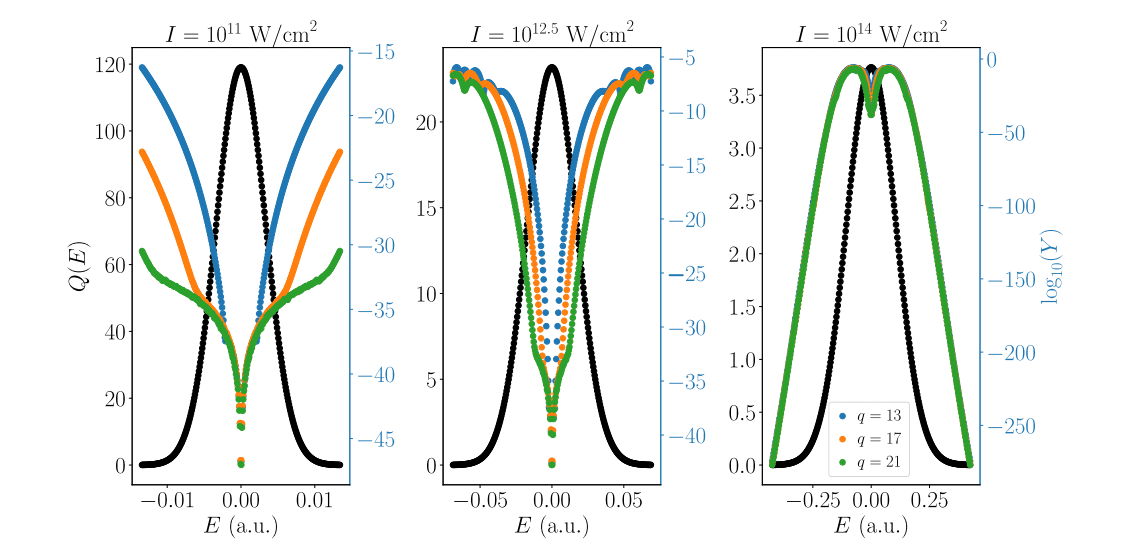
Scientists developed a fully quantized framework to investigate how bright squeezed vacuum (BSV) light propagates through gas media during high-harmonic generation, addressing a critical gap in understanding strong-field quantum optics by accurately modelling the interaction of light with matter at the quantum level. Researchers focused on the interaction of Argon atoms with linearly polarized BSV light, generated from short laser pulses, to analyze the factors limiting propagation length and harmonic yield. The team meticulously modelled atomic ionization, a crucial step in HHG, by combining strong-field ionization and multi-photon ionization processes, deriving an equation to calculate the ionization probability for any quantum state of light, incorporating the probability of finding the light in a specific electric field. This approach enables precise calculation of the number of harmonic photons generated and allows for comparison with conventional laser sources. The study reveals that infrared photon losses, atomic ground-state depletion, and atomic ionization induce decoherence, significantly limiting the propagation length of BSV and reducing harmonic yield. Despite these limitations, the research establishes conditions under which BSV-generated harmonics can be detected, laying the groundwork for future investigations of BSV in strong-field physics, nonlinear optics, and ultrafast science, and advances the field of quantum optics by incorporating fully quantized approaches to model intense light sources.
Squeezed Vacuum Propagation and Decoherence Limits
Recent advances in light engineering now enable the use of bright squeezed vacuum (BSV) femtosecond pulses in highly nonlinear optics, particularly high-harmonic generation. This work introduces a fully quantized framework to understand how BSV propagates through gas media, addressing a key question of how its quantum properties are maintained during light-matter interactions. Researchers investigated the propagation of intense BSV light, using high-harmonic generation as a means to observe its behaviour. The study reveals that infrared photon losses, atomic ground-state depletion, and atomic ionization induce decoherence effects that significantly limit the propagation length of BSV within the medium, reducing harmonic yield by more than two orders of magnitude compared to that produced by conventional coherent laser light.
This reduction stems from the probabilistic nature of nonlinear interactions and the depletion of atoms from their ground state. The team modelled strong-field ionization using a well-established model and incorporated multi-photon ionization to accurately represent the complex interactions. Despite these limitations, the research establishes the conditions under which BSV-generated harmonics can be detected. By carefully analyzing the interplay between ionization rates and quantum properties, scientists determined that preserving the quantum character of BSV is crucial for generating detectable harmonic signals, laying the foundation for future studies exploring the use of BSV in strong-field physics, nonlinear optics, and ultrafast science, and establishing a basis for investigating its propagation in various states of matter.
Squeezed Vacuum Propagation and Harmonic Generation Limits
This research establishes a comprehensive understanding of how bright squeezed vacuum (BSV) femtosecond pulses propagate through gas media, specifically during high-harmonic generation. The team developed a fully quantized framework to model this propagation, revealing that photon losses, atomic ground-state depletion, and ionization induce decoherence, significantly limiting both propagation length and harmonic yield compared to conventional coherent laser light. The findings indicate that while BSV sources are less efficient overall than coherent light for high-harmonic generation, they exhibit enhanced performance beyond the harmonic cut-off region. The team quantified harmonic output, finding that detectable levels of plateau harmonics can be achieved with a medium propagation length, though extreme harmonics remain challenging to observe.
Acknowledging the difficulty of characterizing quantum states at high photon numbers, the authors emphasize that this work does not demonstrate the quantum nature of the BSV source itself, but rather provides a foundation for understanding its propagation. Future research should focus on enhancing BSV power while minimizing photon losses, and critically, on accounting for propagation effects when examining harmonic phase locking, particularly for applications in attosecond science. This work establishes a basis for exploring BSV propagation in all states of matter, with relevance for strong-field physics, nonlinear optics, and ultrafast science.
👉 More information
🗞 Propagation of intense squeezed vacuum light in non-linear media
🧠 ArXiv: https://arxiv.org/abs/2509.19608

