
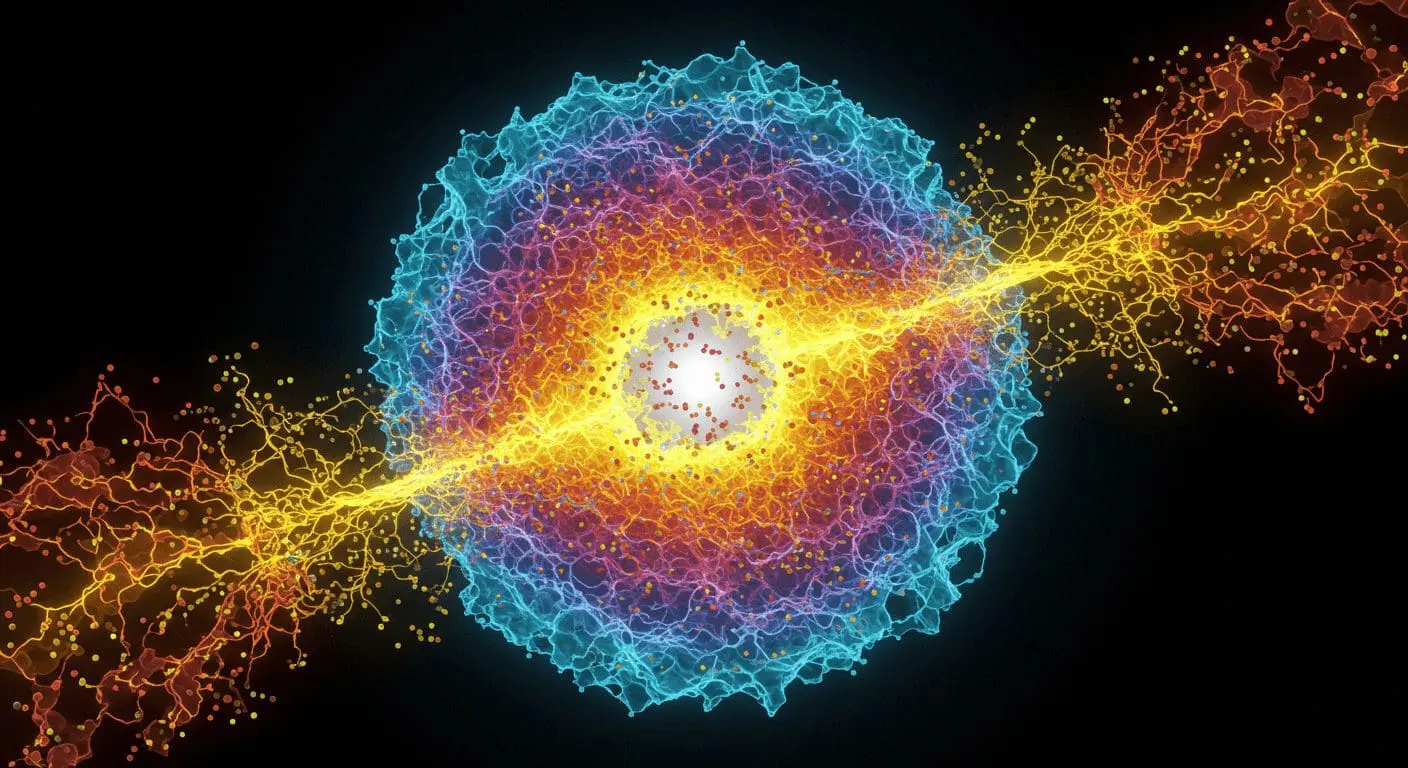
An international team led by researchers from the University of Adelaide has mapped the forces within protons using lattice quantum chromodynamics, a computational technique detailed in their study published in Physical Review Letters.
Their findings reveal force distributions at unprecedented scales, with intensities reaching up to half a million Newtons compressed into spaces smaller than atomic nuclei. This research enhances our understanding of proton behavior in high-energy environments and could contribute to advancements in technologies like proton therapy.
Mapping Proton Forces with Lattice Quantum Chromodynamics
Scientists have made a significant advancement in understanding the “proton inner workings” by mapping the forces within protons using lattice quantum chromodynamics (QCD). This innovative approach involves breaking down space-time into a fine grid to simulate how the strong force varies across different regions inside the proton. By doing so, researchers have achieved unprecedented detail in visualizing these forces.
The findings reveal that despite their minuscule size, the forces within protons are extraordinarily intense, reaching up to half a million Newtons. This discovery underscores the dynamic nature of quarks and gluons within protons, providing critical insights into how they behave under high-energy conditions, such as those observed in experiments at the Large Hadron Collider (LHC).
This research not only deepens our understanding of fundamental physics but also has practical implications. Insights gained from studying proton structure could enhance technologies like proton therapy, which uses high-energy protons to target tumors with precision. By illuminating the “proton inner workings,” this study bridges theory and experiment, paving the way for future innovations in science and medicine.
The work, conducted by an international team including researchers from the University of Adelaide, exemplifies how advanced computational techniques can unlock the mysteries of subatomic particles. Their findings contribute to a broader understanding of matter’s fundamental structure, potentially influencing both theoretical physics and applied technologies.
Exploring Subatomic Matter: Insights from University of Adelaide Researchers
The University of Adelaide researchers have played a pivotal role in advancing our understanding of the “proton inner workings” through their innovative computational methods. By employing lattice quantum chromodynamics (QCD), they have created highly detailed maps of the forces within protons, revealing previously unseen dynamics of quarks and gluons. This achievement represents a significant leap forward in visualizing the intricate interactions that govern the behavior of these fundamental particles.
Joshua Crawford, a University of Adelaide PhD student, spearheaded the computational efforts behind this groundbreaking research. His work demonstrated that the forces within protons are not only immense but also highly localized, reaching up to half a million Newtons in intensity. This discovery provides critical insights into how quarks respond to external stimuli, such as high-energy photons, and how these responses contribute to the overall stability and functionality of the proton.
The implications of this research extend beyond theoretical physics. By illuminating the “proton inner workings,” the findings offer new perspectives on how protons behave in extreme conditions, such as those encountered in particle accelerators like the Large Hadron Collider (LHC). This enhanced understanding could refine models used to predict proton behavior in high-energy environments, ultimately contributing to more accurate simulations and experiments.
Associate Professor Ross Young emphasized the importance of this work within the broader context of scientific discovery. Drawing parallels to historical advancements in understanding light and matter, he highlighted how incremental insights into fundamental physics can lead to transformative technologies. The University of Adelaide team’s research not only deepens our knowledge of subatomic particles but also underscores the potential for future innovations in fields ranging from medicine to energy.
In summary, the University of Adelaide researchers have made a substantial contribution to unraveling the mysteries of the proton’s internal structure. Their work exemplifies how cutting-edge computational techniques can unlock new dimensions of understanding in particle physics, paving the way for both theoretical breakthroughs and practical applications.
Force Field Maps Reveal Intense Internal Dynamics
Joshua Crawford, a University of Adelaide PhD student, spearheaded the computational efforts behind this groundbreaking research. His work demonstrated that the forces within protons are not only immense but also highly localized, reaching up to half a million Newtons in intensity. This discovery provides critical insights into how quarks respond to external stimuli, such as high-energy photons, and how these responses contribute to the overall stability and functionality of the proton.
The implications of this research extend beyond theoretical physics. By illuminating the “proton inner workings,” the findings offer new perspectives on how protons behave in extreme conditions, such as those encountered in particle accelerators like the Large Hadron Collider (LHC). This enhanced understanding could refine models used to predict proton behavior in high-energy environments, ultimately contributing to more accurate simulations and experiments.
Associate Professor Ross Young emphasized the importance of this work within the broader context of scientific discovery. Drawing parallels to historical advancements in understanding light and matter, he highlighted how incremental insights into fundamental physics can lead to transformative technologies. The University of Adelaide team’s research not only deepens our knowledge of subatomic particles but also underscores the potential for future innovations in fields ranging from medicine to energy.
In summary, the University of Adelaide researchers have made a substantial contribution to unraveling the mysteries of the proton’s internal structure. Their work exemplifies how cutting-edge computational techniques can unlock new dimensions of understanding in particle physics, paving the way for both theoretical breakthroughs and practical applications.
More information
External Link: Click Here For More