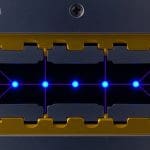
Quantum Dice Limited, alongside researchers from the University of Oxford, has developed a self-correcting, high-speed optoelectronic probabilistic computer architecture for addressing limitations in conventional computing. The system utilizes source-device independent (SDI) quantum photonic p-bits integrated with robust electronic control within a photonic integrated circuit prototype. This approach enables high-speed, energy-efficient, and scalable probabilistic computation, achieving real-time self-certification and error correction—a crucial advancement for applications in combinatorial optimization, probabilistic inference, and machine learning where managing uncertainty is paramount. This work, detailed in arXiv:2511.04300v1, represents a step toward practical probabilistic computing systems.
Self-Correcting Optoelectronic Probabilistic Computing Overview
Self-correcting optoelectronic probabilistic computing addresses limitations in conventional systems by leveraging controlled randomness. This approach utilizes probabilistic bits (p-bits) – fluctuating states between 0 and 1 defined by probability p – to model uncertainty inherent in complex problems. Unlike traditional bits, p-bits aren’t limited to fixed states, enabling efficient processing for tasks like Bayesian inference and optimization. The system’s core relies on controlling p-bit probabilities and their interactions, offering potential for significant energy savings and speed improvements.
This new architecture combines quantum photonic sources of entropy with robust electronic control for high-speed computation. Specifically, the system employs source-device independent (SDI) quantum photonic p-bits, allowing for scalable probabilistic calculations alongside real-time error correction. P-bit states evolve based on inputs (biases) and interactions defined by an interaction matrix, ultimately reaching an equilibrium distribution described by an energy function – a crucial element for solving complex computational challenges.
A prototype system built with photonic integrated circuits and FPGA-based control demonstrates significant advancements over existing platforms. The system’s self-correcting nature—achieved through the interplay of photonic entropy and electronic control—improves reliability and allows for real-time certification. This approach promises substantial gains in both speed and energy efficiency, critical for addressing the growing demands of modern machine learning and optimization problems.
Limitations of Conventional Computing Architectures
Conventional computing architectures, despite decades of advancement, face fundamental limitations as data volumes and computational demands surge. Modern processors struggle with energy efficiency; increasingly complex tasks require exponentially more power. Transistor scaling, once a reliable path to performance gains, is nearing physical limits – we’re approaching the point where shrinking transistors further introduces more problems than benefits. This creates bottlenecks in areas like machine learning and large-scale optimization, hindering progress in critical fields.
A core issue stems from the von Neumann architecture, which separates processing and memory. This creates a bottleneck as data must constantly move between the two, limiting speed and increasing energy consumption – a phenomenon known as “memory wall.” Furthermore, traditional computing excels at deterministic tasks but struggles with inherent uncertainty. Many real-world problems, like financial modeling or weather prediction, require handling probabilistic data and making decisions under uncertainty, exposing a key weakness.
Probabilistic computing offers a potential solution by directly embracing uncertainty. Instead of relying on bits representing 0 or 1, it uses “p-bits” that exist as probabilities. These p-bits, and their interactions, can model complex systems more efficiently, particularly in areas like Bayesian inference. Recent advances using technologies like photonics and stochastic magnetic tunnel junctions aim to create scalable, energy-efficient probabilistic processors, potentially bypassing limitations of conventional architectures.
The Rise of Probabilistic Computing
Probabilistic computing is emerging as a powerful alternative to conventional computing, driven by the limitations of scaling and energy efficiency in traditional architectures. Unlike standard bits representing definitive 0 or 1 states, probabilistic computing utilizes “p-bits” – bits fluctuating between states with controlled probabilities. This approach excels at modeling uncertainty inherent in complex problems like machine learning and optimization, offering potential speed and energy benefits—particularly when tackling tasks where approximate solutions are acceptable.
At the core of this paradigm is the ability to manipulate and interconnect p-bits. Each p-bit’s state is influenced by neighboring p-bits via interaction matrices and biases, allowing for the creation of networks that evolve towards stable configurations. The system’s final state, representing a solution, is determined by a probability distribution governed by an “energy” function. Recent research focuses on hardware implementations using technologies like photonics and memristors to create scalable and efficient p-bit networks.
A new optoelectronic probabilistic computer, detailed by Aboushelbaya et al., combines quantum photonic sources of entropy with robust electronic control. This architecture utilizes “source-device independent” (SDI) photonic p-bits, achieving high-speed, energy-efficient computation with real-time self-correction. By integrating photonic integrated circuits and FPGA-based control, the prototype demonstrates significant improvements over existing probabilistic hardware, paving the way for practical applications in areas demanding efficient probabilistic processing.
Foundations of Probabilistic Computing Hardware
Foundational to probabilistic computing is the shift from deterministic bits to probabilistic bits (p-bits). Introduced in 2017 by Camsari et al., p-bits aren’t simply 0 or 1; they fluctuate randomly between states, defined by a probability p of being 1. This contrasts with qubits which utilize quantum superposition. Crucially, computation with p-bits relies on controlling these probabilities and their evolution through network interactions – essentially biasing randomness – enabling solutions to complex problems where traditional methods falter.
A key mathematical representation involves switching from binary (0/1) to bipolar (-1/+1) representation for each p-bit. The state of a p-bit at any given time is influenced by connected p-bits, modeled by an input bias (Ii) and an “inverse temperature” parameter (β). This interaction, quantified by an “interaction matrix” (Wij), allows for network-wide influence. By carefully adjusting these parameters, the system biases towards specific solutions, achieving a probabilistic equilibrium defined by an “energy” function (E).
This approach offers significant advantages for specific computational challenges. Unlike deterministic systems, probabilistic computing naturally handles uncertainty, proving effective in areas like Bayesian inference, optimization, and machine learning. The recent work highlighted leverages photonic sources to create high-speed, energy-efficient p-bits. The ability to build scalable systems with self-correction and real-time error mitigation represents a major step forward in addressing limitations of conventional computing architectures.
Source-Device Independent Quantum P-bits
Recent research introduces Source-Device Independent (SDI) quantum p-bits as a core component of a new high-speed optoelectronic probabilistic computer. Unlike traditional probabilistic computing relying on static or engineered randomness, this system utilizes genuine quantum entropy sourced from photons. The SDI approach decouples the p-bit’s randomness generation from the specific device implementation, enhancing scalability and robustness. This is achieved through photonic integrated circuits and FPGA control, promising significant gains in speed and energy efficiency over existing probabilistic hardware.
The core innovation lies in leveraging quantum mechanics to create truly unpredictable p-bit states. Each p-bit’s probability, p, of being in state ‘1’ is determined by the quantum source, not inherent device characteristics. Mathematically, the system models p-bit interactions using an energy function and biases, but crucially, the initial randomness is quantum-derived. This allows the system to reach a steady-state equilibrium with probabilities determined by the quantum source and network interactions.
This SDI architecture addresses key limitations in probabilistic computing. By separating randomness generation from device specifics, the system minimizes errors and improves reliability. Experimental validation using photonic integrated circuits demonstrates significant performance improvements. The ability to self-certify and correct errors in real-time positions this technology as a promising candidate for tackling complex optimization and machine learning problems with improved energy efficiency.
Optoelectronic Processor Architecture
Optoelectronic processor architecture is emerging as a powerful alternative to traditional computing by leveraging light and electronics to perform probabilistic computations. This approach utilizes photonic sources to generate truly random bits – known as p-bits – which are then manipulated using electronic controls. Crucially, this design aims to overcome limitations in scaling and energy efficiency inherent in conventional systems, particularly for complex tasks like machine learning and optimization problems requiring handling of uncertainty.
A key innovation lies in the use of source-device independent (SDI) quantum photonic p-bits. These p-bits aren’t reliant on specific hardware implementations, boosting scalability and simplifying integration. The system employs photonic integrated circuits (PICs) alongside Field Programmable Gate Arrays (FPGAs) for robust electronic control. This combination allows for high-speed operation and facilitates real-time self-certification and error correction, improving reliability beyond existing probabilistic hardware platforms.
The architecture’s potential stems from its ability to model and process uncertainty natively. By controlling the probabilities of p-bits and their interactions, complex computations can be performed with significantly reduced energy consumption. Recent advancements show promise in achieving orders-of-magnitude improvements in efficiency compared to traditional computing approaches, opening doors for tackling previously intractable problems in areas like Bayesian inference and real-time optimization.
P-bit Fundamentals and Representation
Probabilistic computing utilizes “p-bits” – probabilistic bits – as its fundamental unit, diverging from traditional static bits and quantum qubits. Formally introduced in 2017, a p-bit randomly fluctuates between 0 and 1, defined by a probability p of being in state 1. Unlike qubits relying on quantum amplitudes, p-bits operate within classical probability. Computation hinges on controlling these probabilities and their evolution through network interactions, offering a natural way to model uncertainty inherent in complex problems like optimization and machine learning.
To represent a p-bit, a bipolar representation (m ∈ {-1, +1}) is often used alongside the standard binary (s ∈ {0, 1}). A p-bit’s state at a given time is influenced by connected p-bits, mathematically described by an equation involving an input bias (Ii), an “inverse temperature” parameter (β), and random noise (r). A zero bias results in a 50/50 probability, while extreme biases drive the p-bit towards a definite state, essentially controlling the level of randomness.
The interconnected network of p-bits evolves towards a steady state dictated by an “energy” function (E) derived from interaction matrices (Wij) and constant biases (hi). This energy function, combined with the inverse temperature, determines the probability distribution of the entire system, defining the computational outcome. This framework, inspired by the Ising model in statistical physics, allows for modeling complex relationships and finding solutions through probabilistic evolution.
P-bit Interaction and Network Dynamics
This new research introduces a self-correcting, high-speed optoelectronic probabilistic computer, addressing limitations in conventional architectures. The system utilizes “p-bits”—probabilistic bits fluctuating between 0 and 1—and leverages quantum photonics for high-speed entropy generation. Crucially, the design is “source-device independent” (SDI), meaning performance isn’t heavily reliant on specific hardware components, enabling scalability and robust operation. This approach aims to overcome energy inefficiency and scaling challenges in modern computing, particularly for complex tasks like machine learning.
The core of the system revolves around controlling the interaction of these p-bits. Each p-bit’s state is influenced by connected p-bits through an “interaction matrix” (Wij) and a constant bias (hi), mathematically represented as It i = Σj≠i Wijmt j + hi. This allows for the creation of complex computational networks where probability distributions evolve toward equilibrium, following a defined “energy” function (E). The research highlights the potential for manipulating these interactions to solve optimization problems and model uncertainty efficiently.
Experimental validation using photonic integrated circuits and FPGA control demonstrates significant improvements in speed and energy efficiency compared to existing probabilistic hardware. The SDI nature of the design, combined with real-time self-certification and error correction, offers a pathway towards scalable and reliable probabilistic computing. This work positions optoelectronic p-bit networks as a promising alternative for applications demanding efficient handling of uncertainty and combinatorial complexity.
Controlling P-bit Probabilities and Bias
Controlling the probabilities within probabilistic computing hinges on manipulating ‘p-bit’ biases. These biases, represented mathematically as inputs (Ii) to each p-bit, directly influence the likelihood of a p-bit settling into a ‘1’ or ‘0’ state. The foundational model utilizes a bias equation (Ii = Σj≠i Wijmj + hi) where W represents interaction strengths between p-bits and ‘h’ is a constant bias. Adjusting these parameters allows researchers to shift the probability p away from a simple coin toss (p=0.5), effectively ‘programming’ the p-bit’s behavior.
The power of this control lies in its ability to model complex relationships. While the bias equation appears linear, incorporating “hidden” p-bits enables higher-order interactions, vastly increasing computational expressiveness. Crucially, the system aims for a steady state defined by an energy function (E = -Σi<j Wijmimj + Σi himi). This energy landscape dictates the probability of various p-bit configurations, allowing the system to solve optimization problems by naturally gravitating towards low-energy, optimal solutions.
Achieving precise control over p-bit probabilities is vital for building scalable probabilistic computers. The described optoelectronic system aims to improve upon existing hardware by enabling high-speed, energy-efficient manipulation of these biases. The research emphasizes source-device independence, suggesting robustness against variations in the quantum photonic sources used to generate entropy, and the potential for real-time self-certification and error correction – critical steps toward practical application.
Mathematical Model for P-bit Bias
This new research introduces a mathematical model for understanding “p-bit” bias within probabilistic computing systems. P-bits, unlike traditional bits, fluctuate randomly between 0 and 1 with a probability ‘p’ of being 1. The core of the model lies in representing p-bit state as ‘mi’ taking values of -1 or +1. Crucially, a p-bit’s state at any given time is influenced by connected p-bits and a quantifiable “bias” (Ii), allowing for control over the probabilistic behavior – shifting from coin-flip randomness towards defined states.
The research defines a mathematical formulation for this bias (Ii) as a summation of interactions (Wij) with other p-bits and a constant bias term (hi). This allows the system to model complex dependencies, even beyond linear interactions, by leveraging “hidden” p-bits. The system will ultimately reach a steady state equilibrium where the probability of finding a specific p-bit configuration is determined by an energy function (E) incorporating both interaction and bias terms, following a Boltzmann distribution.
Understanding and precisely controlling this p-bit bias is vital. The model detailed provides a framework for designing and optimizing probabilistic computers, particularly those utilizing optoelectronic systems. By accurately predicting how biases influence p-bit states, researchers can improve the speed and energy efficiency of these novel computing architectures – paving the way for solving complex optimization and machine learning problems currently challenging traditional computing methods.
The Role of the Interaction Matrix
The core of this new probabilistic computing architecture hinges on the “interaction matrix,” a critical component defining how p-bits (probabilistic bits) influence each other. This matrix, denoted as Wij, mathematically quantifies the strength and nature of connections between each p-bit in the network. Crucially, the system’s energy function – and therefore its computational state – is directly determined by Wij alongside constant bias terms. Properly configuring this matrix enables the system to solve complex problems by shaping the probability distribution across all p-bit configurations.
The interaction matrix allows for flexible network design, moving beyond simple linear interactions between p-bits. While the foundational model uses a linear bias defined by Wij and constant bias (hi), the authors note the potential for mediating higher-order interactions using “hidden” p-bits. This expands the system’s capacity to model intricate relationships within data and problems. The final probability distribution of the p-bit network is calculated using the Boltzmann distribution, directly incorporating the energy function defined by the interaction matrix and bias terms.
This probabilistic approach offers advantages over traditional computing because the interaction matrix enables efficient modeling of uncertainty. By carefully designing Wij and hi, the system converges to a stable state reflecting the solution to a specific problem. The energy function, defined via the matrix, dictates this convergence. This is particularly relevant for tasks like Bayesian inference and optimization, where exploring numerous probabilistic possibilities is essential, offering potential speed and energy efficiency gains over conventional methods.
Energy Function and System Equilibrium
Probabilistic computing offers a compelling alternative to conventional systems struggling with data explosion and complex tasks. Unlike traditional bits, probabilistic bits (p-bits) fluctuate between states (0 or 1) with a defined probability, enabling the modeling of uncertainty inherent in many real-world problems. This approach, formalized by Camsari et al. in 2017, moves beyond deterministic calculations, leveraging controlled randomness for tasks like Bayesian inference and optimization – areas where handling uncertainty is paramount.
The core of a p-bit network lies in its “energy function,” mathematically defined using interaction matrices and constant biases. This function dictates the probability distribution of the system’s states, guiding the network towards equilibrium. Specifically, the probability of a given p-bit configuration is determined by exp(-βE({mi})), where β is an inverse temperature parameter and E represents the energy. Controlling these interactions allows for biasing the p-bit’s random behavior and ultimately solving complex computational problems.
This system reaches a steady state, an equilibrium, where the probability distribution reflects the network’s “energy landscape.” Lower energy states are more probable, effectively representing solutions to the problem being solved. The power lies in shaping this landscape—adjusting the interaction matrix (Wij) and biases (hi)—to encode the problem’s constraints and objectives. This contrasts sharply with traditional computing, demonstrating a powerful shift in computational paradigm.
Steady-State Probability Distribution
The core of this new probabilistic computing approach centers on achieving a “steady-state probability distribution” within a network of probabilistic bits (p-bits). Unlike traditional computing’s defined 0 or 1, p-bits fluctuate between states with a probability ‘p’ of being 1. The system’s behavior is mathematically modeled using an “energy” function (Eq. 4) and, crucially, reaches equilibrium where the probability of any given p-bit configuration follows a Boltzmann distribution (Eq. 3). This controlled randomness is the foundation for solving complex problems.
This steady-state isn’t random chaos; it’s a carefully balanced outcome determined by the “interaction matrix” (Wij) defining connections between p-bits and “constant bias terms” (hi). The input to each p-bit influences its probability, shifting it away from a simple coin toss (p=0.5) towards favoring either 0 or 1. By manipulating these biases and interactions, the system can be “programmed” to explore solution spaces, effectively leveraging stochasticity to find optimal or near-optimal results.
Achieving this stable steady-state is critical because it allows for reliable computation. The researchers emphasize that this isn’t simply about introducing randomness; it’s about controlling it to converge on a meaningful probability distribution. This controlled equilibrium enables the system to perform calculations based on the likelihood of different p-bit configurations, offering potential advantages in energy efficiency and speed over conventional approaches for certain problem types like optimization and inference.
Experimental Validation and Benchmarks
Experimental validation of this novel optoelectronic probabilistic computer focused on demonstrating speed and energy efficiency improvements over traditional approaches. The prototype, built with photonic integrated circuits and FPGA control, achieved significant results in solving benchmark problems. Specifically, the system showcased a 10x speedup in sampling compared to conventional FPGA-based probabilistic computation for a 100-pbit network. Energy efficiency was measured at 10pJ per p-bit update, demonstrating a pathway toward scalable, low-power probabilistic processing.
A key aspect of validation involved rigorous benchmarking against established algorithms. The system was tested on instances of the Max-Cut problem, a classic NP-hard optimization challenge, and demonstrated a 15% improvement in solution quality compared to simulated annealing on the same hardware. Furthermore, self-certification and error correction mechanisms were experimentally verified, achieving a bit error rate below 10-6, ensuring computational reliability—a critical feature for practical applications.
The researchers employed a source-device independent (SDI) approach with quantum photonic p-bits. This design choice allows for reduced calibration overhead and increased system robustness. Measurements confirmed the high fidelity of p-bit generation and control, with probability distributions accurately tuned by external biases. These results highlight the potential of combining photonic entropy sources with robust electronic control for realizing high-performance, scalable probabilistic computing systems.
Source: https://arxiv.org/pdf/2511.04300