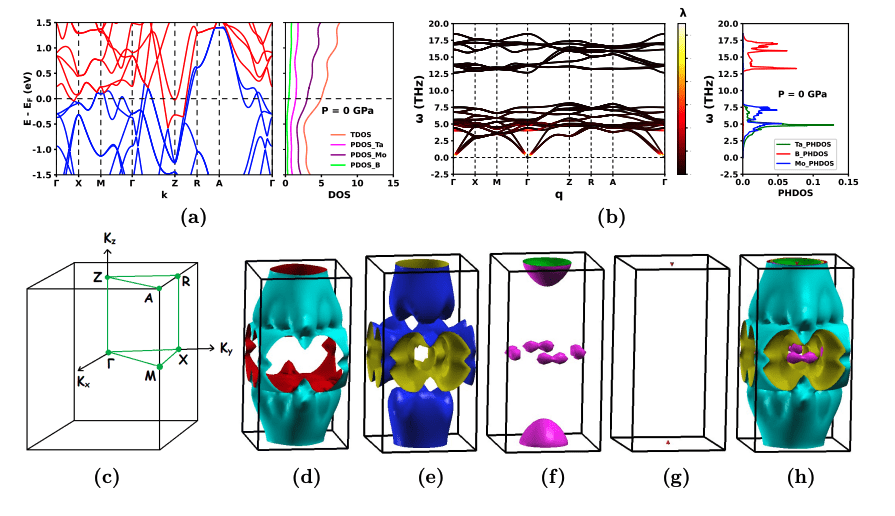
Calculations utilising Migdal-Eliashberg theory reveal anisotropic superconductivity in a ternary boride, arising from strong electron-phonon coupling between molybdenum bonding states and in-plane atomic vibrations, yielding a critical temperature of 4.2 K. Superconductivity initially diminishes with applied hydrostatic pressure up to 59.71 GPa due to reduced density of states and phonon stiffening. However, a Lifshitz transition at 76.69 GPa alters the Fermi surface topology, enhancing Fermi surface nesting and abruptly stabilising superconductivity, resulting in a non-monotonic, V-shaped pressure response.
The behaviour of materials under extreme pressure continues to reveal unexpected phenomena, particularly in superconductivity – the lossless transmission of electrical current. Recent research focuses on ternary borides, compounds containing boron and two other metallic elements, and their potential for high-temperature superconductivity. A team led by Subhajit Pramanick and Sudip Chakraborty, alongside A. Taraphder, have investigated the relationship between applied pressure and the superconducting properties of a specific ternary boride. Their work, detailed in the article ‘Pressure induced evolution of anisotropic superconductivity and Fermi surface nesting in a ternary boride’, utilises computational modelling – specifically Migdal-Eliashberg theory implemented within the Electron Phonon Wannier (EPW) code – to demonstrate a complex, V-shaped response of superconductivity to hydrostatic pressure up to 76.69 GPa. The study highlights the crucial role of Fermi surface topology and electron-phonon coupling in determining a material’s superconducting characteristics.
Pressure-Induced Modulation of Superconductivity in Ternary Boride Ta(MoB)₂
Computational modelling reveals a distinctive pressure-dependent behaviour in the superconducting properties of the ternary boride Ta(MoB)₂. Ab initio calculations, utilising Density Functional Theory (DFT), demonstrate a non-monotonic response of the critical temperature and superconducting energy gap to applied hydrostatic pressure. The material exhibits a minimum in superconducting performance around 59.71 GPa, a behaviour contrasting with many conventional superconductors. This suggests a substantial alteration in the material’s electronic structure under compression.
The research identifies robust electron-phonon coupling – the interaction between electrons and lattice vibrations (phonons) – as crucial for Cooper pair formation, the mechanism underpinning superconductivity. Specifically, bonding states involving molybdenum atoms and their in-plane vibrations contribute significantly to this coupling. However, the strength of this coupling diminishes with increasing pressure up to 59.71 GPa, correlating with a decrease in the density of electronic states at the Fermi level – the highest occupied energy level at absolute zero – and a stiffening of phonon modes. This suppression of superconductivity necessitates detailed analysis of the underlying mechanisms.
Calculations confirm the absence of charge density instabilities, ruling out alternative explanations for the observed changes. Analysis of the Lindhard susceptibility – a measure of the system’s tendency to form charge density waves – revealed no significant peaks, and no phonon softening was observed. Beyond 59.71 Gpa, the material undergoes a notable change. At 76.69 GPa, a Lifshitz transition occurs – a topological change in the Fermi surface, fundamentally altering the electronic landscape and impacting the material’s ability to support superconductivity.
This transition improves the ‘nesting’ condition of the Fermi surface – a measure of how well portions of the Fermi surface can overlap – enhancing the electronic structure’s ability to support superconductivity. Consequently, the superconducting properties abruptly stabilise, resulting in a V-shaped response to pressure: superconductivity is suppressed at lower pressures and enhanced at higher pressures. This unique behaviour highlights the sensitivity of Ta(MoB)₂’s superconductivity to changes in its electronic structure and opens up possibilities for tuning its properties through external pressure.
The study utilises the Migdal-Eliashberg theory, implemented within the Electron-Phonon with Wannier functions (EPW) code, to calculate the anisotropic superconducting properties. Wannier functions, employed to describe the electronic structure, provide an efficient method for calculating electron-phonon interactions, enabling accurate determination of the coupling strength. The findings demonstrate that Ta(MoB)₂ exhibits a single-gap anisotropic superconducting state, indicating a relatively simple superconducting order parameter. This anisotropy suggests that the superconducting properties may vary depending on the direction of the applied electric or magnetic field.
Furthermore, Ta(MoB)₂’s superconductivity is readily tunable via hydrostatic pressure due to its low bulk modulus and negative formation energy, making it a promising material for potential applications. The low bulk modulus indicates that the material is relatively easy to compress, allowing for significant changes in its electronic structure with modest pressure. The negative formation energy suggests that the material is thermodynamically stable, making it easier to synthesise and maintain.
Researchers meticulously examined the electronic structure and phonon spectra to ensure that charge density waves or other instabilities were not contributing to the suppression of superconductivity. This thorough analysis strengthens the conclusion that the Lifshitz transition and the resulting changes in the Fermi surface primarily drive the observed changes in superconductivity. The study provides valuable insights into the complex interplay between pressure, electronic structure, and superconductivity in Ta(MoB)₂, paving the way for future research and potential applications.
Further research could focus on investigating the effects of different types of pressure, such as uniaxial or biaxial pressure, on the superconducting properties of Ta(MoB)₂. Additionally, exploring the possibility of combining pressure with other external stimuli, such as magnetic fields or electric fields, could lead to even more dramatic changes in the material’s superconducting behaviour. The findings of this study contribute to the growing body of knowledge on unconventional superconductivity and highlight the importance of understanding the complex interplay between electronic structure and superconductivity in materials.
👉 More information
🗞 Pressure induced evolution of anisotropic superconductivity and Fermi surface nesting in a ternary boride
🧠 DOI: https://doi.org/10.48550/arXiv.2505.10905