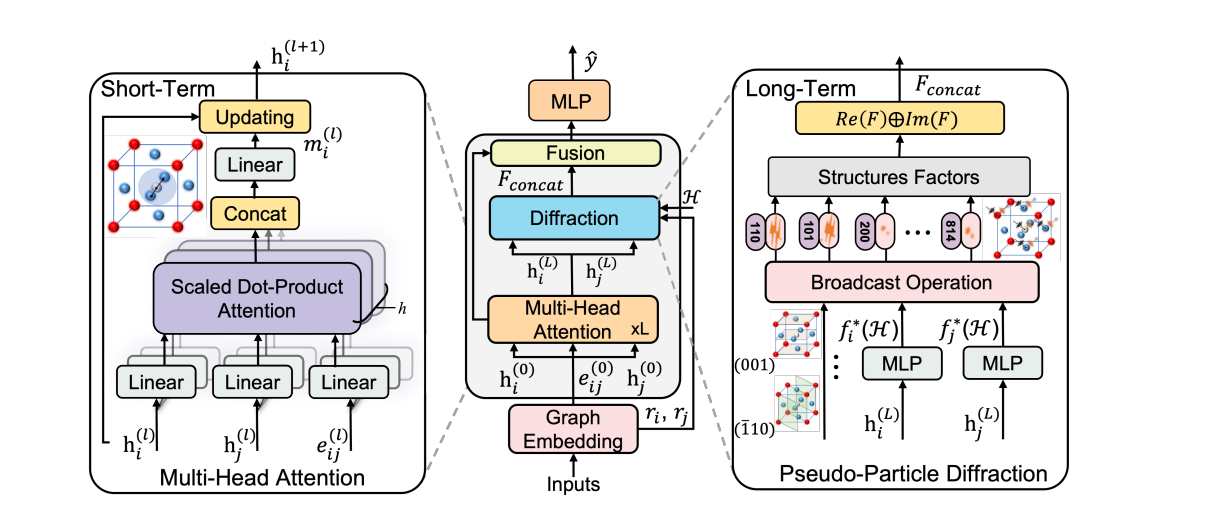
Predicting the properties of crystals presents a significant computational challenge, particularly for complex materials where traditional methods struggle with accuracy and scale. Bin Cao, Yang Liu, and Longhan Zhang, alongside colleagues, now demonstrate a new approach that moves beyond relying solely on a crystal’s structure. Their work introduces a model, PRDNet, which incorporates information from how a material diffracts ‘pseudo-particles’, synthetic representations of fundamental interactions, alongside standard graph-based methods. This innovative combination captures long-range atomic relationships often missed by existing techniques, allowing the model to distinguish between subtly different crystal structures and, crucially, predict material properties with unprecedented accuracy, as validated through extensive testing on large materials databases.
Crystal Structure Prediction with Reciprocal Embedding
Scientists have developed PRIME, a new machine learning model for predicting material properties. This model improves upon existing methods by incorporating information about both the real-space and reciprocal-space representations of crystal structures. Real space describes the familiar arrangement of atoms in three dimensions, while reciprocal space provides a mathematical view based on how waves, such as X-rays, interact with the material. By combining these perspectives, PRIME captures a more complete picture of the atomic interactions within a material. PRIME utilizes a graph neural network, a type of machine learning model well-suited for representing complex relationships.
The model constructs graphs at multiple scales to capture both local and long-range interactions between atoms. Crucially, PRIME explicitly embeds information from the reciprocal lattice into this graph representation, allowing it to understand the symmetry and periodicity of the crystal structure. This design ensures the model’s predictions remain consistent regardless of the crystal’s orientation or position, reflecting fundamental physical principles. The model predicts a range of important material properties, including formation energy, which indicates stability, and band gap, which determines whether a material is a metal, semiconductor, or insulator. It also accurately predicts mechanical properties like bulk modulus, shear modulus, and Young’s modulus, describing a material’s resistance to deformation. By incorporating physics-based principles into its design, PRIME demonstrates improved accuracy and generalizability compared to existing models, offering a powerful tool for materials discovery and design.
Predicting Crystalline Material Properties with PRDNet
Researchers have created PRDNet, a new method for predicting the properties of crystalline materials, achieving state-of-the-art performance across multiple datasets. This work introduces a novel approach to capturing long-range atomic interactions by incorporating information about how materials diffract waves, such as X-rays, into a neural network. This provides a more physically informed model than existing methods, consistently outperforming previous models on the Materials Project, JARVIS-DFT, and MatBench databases. Experiments reveal that PRDNet achieves the lowest errors in predicting formation energy, reaching 0.
028 eV/atom on the Materials Project and 0. 032 eV/atom on JARVIS-DFT. Furthermore, the model accurately predicts band gaps, achieving 0. 151 eV on the Materials Project and 0. 140 eV on JARVIS-DFT.
Predictions of bulk modulus also demonstrate significant improvement, with errors of 0. 035 log(GPa) and 0. 064 log(GPa) respectively on the two datasets. Improvements are also seen in predicting shear modulus, achieving 0. 108 log(GPa) and 0.
122 log(GPa) on the Materials Project and JARVIS-DFT. Notably, PRDNet achieved 93. 3% accuracy in classifying materials as either metals or non-metals on the Materials Project. Detailed analysis confirms the importance of each component within PRDNet, demonstrating that removing the diffraction module, using a simplified attention mechanism, or excluding crucial connections all lead to performance degradation. The team also compared a learned representation of atomic interactions to one based on X-ray photons, finding that the learned representation consistently outperformed the X-ray method across all datasets and property prediction tasks. These results demonstrate that PRDNet offers a principled framework for integrating crystallographic theory with deep learning, providing a novel conception of invariant crystal representation and achieving superior performance in material property prediction.
Diffraction Neural Network Predicts Crystal Properties
Scientists have introduced PRDNet, a new approach to predicting the properties of crystalline materials. This method employs a Pseudo-Particle Ray Diffraction Neural Network, integrating crystallographic theory with deep learning. By incorporating a physically-based representation of how materials diffract waves, PRDNet captures long-range atomic interactions more effectively than previous methods, achieving state-of-the-art performance across multiple databases. The key innovation lies in the use of a diffraction-based representation, which allows the network to better understand the relationships between atoms within a crystal structure.
This representation proves particularly sensitive to variations in atomic type, local chemical environment, and diffraction directions, leading to improved predictive accuracy. Extensive experiments demonstrate PRDNet’s effectiveness in predicting formation energy and band gap, establishing a principled framework for integrating physical knowledge into deep learning models for materials science. The authors acknowledge that the benefits of this diffraction-based approach are currently limited to periodic structures and does not easily extend to non-periodic materials. Future research directions include expanding the model to incorporate additional physical phenomena like phonon interactions and electronic structures, and developing multi-scale modeling capabilities to handle structures across different length scales. The team also envisions integrating PRDNet with experimental design frameworks to accelerate the process of materials discovery and structure refinement.
🗞 Beyond Structure: Invariant Crystal Property Prediction with Pseudo-Particle Ray Diffraction
🧠 ArXiv: https://arxiv.org/abs/2509.21778