Quantum computers promise to revolutionise fields from medicine to materials science, but building them presents formidable challenges. Wolfgang Dür from the University of Innsbruck and colleagues demonstrate a new approach to performing complex calculations on quantum computers with limited connections between individual quantum bits. The team proposes a novel architecture that efficiently separates the roles of data processing and entanglement generation, allowing for the creation of multiple, long-ranged connections between qubits using only local, nearest-neighbour interactions and mid-circuit measurements. This method enables several quantum operations to occur in parallel, significantly speeding up computation, and importantly, can be implemented with minimal additional resources on existing quantum computing platforms. This research represents a crucial step towards building more scalable and powerful quantum computers capable of tackling currently intractable problems.
Quantum computers hold immense promise for revolutionizing fields like materials science, optimization, and chemistry. However, building these powerful machines presents significant challenges, particularly in establishing connections between qubits – the fundamental units of quantum information. Current systems often limit interactions to immediate neighbors, hindering scalability and requiring complex workarounds for distant qubit communication.
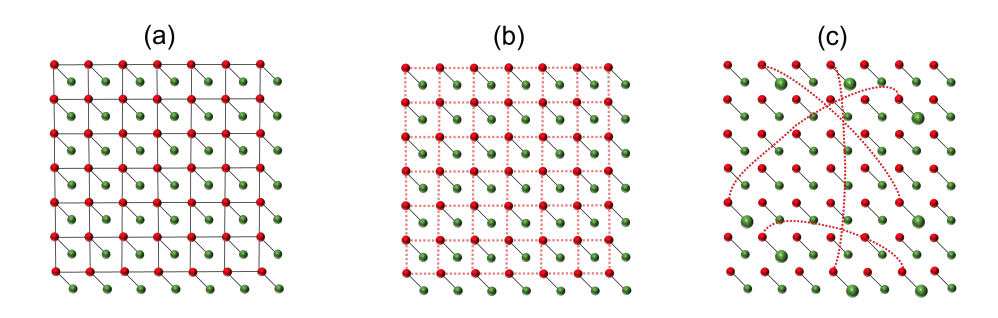
Researchers are now addressing this limitation with novel architectures that efficiently enable long-range interactions. This emerging approach cleverly divides qubits into two groups: ‘data qubits’ which store and process information, and ‘auxiliary qubits’ dedicated to creating connections. Instead of directly linking distant data qubits, the system uses entanglement – a crucial quantum phenomenon – generated amongst the auxiliary qubits as a resource.
This entanglement acts as a bridge, allowing operations between data qubits that would otherwise be impossible or incredibly inefficient. The core of this method lies in generating a specific type of entangled state – a two-dimensional cluster state – amongst the auxiliary qubits. This cluster state, created through short-range interactions, is then reshaped through carefully chosen measurements.
These ‘mid-circuit measurements’ don’t destroy the entanglement, but rather reconfigure it, effectively creating multiple long-distance connections – known as Bell pairs – between the data qubits. This allows for the parallel execution of multiple two-qubit operations, significantly speeding up computations and offering a pathway towards building more scalable and efficient quantum computers. Researchers have identified optimal lattice structures to maximize the effectiveness of this approach, paving the way for practical implementation in future quantum processors.
A key innovation lies in the measurement process itself. Rather than disrupting the overall entanglement structure, the team employs a technique that preserves it, allowing for multiple connections to be established simultaneously. They achieve this by following specific ‘paths’ across the cluster state and performing measurements in a coordinated manner.
These paths aren’t straight lines; they weave back and forth, allowing for complex connections without isolating sections of the quantum state. This ‘entanglement-structure-preserving’ approach is particularly powerful because it allows for the creation of multiple, crossing connections, increasing computational possibilities and making the architecture highly versatile. The results demonstrate that this architecture can be implemented with minimal overhead in existing quantum computing systems, making it a practical advancement.
Researchers have shown that this approach isn’t limited to theoretical designs; it can readily perform not just individual two-qubit gates, but also complex multi-qubit rotations and even arbitrary multi-qubit diagonal gates. Notably, they can generate specific multi-qubit rotations with a level of control and precision previously difficult to achieve. Furthermore, this architecture efficiently implements Clifford circuits – a fundamental building block for many quantum algorithms – through a form of quantum teleportation.
By leveraging a connection to graph states, these circuits can be implemented deterministically, opening doors to more complex and powerful quantum algorithms. The team has also found that using a specific measurement scheme improves the fidelity of the generated connections, and that three-dimensional structures could achieve even higher fidelity. This research represents a significant step forward in quantum computing, offering a pathway to build larger, more powerful, and more versatile quantum processors.
👉 More information
🗞 Long-ranged gates in quantum computation architectures with limited connectivity
🧠 DOI: https://doi.org/10.48550/arXiv.2507.08936