

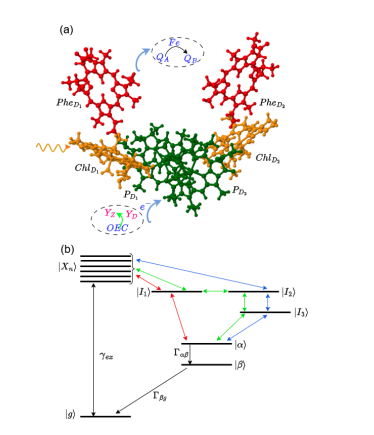
Photosynthetic reaction centres, the molecular complexes responsible for initiating energy conversion in plants, exhibit a surprising capacity for work beyond simple energy transfer. New research delves into the thermodynamic limits of this capacity, specifically examining ‘ergotropy’ – the maximum work obtainable from a quantum state. Trishna Kalita, Manash Jyoti Sarmah, and colleagues from the QuAInT Research Group at Gauhati University, present a theoretical analysis of Photosystem II, utilising a master equation approach to model excitonic and charge-transfer rates. Their findings, detailed in the article ‘Ergotropy of a Photosynthetic Reaction Center’, reveal that specific electron transfer pathways within the complex demonstrate a greater potential for work extraction, suggesting a sophisticated mechanism for biological energy harvesting and storage.
Quantum thermodynamics investigates the limitations and possibilities of energy conversion in quantum systems, extending classical thermodynamics into the realm of quantum mechanics. A central concept is ergotropy, which quantifies the maximum work obtainable from a quantum state via unitary transformations, distinguishing between usable and inaccessible energy. This is particularly relevant for systems far from thermal equilibrium, where both ‘active’ states capable of work extraction and ‘passive’ states unable to perform work coexist, refining our understanding of work at the nanoscale and informing the design of quantum devices.
Biological systems, notably those involved in photosynthesis, present intriguing examples of efficient energy conversion operating under non-equilibrium conditions, and the Photosystem II Reaction Centre (PSIIRC) serves as a model for exploring this interplay between quantum thermodynamics and bioenergetics. PSIIRC facilitates charge separation through complex pathways involving excitons and pigment-protein interactions, exhibiting quantum coherence and potentially exploiting non-equilibrium population structures.
Recent experimental work positions PSIIRC constructs between electrodes to directly observe quantum transport effects and measure photocurrents, providing valuable insights into the quantum dynamics within the system and validating theoretical models. By analysing different charge transfer pathways within PSIIRC, scientists aim to determine how the system optimises energy conversion and potentially functions as a biological ‘energy capacitor’, connecting fundamental thermodynamic principles to the intricacies of biological energy harvesting.
Researchers currently investigate the intricacies of photosynthetic reaction centres, specifically Photosystem II, employing a master equation approach to analyse energy conversion efficiency. This methodology models excitonic and charge-transfer rates at levels reflecting realistic biological conditions, allowing scientists to establish a benchmark against which to measure the potential of Photosystem II. This approach moves beyond traditional efficiency calculations, probing the fundamental limits of energy conversion within the biological system and revealing the potential for optimising energy harvesting.
The analysis reveals that specific electron transfer pathways
The analysis reveals that specific electron transfer pathways within Photosystem II exhibit significantly higher ergotropy than others, with pathways involving initial charge separation and progressing through three sequential charge-separated states demonstrating a greater capacity for work extraction. These pathways effectively function as ‘energy capacitors’ within the photosynthetic apparatus, while a pathway circumventing a particular pair of components displays markedly reduced ergotropy, suggesting a less efficient route for energy conversion. This disparity arises from the population dynamics within the system, specifically transitions between ‘active’ and ‘passive’ regimes, where an active regime implies a state capable of performing work and a passive state represents a dissipation of potential energy.
The master equation methodology allows researchers to model the complex interplay between these regimes, revealing how population control influences the overall energy conversion efficiency, and the concept of population-induced transitions is central, as the distribution of molecules across different energy states dictates the system’s ability to perform work. By manipulating these populations, biological systems may optimise energy harvesting, effectively ‘tuning’ the photosynthetic apparatus for maximum efficiency, not through simple increases in energy input, but through a sophisticated control of energy flow and distribution.
Photosystem II, a pivotal protein complex in plant life, actively harvests light energy and converts it into chemical energy, a process now under intense theoretical scrutiny. Researchers employ a master equation approach to model energy transfer within the reaction centre, focusing on ergotropy – a measure of the maximum work obtainable from a quantum state without energy dissipation, incorporating both excitonic and charge-transfer rates, and utilising realistic spectral densities to accurately represent the complex’s behaviour. The study identifies specific electron transfer pathways that demonstrate a heightened capacity for work extraction, effectively functioning as ‘energy capacitors’, with pathways involving charge separation between primary donor and acceptor molecules, alongside a sequential route through three charge-separated states, yielding significantly higher ergotropy compared to a bypass route.
This difference in efficiency stems from population-induced transitions between active and passive thermodynamic regimes within the complex, and the researchers demonstrate that the population dynamics directly influence the system’s ability to perform work. The master equation framework allows for a detailed examination of energy flow, revealing how the complex navigates between states capable of performing work and those that dissipate energy, and by constructing passive states, the researchers quantify the potential for work extraction along each pathway, providing a nuanced understanding of the complex’s energetic landscape. This approach moves beyond simple efficiency calculations, focusing instead on the thermodynamic potential inherent within the system, suggesting biological systems actively exploit non-equilibrium population structures to optimise energy conversion.
This body of work demonstrates a sustained investigation
This body of work demonstrates a sustained investigation into the quantum dynamics underpinning biological light harvesting and molecular-scale electron transport, actively probing the efficiency of energy transfer within photosynthetic complexes, utilising advanced spectroscopic techniques and computational modelling. Theoretical investigations employ master equations and related approaches to model the dynamics of open quantum systems, acknowledging the crucial role of environmental interactions, extending beyond simple Markovian descriptions, recognising the importance of non-Markovian dynamics where past states influence present behaviour. The application of these techniques to Photosystem II specifically reveals pathways for optimising energy conversion, identifying routes involving charge separation as particularly effective in maximising work extraction, effectively functioning as biological ‘energy capacitors’.
The research highlights a clear connection between thermodynamic principles and biological energy harvesting, and by constructing passive states, researchers quantify ergotropy, the maximum work obtainable from a system, demonstrating how population-induced transitions between active and passive regimes influence energy conversion efficiency. This suggests biological systems actively exploit non-equilibrium population structures to enhance their performance, a finding with potential implications for the design of artificial light-harvesting devices. Future work should concentrate on refining the accuracy of theoretical models by incorporating more realistic representations of the protein environment and solvent effects, investigating the interplay between quantum coherence and environmental noise, and exploring the potential for manipulating these factors to further enhance energy transfer efficiency.
Extending these investigations to other biological systems and exploring the possibility of replicating these principles in artificial molecular devices represents a logical progression, and a deeper understanding of the role of vibrational modes in facilitating energy transfer warrants further attention. Combining advanced spectroscopic techniques with sophisticated computational modelling will be essential for elucidating these complex interactions, ultimately aiming to bridge the gap between fundamental physics and biological function, paving the way for innovative technologies inspired by nature’s elegant solutions. This research establishes a framework for understanding how biological systems manage energy flow at a quantum level, potentially inspiring new technologies.
🗞 Ergotropy of a Photosynthetic Reaction Center
🧠 DOI: https://doi.org/10.48550/arXiv.2507.04097


