Silicon-based quantum computing attracts considerable attention due to its compatibility with existing microfabrication techniques, and researchers continually explore ways to build robust quantum bits within this material. Shahrzad Taherizadegan, Faezeh Kimiaee Asadi, and Jia-Wei Ji, all from the University of Calgary, alongside Daniel Higginbottom from Simon Fraser University and Christoph Simon, also of the University of Calgary, investigate the feasibility of creating quantum gates using defects known as T centers in silicon. Their work explores several methods for linking these quantum bits, ranging from relying on the chance interaction of photons to utilising more predictable magnetic fields, and importantly, assesses the potential for achieving high-fidelity operations. The team’s detailed analysis, including the first analytical calculations accounting for real-world imperfections, suggests that a photon interference-based scheme with feedback offers a promising pathway towards competitive efficiency and fidelity, potentially accelerating the development of silicon-based quantum technologies.
Researchers are actively exploring ways to control and connect individual ‘T’ centers, atomic-scale defects within silicon, to create powerful quantum computers. This research investigates several methods for achieving this control, encompassing both probabilistic techniques relying on detecting individual photons and deterministic approaches utilising magnetic fields.
SiV Qubit Gate Fidelity Calculations and Analysis
The team meticulously analysed several proposed quantum gate schemes using silicon-vacancy (SiV) centers in diamond, focusing on methods for entangling and manipulating these quantum bits. They developed analytical expressions to calculate the fidelity of each scheme, considering factors that degrade performance, such as decoherence and experimental limitations. This detailed analysis aims to assess the feasibility of implementing these gates with current and near-future technology. One scheme, relying on virtual photon exchange, requires strong interaction between the qubits and a surrounding cavity.
While conceptually simple, achieving the necessary conditions proves challenging. Another approach, Raman virtual photon exchange, offers potentially higher fidelity by avoiding direct excitation of the qubits, but still demands precise control and strong cavity interaction. A third method, based on photon scattering, faces limitations due to slow operation speeds. A critical parameter across all schemes is ‘cavity cooperativity’, a measure of the strength of interaction between the qubits and the cavity. Higher cooperativity generally leads to improved fidelity, but is difficult to achieve experimentally. The analysis also considers the impact of various decoherence mechanisms, which limit the duration of quantum information. The team used mathematical approximations to simplify calculations and gain insights into the key factors affecting gate performance.
T Center Entanglement via Photon Interference
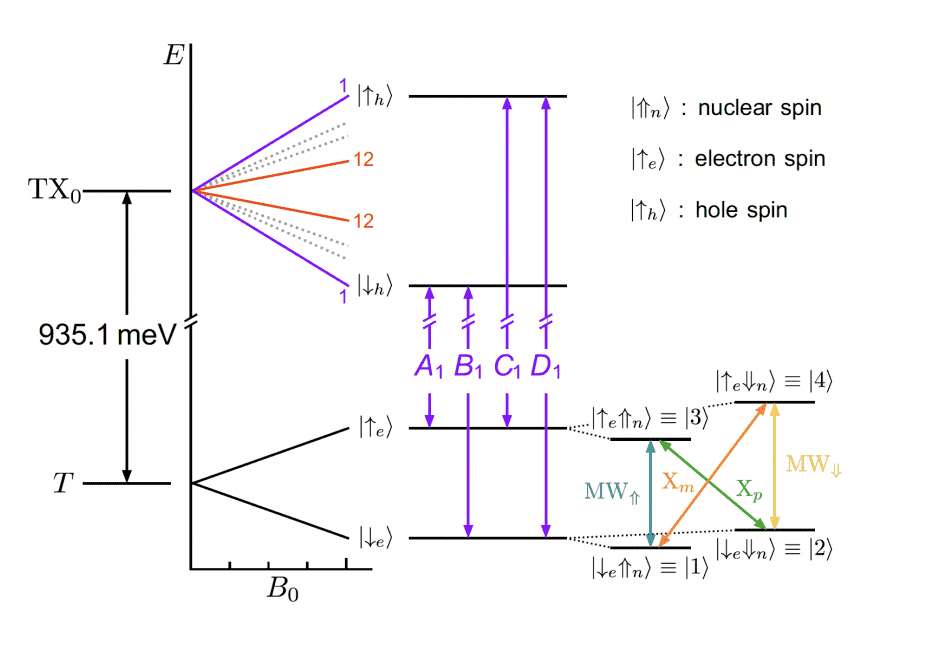
Silicon-based quantum technologies are gaining prominence, and research focuses on utilizing the unique spin properties of defects within silicon known as T centers. Several methods for controlling interactions between these T centers have been investigated, ranging from probabilistic approaches relying on photon detection to deterministic methods using magnetic fields. Researchers have meticulously analyzed the potential of each scheme, considering factors like efficiency, fidelity, and the time required to perform operations. One promising approach involves creating entanglement through photon interference, where the emission from two T centers is combined and analyzed.
Initial calculations suggested a maximum theoretical efficiency of 50% for this method, but practical limitations like photon loss significantly reduce performance. To address this, researchers explored adding a feedback mechanism, where the system responds to detected photons, and have demonstrated that this can boost success probabilities above 50%. This improvement stems from the ability to filter out unwanted outcomes and focus on those that herald successful entanglement. Detailed analysis using a sophisticated mathematical technique called photon-count decomposition has allowed precise calculation of both efficiency and fidelity, accounting for imperfections like optical decoherence and detection errors.
The results demonstrate that the feedback-enhanced photon interference scheme offers a competitive balance between these crucial metrics. Furthermore, incorporating optical cavities, structures that trap and enhance light, significantly improves both efficiency and fidelity by increasing the probability of detecting emitted photons. Compared to other methods, including those relying on deterministic magnetic fields, the photon interference scheme with feedback presents a viable path toward practical implementation. While spin decoherence, the loss of quantum information, remains a challenge, the research highlights that the dominant form of decoherence, spin dephasing, can be mitigated, allowing for longer operation times. These findings suggest that this approach warrants further experimental investigation as a key component of future silicon-based quantum technologies
Silicon Qubit Gates, Comparative Analysis and Outlook
This research investigates several methods for creating quantum gates between individual ‘T’ centers in silicon, exploring both probabilistic and deterministic approaches. The team assessed the potential of schemes based on photon interference, photon scattering, and magnetic dipole interactions, calculating key performance metrics like fidelity and efficiency for each. Notably, the photon interference scheme, when incorporating feedback, demonstrated the potential to achieve competitive efficiency and fidelity, exceeding 50% success probability, and warrants further experimental investigation. The study provides a comparative analysis of these different gate implementations, considering current and near-future technological capabilities. While acknowledging the inherent limitations of probabilistic schemes, the research highlights that improvements to efficiency are possible through techniques like using ancillary photons, though at the cost of increased complexity. The authors emphasize that the photon interference scheme with feedback presents a promising avenue for exploration, offering a balance between performance and feasibility in the context of silicon-based quantum technologies.
👉 More information
🗞 Exploring the feasibility of probabilistic and deterministic quantum gates between T centers in silicon
🧠 ArXiv: https://arxiv.org/abs/2508.06474