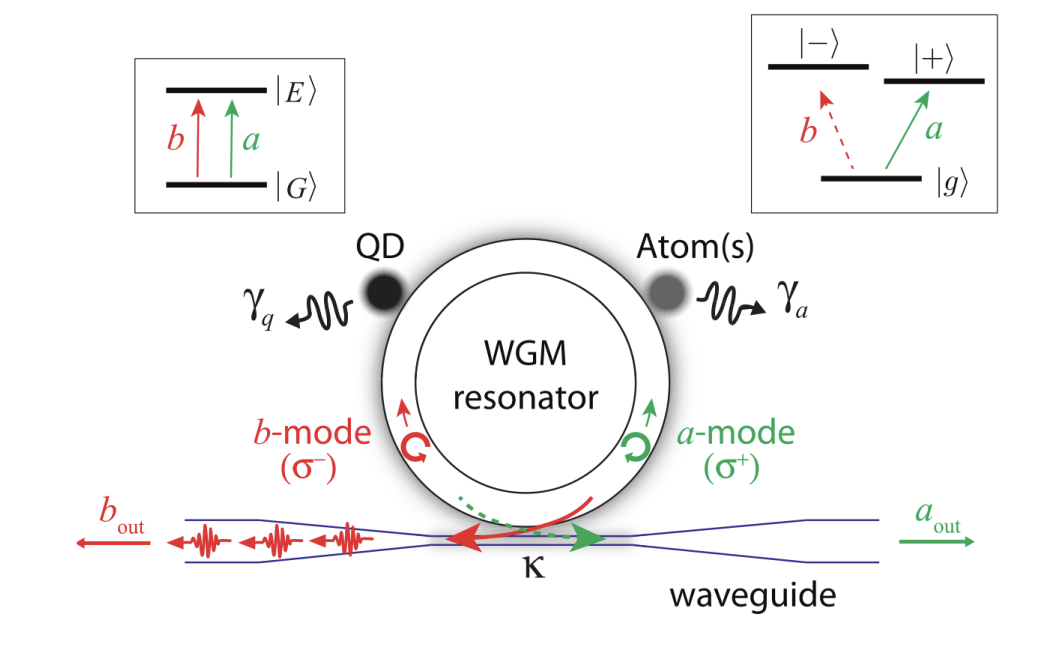
The subtle connection between the direction of light emission and the quantum entanglement of its source is the focus of new research led by Ivan Saychenko of the University of Parma, Robert Weiß of Universität Heidelberg, and Scott Parkins of the University of Auckland, along with colleagues. This team investigates whether highly directional photon emission indicates a strong degree of correlation between the quantum emitters producing the light, finding a clear relationship exists across a wide range of conditions. The research demonstrates that the observed directionality of emitted photons allows for a reliable estimation of entanglement, a crucial step towards building more complex quantum technologies. This finding offers a novel method for verifying entanglement during the preparation of quantum states, with potential implications for the development of quantum networks and other advanced applications.
Entangling Quantum Dot and Single Atom
This research details the interplay between light, matter, and entanglement within a specifically designed nanophotonic system. The core idea is to create a system where a single quantum dot and a single atom are strongly coupled to a microresonator, a tiny optical cavity. Researchers investigate how this coupling leads to the creation of dark states, quantum states where light is not directly emitted, but which exhibit strong quantum entanglement between the quantum dot and the atom. A key finding is that the degree of entanglement can be inferred from the directionality of the emitted light, making it potentially measurable in an experiment.
A quantum dot is a semiconductor nanocrystal exhibiting quantum mechanical properties, acting as an artificial atom that emits single photons. A microresonator, or optical cavity, is a tiny structure designed to trap and enhance light, increasing the interaction between the quantum dot and the atom. Entanglement is a fundamental quantum mechanical phenomenon where two or more particles become linked, even when separated by large distances; measuring the state of one particle instantly influences the state of the other. A dark state is a quantum state where there is no direct emission of light, but the system remains in a coherent superposition of states, allowing entanglement to exist.
Directionality refers to the preferential emission of light in a specific direction, and concurrence is a measure of entanglement between two quantum systems. The primary purpose of this work is to theoretically investigate the conditions under which strong entanglement can be created between a quantum dot and an atom in a microresonator, to establish a link between measurable directionality of emitted light and the degree of entanglement, and to provide a pathway for experimentally verifying and quantifying entanglement. Researchers demonstrate that concurrence, a measure of entanglement, is related to the directionality of the emitted light; high concurrence corresponds to a more directional emission pattern. The creation of dark states is crucial for achieving strong entanglement between the quantum dot and the atom. This link between directionality and entanglement provides a practical way to verify and quantify entanglement in an experiment, as measuring the directionality of the emitted light is much easier than directly measuring the quantum state of the system. This research has implications for quantum information processing, single-photon sources, quantum metrology, and fundamental physics, potentially contributing to the development of more efficient and robust quantum technologies.
Entanglement Estimated Via Photon Emission Directionality
Researchers have demonstrated a strong link between the directionality of photon emission and the degree of entanglement between two light-emitting systems, a quantum dot and an atom, interacting within an optical cavity. This work reveals that by carefully controlling the emission direction, it is possible to reliably estimate the entanglement shared between these two quantum systems. The team achieved this by showing a consistent relationship between how focused the emitted light is and the quantifiable measure of entanglement known as concurrence. The research centers on creating a “dark state”, a specific quantum state where the system ceases to emit light, and then assessing the entanglement present when the system enters this state.
Crucially, the team discovered that the directionality of photons emitted before reaching the dark state provides a direct indication of the entanglement that exists. This means that by measuring the preference for photons to travel in one direction versus another, researchers can accurately determine how strongly the quantum dot and atom are linked. The strength of this connection is significant because it offers a new way to characterize entanglement without directly measuring the quantum state itself, which is often a complex undertaking. The team’s calculations show that the relationship between directionality and concurrence holds true across a broad range of experimental conditions.
While perfect directionality does not guarantee entanglement, the research establishes a clear and predictable correlation, allowing for reliable estimation of entanglement levels. Furthermore, the system emits photons at a rate of tens of megahertz, far exceeding the typical drift rate of experimental parameters, meaning that measurements can be taken quickly and reliably. Researchers can adjust the system’s coupling strengths to fine-tune the entanglement, and the protocol allows for verification that the desired entangled state has been achieved. This advancement opens possibilities for building and characterizing more complex quantum networks and devices where entanglement is a key resource.
Photon Directionality Reveals Quantum Correlation Strength
The research demonstrates a clear relationship between the directionality of photon emission and the degree of correlation between two light-emitting components, a quantum dot and an atom, within a circulating cavity. Specifically, the team shows that a strong preference for photons to be emitted in a particular direction corresponds to a high degree of correlation between the quantum dot and the atom. Notably, the authors establish that the observed directionality of emitted photons can be used to estimate the degree of correlation between the emitters reliably. This is significant because it offers a method for characterizing the interaction between these quantum systems by simply measuring the properties of the emitted light.
This approach has potential applications in developing more complex quantum networks, where establishing and verifying correlations between components is crucial. The authors acknowledge that their analysis relies on the assumption that the system remains stable for a sufficient duration relative to the cavity lifetime, and note the limitations inherent in simplifying the complex interactions within the system through their theoretical model. Future research, as suggested by the authors, could explore extending these findings to more complex scenarios and investigating the behaviour of larger networks of interacting quantum emitters.
🗞 Detecting entanglement between quantum emitters using directional emission
🧠 ArXiv: https://arxiv.org/abs/2508.06210