Quantum emitters hold immense promise for next-generation technologies, capable of producing single photons crucial for secure communication and advanced computation. However, a persistent challenge lies in preventing these emitters from occasionally releasing two photons instead of one, diminishing the purity of the signal. Now, Lennart Jehle, Lena M. Hansen, and Patrik I. Sund, working at the University of Vienna with colleagues including researchers from the University of Stuttgart, demonstrate a significant advance in controlling this process. Their research reveals that by exciting the quantum emitter using a technique called phonon-assisted excitation-a robust method that filters out unwanted laser light—they observe a surprising asymmetry in the emitted photons. This asymmetry not only provides new insights into the fundamental physics of how these emitters respond to stimulation but also allows the team to selectively suppress the unwanted two-photon noise, paving the way for brighter, more reliable single-photon sources for quantum technologies.
The promise of quantum technologies, from secure communication to robust computation, hinges on the creation of reliable single-photon sources – devices that emit light consisting of just one particle, a photon, at a time. Quantum dots are leading candidates for these sources, offering bright and controllable emission; however, a fundamental challenge limits their performance: re-excitation, where a single attempt to trigger photon emission inadvertently produces two photons instead of one. This compromises the purity of the light and hinders quantum applications.
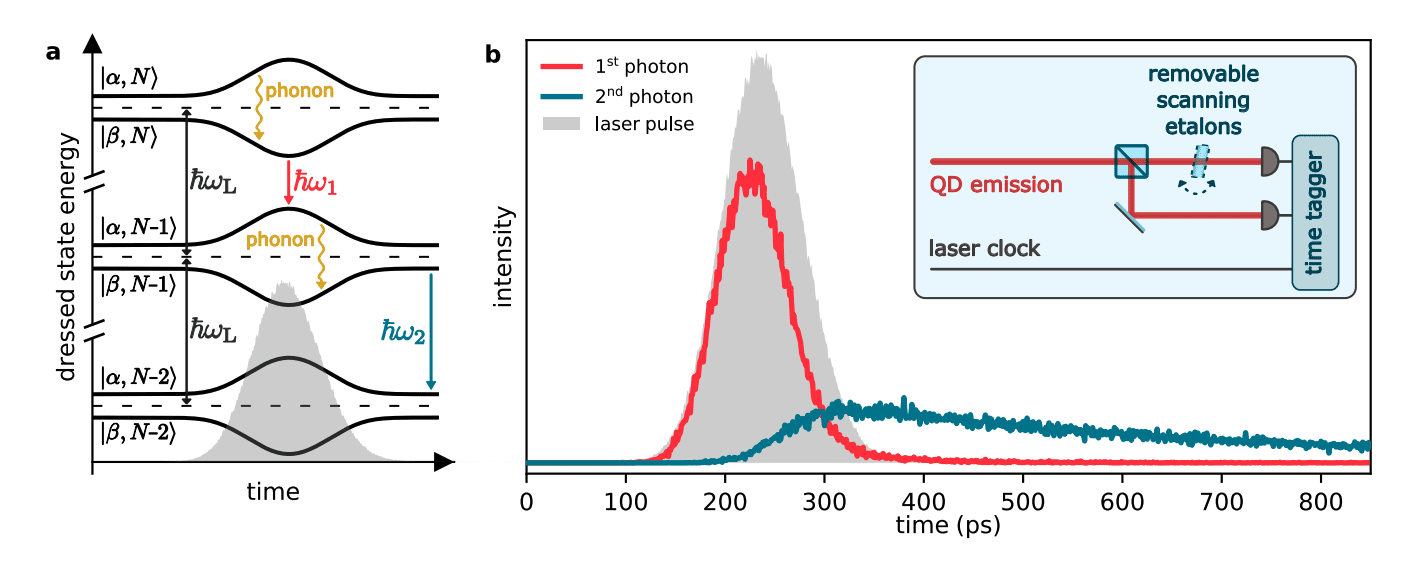
Researchers are now refining techniques to overcome this limitation, and a recent study reveals a significant advance through the use of phonon-assisted excitation. This innovative method harnesses interactions with vibrations within the quantum dot material – phonons – to indirectly stimulate photon emission, offering a robust alternative to conventional techniques. Instead of directly exciting the quantum dot with light, the team carefully tuned a laser to interact with these phonons, effectively transferring energy and triggering the release of photons.
This approach offers inherent robustness against laser fluctuations and allows for straightforward filtering of background laser light, simplifying the process of isolating single photons. Detailed characterisation of the re-excitation process itself distinguishes this methodology from previous studies. The researchers meticulously resolved the timing and spectral properties of each emitted photon, uncovering unique correlations between emission time and wavelength.
This revealed the distinct signature of phonon-assisted pumping, allowing them to model the re-excitation process as a series of different events and provide a deeper understanding of how multiple photons are generated. Crucially, this work reveals that phonon-assisted excitation fundamentally alters the characteristics of re-excitation, introducing a unique spectral shift in the first emitted photon. This shift, akin to the dynamic Stark effect, arises naturally from the phonon-assisted excitation process itself, allowing researchers to predict and control re-excitation with unprecedented precision.
By exploiting this spectral shift, the team demonstrated the ability to suppress unwanted multiple-photon emissions using standard filtering techniques selectively. This results in a remarkably pure single-photon source, maintaining high performance regardless of the duration of the laser pulse used to trigger emission. The implications of this work are substantial, promising to significantly enhance the performance and scalability of quantum technologies that rely on reliable single-photon sources, thereby paving the way for more powerful and secure quantum systems.
Furthermore, the researchers successfully extracted the Rabi frequency of the quantum dot—a measure of its interaction with the laser—directly from the re-excitation spectrum, providing valuable insights into the underlying physics. Future research could explore the impact of phonon spectral density, potentially through the use of phononic cavities, which could open new avenues for quantum communication and photonic quantum computing. This work highlights the active and rapidly evolving nature of research into re-excitation processes under various excitation conditions.
👉 More information
🗞 Asymmetric two-photon response of an incoherently driven quantum emitter
🧠 DOI: https://doi.org/10.48550/arXiv.2507.07082