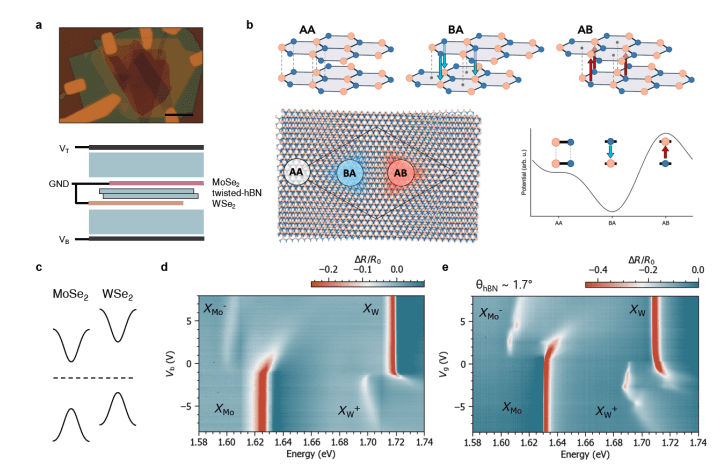
The pursuit of exotic collective behaviours in interacting particles receives a significant boost from new research into precisely layered materials, as demonstrated by Amine Ben Mhenni, Elif Çetiner, and colleagues from Technical University of Munich and the National Institute for Materials Science. This team successfully engineers a dual moiré system, a platform where two overlapping, patterned lattices create unique opportunities to study strongly interacting particles, specifically those behaving as composite bosons. Previous attempts to build such systems suffered from misalignment, hindering control over particle interactions, but this work achieves perfect alignment using layers of hexagonal boron nitride to both generate the patterned potential and separate monolayers of molybdenum selenide and tungsten selenide. The resulting platform allows researchers to observe and manipulate correlated electron phases, identify novel interlayer particles called Rydberg trions, and, crucially, electrostatically program the system to explore a range of interactions and symmetries, establishing a versatile route towards understanding and controlling complex bosonic behaviours.
Exotic collective phenomena emerge when bosons strongly interact within a lattice. Creating a robust and tunable solid-state platform to explore such phenomena has, however, been elusive. Dual moiré systems, comprising two Coulomb-coupled moiré lattices, offer a promising system for investigating strongly correlated dipolar excitons, which are composite bosons, with electrical control.
TMD Monolayers Reveal Correlated Electron Phases
Scientists have uncovered correlated electron phases within atomically thin materials. They investigated layered structures composed of molybdenum diselenide and tungsten diselenide, sandwiched between layers of hexagonal boron nitride. This arrangement allows for the observation of strongly correlated electron behaviour and the emergence of unique quantum states. The team observed Rydberg excitons and dipolar excitons, which are bound pairs of electrons and holes, exhibiting strong interactions within the layered structure. Detailed measurements of reflection contrast reveal the formation of a periodic potential within the layered materials.
This potential arises from the interaction between the different layers and influences the behaviour of electrons within the system. The data demonstrates the creation of a dual moiré system, leading to the emergence of novel quantum phenomena. These findings establish a new pathway for exploring exotic quantum states and understanding the fundamental principles of correlated electron systems.
Twisted Bilayer Creates Aligned Moiré Potential
Scientists have engineered a novel system for exploring strongly correlated quantum phenomena by creating a separated molybdenum diselenide and tungsten diselenide double-layer structure. This structure supports long-lived dipolar excitons experiencing a strong periodic potential. The work establishes a platform where charges reside in moiré potentials with identical periodicities and perfect relative alignment. This is achieved through the use of a twisted hexagonal boron nitride bilayer, which generates an electrostatic moiré potential and separates the two monolayers. This innovative approach simultaneously separates charges while preserving strong intralayer Coulomb coupling, essential for stabilizing long-lived dipolar excitons.
The team observed the emergence of a periodic electrostatic potential within the twisted boron nitride bilayer, originating from charge transfer between boron and nitrogen atoms. This potential permeates into both adjacent transition metal dichalcogenide monolayers, creating a unique environment for quantum interactions. Experiments reveal strongly correlated fermionic states within each monolayer, alongside strong interlayer correlations that manifest through the emergence of interlayer Rydberg trions and a dipolar excitonic phase. The researchers demonstrate the ability to induce an electrostatic moiré superlattice, allowing precise control over the quantum environment. Gate-dependent reflection contrast measurements confirm the successful implementation of the engineered potential, establishing a versatile platform for investigating exotic collective bosonic phenomena, including exciton crystals, superfluids, and topological exciton structures.
Electrically Programmable Moiré Lattice for Correlated Electrons
Researchers have successfully created a novel platform for exploring strongly correlated electron phases and exotic bosonic phenomena. By carefully aligning two layers of hexagonal boron nitride and placing monolayers of molybdenum diselenide and tungsten diselenide between them, the team constructed a ‘dual moiré’ system. This innovative design utilizes electrostatic forces to create precisely controlled patterns, or moiré lattices, within the layered materials. Observations confirm the emergence of strongly correlated electron phases, alongside the identification of interlayer Rydberg trions, which become trapped when a Mott insulating state develops.
Importantly, this system is electrostatically programmable, allowing researchers to manipulate the lattice symmetry and control the interactions between the layers. By injecting charges, the team realized a dipolar excitonic phase, demonstrating the platform’s versatility for investigating complex quantum states. This achievement establishes a robust and tunable system for exploring a range of exotic and topological bosonic many-body phases, opening new avenues for research in condensed matter physics.
👉 More information
🗞 Engineering strong correlations in a perfectly aligned dual moiré system
🧠 ArXiv: https://arxiv.org/abs/2509.13159