Microwave-frequency field sensing stands to benefit from increasingly sensitive and versatile technologies, and recent work demonstrates a significant advance using the unique properties of molecular crystals. Boning Li, Garrett Heller, and Jungbae Yong, alongside Alexander Ungar, Hao Tang, and Guoqing Wang, report a new method for robust three-dimensional microwave vector sensing that operates at zero magnetic field and room temperature. The team achieves this breakthrough by harnessing the photoexcited spin triplet of pentacene molecules embedded in deuterated naphthalene crystals, effectively reconstructing microwave fields by detecting subtle changes in spin behaviour. This innovative approach, enhanced by a phase-alternated protocol that dramatically extends measurement times, delivers sensitivities with sub-micrometer spatial resolution, establishing pentacene-based molecular spins as a practical and high-performance platform for a range of sensing applications and offering broadly applicable control techniques for other spin systems.
Quantum sensors based on electronic spins have emerged as powerful probes of microwave-frequency fields. Molecular crystals, in particular, offer advantages such as high spin density and the potential for chemical modification, making them promising materials for enhanced quantum sensing. This research investigates how to exploit these unique properties to create sensors with improved sensitivity and performance, optimising the interaction between microwave fields and electronic spins within the crystal structure to maximise signal-to-noise ratio and achieve more precise measurements. This work contributes to the advancement of quantum sensing technology, paving the way for applications in materials science, medical imaging, and fundamental physics.
Nitrogen-Vacancy Centers for Enhanced Quantum Sensing
This body of research explores the diverse applications of nitrogen-vacancy (NV) centers in diamond for advanced sensing and measurement techniques. A significant focus lies on utilising NV centers to detect magnetic fields, electric fields, temperature, and other parameters with unprecedented precision, and enhancing the sensitivity of magnetic resonance techniques, including nuclear magnetic resonance (NMR) and electron paramagnetic resonance (EPR). Researchers are also investigating dynamic nuclear polarization (DNP) in conjunction with NV centers, and employing these centers for materials characterisation, probing material properties at the nanoscale. A substantial portion of the research concerns the design and study of molecules and materials with tailored magnetic properties, aiming to improve their performance in quantum sensing applications. Theoretical models and simulations play a crucial role, providing insights into NV center behaviour, magnetic resonance phenomena, and quantum sensing processes. This interdisciplinary field brings together physics, chemistry, materials science, and engineering, driven by the quest for ever-increasing sensitivity in magnetic resonance and quantum sensing.
Room Temperature Magnetometry Using Pentacene Molecules
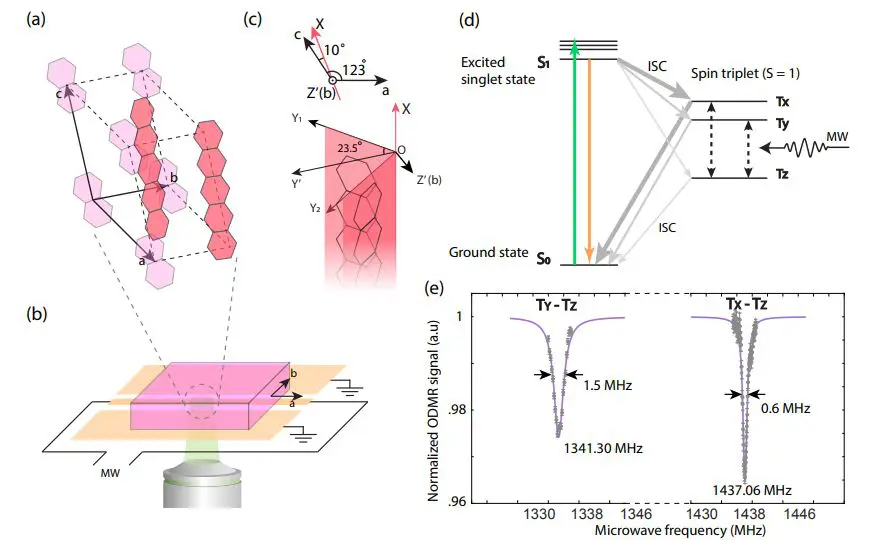
Scientists have demonstrated a new approach to microwave vector magnetometry using the photoexcited spin triplet of pentacene molecules embedded in deuterated naphthalene crystals, achieving operation at room temperature and without requiring an external magnetic field. The research establishes a practical and high-performance platform for microwave sensing by detecting the Rabi frequencies of anisotropic spin-triplet transitions associated with two distinct crystallographic orientations of pentacene. Experiments reveal that the pentacene molecules align along these orientations within the naphthalene host, establishing a well-defined geometric relationship between the molecular and laboratory sensing frames. The team achieved sensitivities of approximately 1 μT/√Hz with sub-micrometer spatial resolution, a significant advancement in molecular quantum sensing.
This sensitivity was enhanced through the introduction of a phase-alternated protocol, which extends the rotating-frame coherence time by an order of magnitude. Measurements confirm that the pentacene concentration within the naphthalene crystals was precisely controlled at 4 × 10⁻⁵ mol/mol, ensuring optimal spin density and performance. The data demonstrates that the system effectively reconstructs three-dimensional microwave fields by leveraging these anisotropic transitions, delivering a viable pathway toward room-temperature quantum sensing and vector-field imaging using molecular spin systems.
Pentacene Spins Map Microwaves at Room Temperature
This work demonstrates a new approach to microwave vector magnetometry using the photoexcited spin triplets of pentacene molecules embedded in a naphthalene crystal, operating at room temperature and without the need for an external magnetic field. By detecting the Rabi frequencies associated with different molecular orientations, the team successfully reconstructed three-dimensional microwave fields with sub-micrometer spatial resolution and sensitivities reaching approximately 1 μT/√Hz. This achievement establishes pentacene-based molecular spins as a viable, high-performance platform for microwave sensing, offering advantages over existing solid-state technologies. A key innovation lies in the development of a rotary-echo quantum sensing protocol, which significantly extends spin coherence by an order of magnitude and effectively decouples the system from low-frequency noise. This technique overcomes limitations inherent in standard Rabi sensing and enables accurate, broadband detection of weak AC fields. Importantly, this molecular spin-based approach offers intrinsic tolerance to background magnetic fields, addressing a common challenge faced by traditional solid-state defect sensors and opening new possibilities for sensitive magnetic field measurements in diverse environments.
🗞 Robust AC vector sensing at zero magnetic field with pentacene
🧠 ArXiv: https://arxiv.org/abs/2512.06272