Florian Ginzel, Javad Kazemi, Valentin Torggler, and Wolfgang Lechner at ParityQC have introduced a novel class of quantum gates, termed replacement-type gates, representing a departure from conventional paradigms reliant on pairwise qubit interaction and rotations. Detailed in the pre-print Replacement-type Quantum Gates, these gates operate by preparing candidate qubits in the possible outcome states, selecting those possessing the targeted states, and replacing the original qubits—a process occurring within an extended Hilbert space and circumventing limitations imposed by no-go theorems. This methodology crucially preserves the intrinsic noise bias of physical hardware platforms, such as the predominance of phase-flip errors in spin qubits or Rydberg atom qubits, enabling the use of resource-efficient asymmetric or even classical error correction codes and drastically reducing the overhead associated with quantum error correction.
Concrete examples of replacement-type X and CNOT gates have been proposed for both Rydberg atom qubits and spin qubits in quantum dots, demonstrating broad applicability across major quantum hardware platforms and aligning with the ParityQC Architecture—a system conceptualised as an error correcting code itself—with an international patent application filed to underscore the technology’s novelty and potential impact. This approach is particularly advantageous for architectures like ParityQCs, which natively exploit noise bias. It represents a foundational change towards enabling early fault-tolerance by reducing the need for large overheads typically required in quantum error correction.
A Novel Approach to Quantum Gate Design
A significant departure from conventional quantum computation paradigms has been unveiled by physicists at ParityQC, introducing a novel class of quantum gates termed ‘replacement-type gates’. Detailed in the pre-print manuscript, Replacement-type Quantum Gates, authored by Florian Ginzel, Javad Kazemi, Valentin Torggler, and Wolfgang Lechner, this approach is designed for implementation across diverse hardware platforms, notably neutral atoms and spin qubits, with the explicit aim of substantially reducing the overhead associated with quantum error correction (QEC). The research team, comprising experts in quantum hardware and architecture, posits a fundamental shift in gate operation, moving away from the established methodology of pairwise qubit interaction and continuous state rotation.
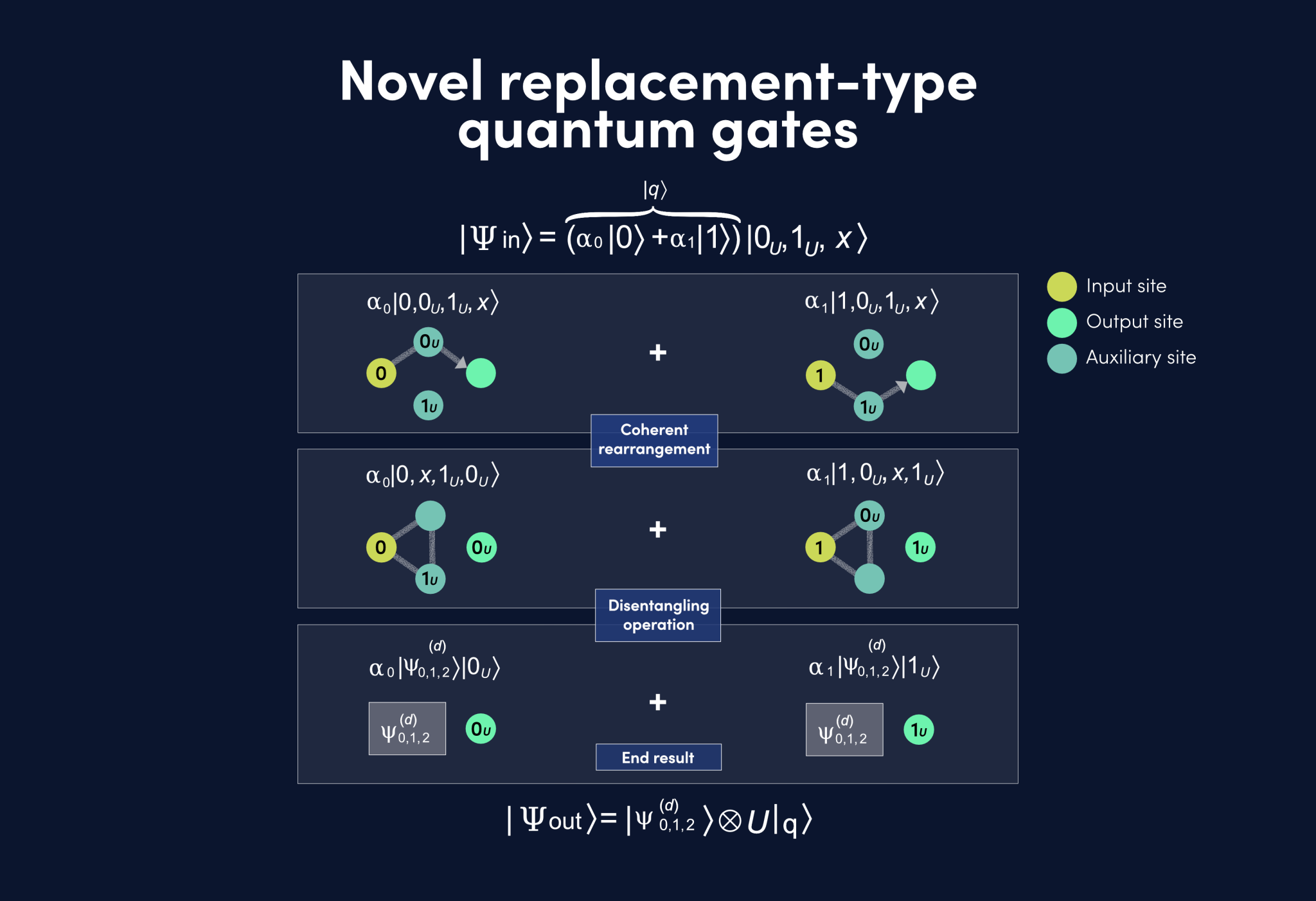
Conventional quantum gates function by bringing two qubits into proximity, facilitating interaction that alters their quantum state through unitary transformations. In contrast, replacement-type gates operate on the principle of preparing candidate qubits in states corresponding to the possible outcomes of the desired gate operation. The gate then selectively identifies candidates possessing the target state and effectively replaces the original qubits with these, thus performing the computation without direct physical qubit rotations. This process leverages an extended Hilbert space, circumventing limitations imposed by a no-go theorem which restricts noise-bias-preserving operations on many qubit types. The extended Hilbert space allows for a broader range of possible quantum states to be explored during the gate operation, increasing the flexibility and efficiency of the computation.
A key advantage of this methodology lies in its potential to preserve the intrinsic noise bias of physical hardware platforms. Qubit technologies, such as spin qubits and Rydberg atom qubits, are inherently susceptible to specific types of errors – for example, phase-flip errors are often dominant in spin qubit systems. Exploiting this noise bias is crucial, as it can dramatically reduce the resource demands of QEC. Most conventional gate sets, particularly those relying on CNOT decompositions into Hadamard and CZ gates, tend to destroy this inherent noise asymmetry, rendering them incompatible with efficient, bias-exploiting codes. Replacement-type gates, however, avoid this issue by offering bias-preserving gate operations, providing a significant advantage for implementing advanced error correction schemes. This preservation of noise bias allows for the use of asymmetric or even classical error correction codes, potentially reducing the number of qubits and operations required for fault-tolerant computation.
The researchers have proposed concrete examples of replacement-type X and CNOT gates implemented on both Rydberg atom qubits and spin qubits in quantum dots, demonstrating the broad applicability of this concept across major quantum hardware platforms. This versatility is crucial for the widespread adoption of the technology, as it allows for integration with existing and emerging qubit technologies. The potential impact of this innovation extends to enabling early fault-tolerance, by reducing the substantial overhead typically required in QEC. Florian Ginzel, Quantum Hardware Physicist at ParityQC, highlights the synergy between this gate design and the ParityQC Architecture, stating that their architecture can be understood as an error correcting code itself. If it can rely on a noise-bias-preserving gate set, its redundant encoding allows error correction and fault-tolerant quantum computing with biased-noise qubits.
Wolfgang Lechner and Magdalena Hauser, co-CEOs at ParityQC, characterise this as a foundational change, asserting that they are not merely improving existing gates, but proposing an entirely new class of gate operations that could make early fault tolerance a practical goal, particularly for architectures like theirs that already exploit noise bias. They anticipate exciting and promising new designs for quantum computing from further exploration of this path. An international patent application has been filed, underscoring the novelty and potential impact of this technology. This patent application signifies the company’s commitment to protecting its intellectual property and establishing a leading position in the field of quantum computing. The core innovation encompasses a new paradigm for gate design, breaking from traditional rotations by introducing candidate qubits and an extended Hilbert space, enabling computation without physical qubit rotations, and offering enhanced noise-bias preservation, approximately maintaining the intrinsic noise bias of hardware platforms, allowing for the use of resource-efficient asymmetric or even classical error correction codes, and practical examples for real hardware, with replacement-type X and CNOT gates proposed for both Rydberg atoms and quantum dots, showing versatile applicability across major quantum platforms.
Reducing Error Correction Overhead
The pursuit of scalable quantum computation necessitates a substantial reduction in the overhead associated with quantum error correction (QEC). Conventional QEC schemes, while theoretically robust, demand a significant increase in the number of physical qubits to encode a single logical qubit, hindering near-term scalability. Researchers at ParityQC, led by Florian Ginzel, Javad Kazemi, Valentin Torggler, and Wolfgang Lechner, have introduced a novel class of quantum gates – termed ‘replacement-type gates’ – designed to address this critical challenge. Detailed in the pre-print Replacement-type Quantum Gates, currently undergoing peer review, these gates represent a departure from traditional gate operations predicated on pairwise qubit interaction and coherent rotations.
The fundamental innovation lies in the gate’s operational mechanism. Instead of directly manipulating qubit states through rotations, replacement-type gates leverage a pool of candidate qubits pre-prepared in the possible outcome states of the desired gate operation. The gate then selectively chooses candidates possessing the target state, effectively replacing the original qubits with these pre-prepared states. This process circumvents limitations imposed by a no-go theorem which restricts noise-bias-preserving operations on many qubit types. Crucially, this approach operates within an extended Hilbert space, enabling computation without requiring physical rotations on the original qubits. The team has specifically demonstrated the feasibility of implementing replacement-type X and CNOT gates on both Rydberg atom qubits and spin qubits in quantum dots, showcasing broad applicability across leading quantum hardware platforms.
The preservation of intrinsic noise bias is a key advantage of this methodology. Most physical qubit systems exhibit a predominance of specific error types – for example, phase-flip errors in spin qubits or Rydberg atom qubits. Conventional gate sets, particularly those relying on CNOT decompositions into Hadamard and CZ gates, often destroy this inherent noise asymmetry. This necessitates more complex and resource-intensive QEC schemes to mitigate the resulting isotropic error landscape. Replacement-type gates, however, are designed to approximately maintain the intrinsic noise bias of the hardware. This allows for the implementation of asymmetric or even classical error correction codes, significantly reducing the number of qubits and operations required for effective error mitigation. The potential for utilising these simplified codes represents a substantial reduction in QEC overhead.
The implications of this research are particularly pronounced for architectures like the ParityQC Architecture, which natively exploits noise bias. As Florian Ginzel, Quantum Hardware Physicist at ParityQC, explains, their architecture functions as an inherent error correcting code. By leveraging a noise-bias-preserving gate set, the redundant encoding within the ParityQC Architecture facilitates error correction and fault-tolerant quantum computing even with biased-noise qubits. Wolfgang Lechner and Magdalena Hauser, co-CEOs at ParityQC, characterise this as a foundational shift, asserting that they are not simply refining existing gates but proposing an entirely new class of gate operations that could bring early fault tolerance within reach. An international patent application has been filed to protect this intellectual property, underlining the novelty and potential impact of the technology. The team’s work represents a significant step towards realizing scalable, fault-tolerant quantum computation by addressing a critical bottleneck in the field: the reduction of error correction overhead.
More information
External Link: Click Here For More