The creation of non-classical states of light holds immense promise for advancing quantum technologies, and a new study demonstrates a novel method for generating these states using the dynamical Casimir effect in circuit QED systems. Researchers at the University of Brasília, including A. P. Costa, H. R. Schelba, and A. V. Dodonova, investigate how carefully modulating a superconducting qubit can mimic this effect, traditionally achieved with rapidly moving mirrors. Their work reveals that this parametric modulation not only simulates the dynamical Casimir effect, but also produces light with properties that surpass those of classical light sources with equivalent energy, offering a significant advantage for precision measurements. The team’s calculations show that the resulting states exhibit a level of sensitivity, quantified by the Fisher Information, that exceeds classical limits, paving the way for enhanced quantum sensing and communication technologies.
Dynamical Casimir Effect with Superconducting Qubits
This research investigates the creation of quantum states and the exploration of quantum phenomena using superconducting circuits. The central idea is to harness the dynamical Casimir effect (DCE), a process that generates photons from the vacuum due to rapidly changing circuit properties, and amplify it through specific modulation techniques and strong interactions between qubits and resonators. The system utilizes superconducting circuits to create qubits, the fundamental units of quantum information, and resonators, which act as cavities to trap photons. The researchers focus on enhancing the DCE by carefully controlling the modulation of qubit parameters, effectively driving the creation of multiple photons simultaneously.
This approach operates within the framework of the Rabi model, a cornerstone of quantum optics, and aims to achieve ultrastrong coupling, where the interaction between light and matter is exceptionally strong. The ultimate goal is to generate specific quantum states of light, which are essential for advancements in quantum information processing and other quantum technologies. This research is significant because it offers a novel and controllable method for generating quantum states of light, potentially surpassing traditional techniques. Operating in the ultrastrong coupling regime allows the researchers to explore and exploit quantum effects not accessible in conventional systems, opening doors for applications in quantum communication, computation, and sensing. Superconducting circuits are a promising platform for building large-scale quantum computers, making this research a potential step towards more powerful and versatile quantum devices.
Dynamical Casimir Effect Generates Superior Light States
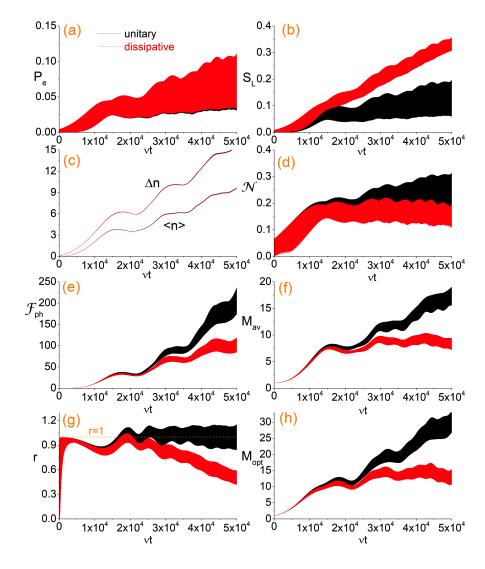
Researchers have successfully generated nonclassical light states from a vacuum using a circuit QED system, achieving performance exceeding that of classical light sources. The system involves an artificial atom coupled to a resonator, with the atom’s energy levels modulated by a carefully tuned frequency sweep. This modulation effectively simulates the dynamical Casimir effect, creating photons from seemingly empty space. The research reveals that the generated light exhibits significantly higher quantum Fisher information than the average number of photons produced, indicating a substantial advantage for precision measurements of phase and displacement.
In some instances, the system achieved values of metrological power exceeding those of squeezed vacuum states, a benchmark for quantum light sources. Specifically, the ratio of certain metrological indicators reached values greater than one, even when accounting for energy loss within the system, demonstrating a clear quantum advantage. In regimes simulating a four-photon dynamical Casimir effect, the system exhibited even higher levels of performance, with metrological indicators reaching values as high as 60 under ideal conditions and remaining above 30 even with energy loss. These findings are noteworthy because the system operates with realistic parameters, including energy dissipation, while maintaining its quantum advantage.
Dynamic Casimir Effect Generates Nonclassical Light States
This research demonstrates the generation of nonclassical states of light within a circuit QED system through the dynamic Casimir effect, achieved by modulating a qubit’s energy levels. The team numerically modelled a system where a qubit interacts with a resonator, finding that carefully chosen modulation parameters yield states with significantly enhanced quantum Fisher information for phase and displacement estimation. These generated states outperform classical counterparts, including squeezed vacuum states, with equivalent energy levels, suggesting potential applications in precision measurement. The study reveals that the generated states are mixed and exhibit distinct photon number distributions, differing from those of standard squeezed states. This indicates that single-qubit dynamic Casimir effects not only create excitations from the vacuum but also provide a resource for producing states of light with considerable metrological power.
🗞 Metrological power of single-qubit dynamical Casimir effect in circuit QED
🧠 ArXiv: https://arxiv.org/abs/2508.10182