The behaviour of superconductivity, where materials exhibit zero electrical resistance, continues to reveal unexpected complexity, particularly in systems exhibiting spatially modulated pairing known as pair-density-wave (PDW) superconductors. These materials challenge conventional understandings of how superconductivity arises and sustains itself, prompting investigation into the factors governing their stability and measurable properties. Researchers Ke Wang, Qijin Chen, Rufus Boyack, and K. Levin, representing institutions including the University of Chicago, the University of Science and Technology of China, and Dartmouth College, address this challenge in their recent work, titled ‘Anomalous Superfluid Density in Pair-Density-Wave Superconductors’. Their study, utilising a microscopic model to explore the superfluid density – a crucial parameter determining stability – reveals a surprising negative contribution across a substantial portion of the phase diagram, alongside an unusually small and direction-dependent superfluid density, potentially leading to enhanced conductivity at specific frequencies. The team’s theoretical framework accounts for the behaviour of Bogoliubov quasiparticles – excitations arising from the superposition of electrons and holes – and the influence of Van Hove singularities – points of high density of states in the electronic band structure – to explain these anomalous findings.
Pair-density waves (PDWs) represent a compelling alternative to conventional superconductivity, particularly when attempting to explain the behaviour observed in high-temperature cuprates. These states challenge established theories by proposing a mechanism where superconductivity arises not from a uniform condensation of Cooper pairs, but from a spatially modulated density of these pairs. This investigation establishes a theoretical framework detailing the energetic landscapes and unique characteristics of PDW states, and proposes experimental signatures for their identification.
Researchers demonstrate that the energy of superconducting states does not necessarily minimise at zero momentum transfer, a key tenet of conventional Bardeen-Cooper-Schrieffer (BCS) theory. BCS theory explains superconductivity as arising from the formation of Cooper pairs—pairs of electrons bound together—at temperatures below a critical temperature (Tc). The finding suggests the potential for stable PDW phases, where the lowest energy configuration involves a spatial modulation of these Cooper pairs. This implies a competition between PDW order and conventional superconductivity, potentially allowing phase transitions between the two states, offering a dynamic picture of the superconducting state in these materials. Crucially, the model incorporates preformed pairs, existing even above Tc, which condense to form the PDW state, contrasting with BCS theory where pair formation is exclusively a sub-critical temperature phenomenon.
The research demonstrates the existence of two competing
The research demonstrates the existence of two competing superconducting states, with the stable PDW state exhibiting a non-zero pairing momentum. This momentum arises from the spatial modulation of the Cooper pairs, distinguishing PDWs from conventional superconductors and providing a unique fingerprint for their detection. The study highlights a potentially observable discontinuity in the anti-nodal gap—the energy gap at a specific point in the material’s electronic structure—at Tc, offering a key prediction that differentiates PDW superconductivity from conventional BCS scenarios. This discontinuity stems from the unique behaviour of the preformed pairs, providing a specific experimental target for verifying the PDW mechanism.
Researchers also demonstrate that the superfluid density, a measure of the ability of electrons to flow without resistance, exhibits unusual temperature dependencies due to the presence of gapless bands in the electronic structure. These gapless bands arise from Van Hove singularities, points in the material’s electronic structure where the density of states diverges, leading to unusual behaviour. The analysis of pair susceptibility, utilising Green’s functions and angular momentum components to account for the complex symmetry involved in PDW states, yields gap equations which determine the energy gap as a function of momentum. These equations are expressed as a matrix equation where a zero determinant signifies a stable PDW state.
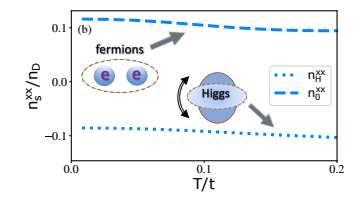
The resultant formalism predicts a discontinuous evolution of the anti-nodal gap, potentially serving as an experimental signature of PDW order. Researchers highlight a negative contribution to the superfluid density over a significant portion of the phase diagram, indicating potential instability and providing further signatures of the unusual order. The presence of gapless bands in the Bogoliubov quasiparticle dispersion, arising from Van Hove singularities, contributes to unusual temperature dependencies in the superfluid density and Sommerfeld contributions. These gapless bands, alongside contributions from the Higgs mode—a collective excitation of the superconducting state—result in a highly anisotropic and unexpectedly small superfluid density.
Consequently, the model predicts an anomalously large finite-frequency
Consequently, the model predicts an anomalously large finite-frequency weight in the conductivity, offering a potential avenue for experimental verification of PDW order. Researchers combine theoretical modelling and analysis of the resulting physical properties to gain a deeper understanding of the complex behaviour of PDW superconductors. This combination offers potential avenues for designing new materials with enhanced superconducting properties.
🗞 Anomalous Superfluid Density in Pair-Density-Wave Superconductors
🧠 DOI: https://doi.org/10.48550/arXiv.2506.13631